
Existing international environmental laws are not enough. Ecocide law is an important part of the puzzle.

This guest blog is authored by Paola Vitale, a law graduate from the University of Bologna, who is now committed to environmental and climate law advocacy and collaborates with Youth for Ecocide Law as a core team member.
Existing enforcement mechanisms intended to protect the environment fall short when states fail to meet their environmental obligations. This is not a difficult case to argue - globally ecosystems are being destroyed at an alarming rate, and most states are failing to meaningfully tackle climate change.
So why do our enforcement mechanisms fall short and how can we create a more effective framework? This article explores what is driving weaknesses in enforcement and how novel paradigms like ecocide law can introduce legal consequences that current mechanisms fail to deliver.
The difference between compliance, implementation and enforcement
To understand the problem, I begin by clarifying how I use three key terms: “compliance”, “implementation”, and “enforcement”. According to the United Nations Environment Programme (UNEP), compliance simply means a state meets the obligations it agreed to (for instance, by aligning its domestic legislation with a treaty it has ratified).
By contrast, implementation refers to all relevant laws, policies, actions that an actor adopts to meet the obligations it agreed to (such as establishing monitoring systems, training authorities, and creating institutional procedures).
Lastly, enforcement refers to the measures in place to compel actors to comply with their obligations (for example through sanctions).. For the purposes of this article, enforcement refers not only to the behaviour of persons and organisations but to that of states as well, consistent with how scholars employ the term.
Understanding the causes of weak enforcement
Formally, international environmental law has never looked stronger on paper. We have hundreds of treaties, global frameworks, non-binding guidelines and, over the last decade, an explosion of climate litigation. Yet, it often appears as though its actors operate under a ‘shared fantasy’, in which their belief in the functioning of international law far outstrips the reality.

The Peace of Westphalia (1648), a foundational moment in the development of international law, which implemented a self-judging, voluntary system.
Image credit: The National Gallery.
Part of the reason why enforcement is weak lies in the historical features of international law itself. International law originated as a self-judging system. In particular, unlike other branches of international law, international environmental law has never developed a comprehensive global enforcement system. Furthermore, access to courts has remained limited over time, as standing rules have often prevented NGOs or affected communities from bringing cases, especially when harm is collective or long-term.
Beyond the historical features of environmental law, the lack of respect for environmental regulations depends on several factors. Kassie identifies the main problems in the weak implementation at the national level, poor communication between scientists and policymakers, and treaty language that is vague or interpreted differently by each country.
According to other experts, such as Brunée, the issue is not the absolute absence of enforcement tools, but rather the lack of capacity (technical, financial, institutional) to make those tools work in practice. In this view, the problem is not that enforcement mechanisms do not exist at all, but that insufficient funding and inadequate institutional infrastructure prevent them from functioning effectively.
A study by Prameela and Asha Sundaram shows just how deep this problem runs, especially in developing countries. By interviewing 231 people working in NGOs, government, industry and environmental regulation, the authors found that many viewed environmental laws as ineffective. The biggest barriers? Lack of resources, limited public awareness, incomplete legal frameworks, corruption, and weak governance.
Treaties themselves have tried almost every strategy: soft law, hard law, bottom-up flexibility, top-down obligations. But relying on one model alone has had severe limitations, as seen in the long and uneven history of the UNFCCC and the Kyoto Protocol.
The same pattern appears in other environmental agreements. Hedemann-Robinson points out that states often did not even submit the basic reports needed to check implementation: ‘Only 13% of contracting parties submitted their annual report for 2013 on dumping permits under the aegis of the 1972 Convention on the Prevention of Marine Pollution by Dumping of Wastes and Other Matter. Only 47% of contracting parties of the 1996 London Protocol to the 1972 Convention had submitted marine dumping permit reports for 2013, whilst just 25% of contracting parties had submitted their reports on implementation measures by 2015.’
Because of this, mixed approaches perform best—those that blend legal obligations with political guidance, cooperation and transparency. In many Asia-Pacific states, for example, soft-law instruments are not considered “weaker” options but practical tools to influence behaviour, as Tan Hsien-Li explains. Yet even these hybrid strategies have limits; they encourage progress, but cannot guarantee it.
New and emerging legal tools offering hope
A good example of an alternative tool is the Environmental Enforceable Undertakings (EEUs),increasingly used in Australia and the UK. Instead of paying a fine or going to court, companies commit to concrete steps: repairing the damage, preventing recurrence, changing internal systems, supporting community projects, and making the agreement public. These mechanisms can work—but they depend on trust, transparency and oversight. They can also present risks, potentially resulting in “closed-door” negotiations and a lack of transparency, or power asymmetries between regulators and businesses. To address this, the authors recommend public guidelines, online registries for all EEUs, and community involvement. Still, these instruments do not replace the civil or criminal systems but complement them, and as noted above, they are not free from challenges.
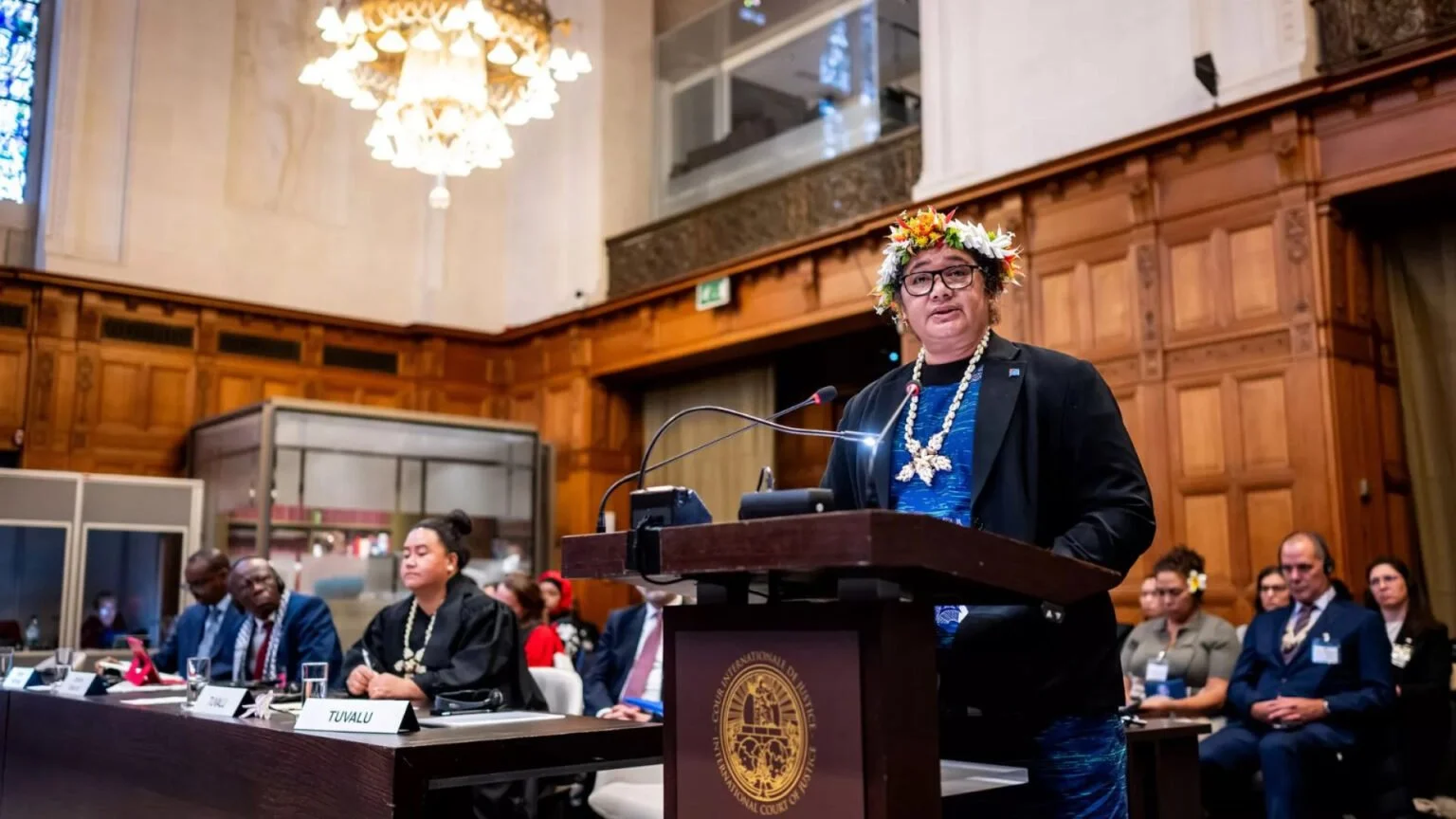
Hearings at the International Court of Justice for its Advisory Opinion on Climate Change, 2024.
Image credit: ICJ/CIJ/Frank van Beek.
Another increasingly significant tool is the advisory opinion (AO), through which international courts respond to specific legal questions. On 23 July 2025, the International Court of Justice (ICJ) released its Advisory Opinion on climate change. In this opinion, the Court emphasises that climate treaties should be interpreted together, not in isolation, and that states must meet their trade and climate obligations simultaneously. This pushes states toward “Paris-aligned interpretation.” across all sectors (which means that for example, even in trade law disputes compliance with the Paris Agreement may become relevant.).
Yet, AOs come with limitations. First, they are not binding, as they describe what the law requires but cannot force action. Second, since they must navigate political constraints, they often avoid the hardest questions. As Mario Prost observed, the ICJ Advisory Opinion does not tell us whether new fossil fuel expansion is compatible with due diligence obligations, or if climate finance decisions are binding.
However, limitations are not confined to legal mechanisms, they also appear in political processes—especially multilateral negotiations. The latest Conference of the Parties, COP30 in Belém, illustrated these tensions. The so-called ‘Bélem Political Package’ includes adaptation indicators that are “voluntary, non-prescriptive, non-punitive, facilitative, global in nature, respectful of national sovereignty and national circumstances and country-driven,” and specifies that they “shall not be used under any circumstances as a condition for developing country Parties to access funding under the Convention and the Paris Agreement.” This language reflects an enduring reluctance to transform climate commitments into enforceable obligations.
Why Ecocide Law Matters
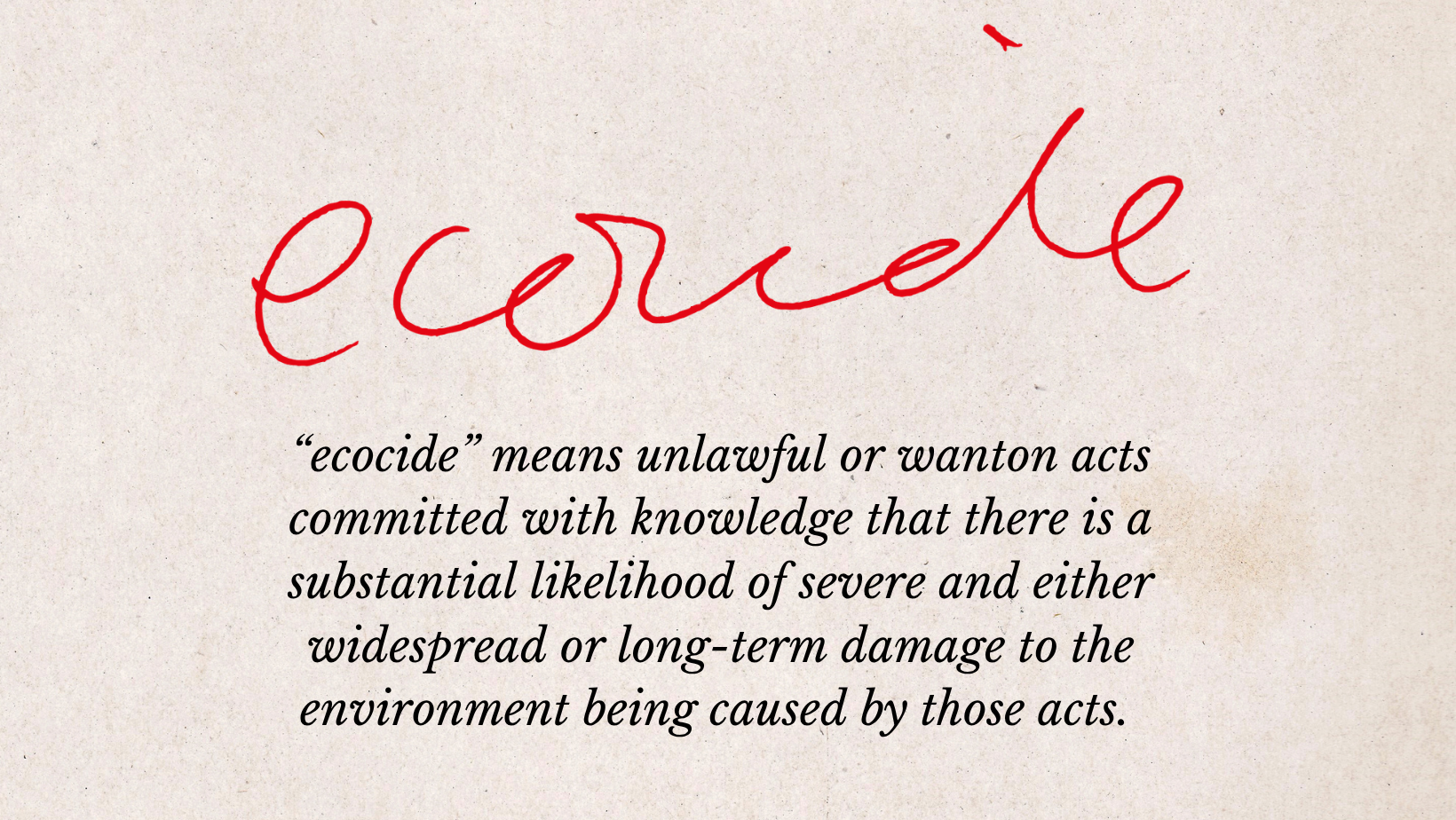
The legal definition of ecocide formulated by an Independent Expert Panel (convened by the Stop Ecocide Foundation) in 2021.
Despite the variety of international legal instruments designed to secure compliance—ranging from courts to innovative non-judicial mechanisms like the EEUs —the same structural limitations remain. Environmental harm on a massive scale can still occur with little or no legal consequence for those who cause it.
This is why ecocide law is an important piece of the puzzle. Criminal law emerges when other fields of law have repeatedly shown their limits. Recognising ecocide as an international crime would signal that the protection of the environment and the climate system is not just desirable and strategically important, but a value at the very apex of our collective priorities.
Existing tools matter, and they should continue to evolve. But they are not enough. That’s because soft law will never compel the behaviour it merely encourages, advisory opinions cannot force action, EEUs cannot remedy systemic harm, and courts cannot overcome political reluctance.
Ecocide law fills a gap that the current enforcement structure cannot reach: it introduces legal consequences where today there are almost none. It names the harm for what it is, and it places responsibility where it belongs. Ultimately, it reflects a choice about what we as the international community are willing to accept—and what we are not. Perhaps most importantly, it tells us something about who we choose to be as an international community—what we are willing to tolerate, and what we refuse to accept.
References
Bodansky, Daniel, Harro van Asselt, eds. The Art and Craft of International Environmental Law. Oxford University Press, 2024.
Parella, Kishanthi, “Enforcing International Law Against Corporations: A Stakeholder Management Approach,” Harvard International Law Journal, vol. 65 (2024), pp. 283–341.
Brunnée, Jutta, “Enforcement Mechanisms in International Law and International Environmental Law,” Environmental Law Network International (ELNI), no. 1 (2005), pp. 1–10.
Kassie, Denicia, “Unravelling the Legal Labyrinth: Investigating Barriers to Effective Adoption and Enforcement of International Environmental Law in Domestic Jurisdictions,” Journal of Environmental Management, vol. 352 (2024).
Prameela, A., Sundaram, A., “The Enforcement of Environmental Laws in Developing Countries: Challenges and Opportunities,” Library Progress International, 44(3) (2024), pp. 17661–17674.
Verones, Cristina, “Mechanisms for Reviewing Compliance with International Environmental Law Open to Private Parties,” in B. B. Richardson (ed.), Rule of Law for Nature, Cambridge University Press (2015), pp. 275–292.
Gizari-Xanthopoulou, Anna & Manou, Dimitra, “Complying with and Enforcing Environmental Law: A Critical Appraisal,” International Journal of Environment and Sustainable Development, vol. 13, no. 3 (2014), pp. 240–258.
Van Deursen, Max & Gupta, Aarti, “Is Enhanced Transparency the ‘Backbone’ of the Paris Agreement? A Critical Assessment,” Transnational Environmental Law, vol. 14, no. 1 (2025), pp. 41–68.
Tan, Hsien-Li, “No Longer Hard Law’s ‘Poor Relative’: The Growing Respect for Soft, Non-Binding Legal Instruments in the International Order,” EJIL:Talk! (2025).
Prost, Mario, “Disaster Passing as Miracle? A Critical Take on the ICJ’s Climate Advisory Opinion,” EJIL:Talk! (2025).
Forsyth, Miranda & Tepper, Felicity, “Environmental Enforceable Undertakings: An Innovative Tool to Repair and Prevent Environmental Harm,” Journal of Environmental Law, vol. 36 (2024), pp. 385–411.
Kuo, Susan S. & Means, Benjamin, “Forcing Climate Change Compliance,” Harvard Environmental Law Review, vol. 48 (2024), pp. 441–490.
Wewerinke-Singh, Margaretha & Mead, Sarah, “Climate Litigation and the Enforcement of Paris Commitments,” in The Cambridge Handbook on Climate Litigation, Cambridge University Press (2025), p. 15.