How Bad Is “Bad Enough”? Reclaiming the Moral and Legal Threshold of Ecocide
This guest blog is authored by the ESG and Data for Good Center of Excellence (CoE), an organisation dedicated to using data analytics and AI for sustainable and good purposes.
The proposed legal definition of ecocide is clear and intentionally rigorous:
“Unlawful or wanton acts committed with knowledge that there is a substantial likelihood of severe and either widespread or long-term damage to the environment.”
Yet a question persists, one that is not merely legal, but ethical and civilisational: how much harm is “enough” to cross that threshold? What qualifies as “severe”? What makes damage “widespread” or “long-term”? And crucially, at what point do we decide that the destruction of the living world is no longer tolerable?
Ecocide is commonly understood as mass environmental harm. But what does this mean? If the destruction of an entire forest is unquestionably catastrophic, what, then, is the true significance of destroying a single tree?
Is the life of one tree as sacred as the life of a thousand? Are living beings, human and non-human alike, units to be aggregated only once losses become visible at scale?
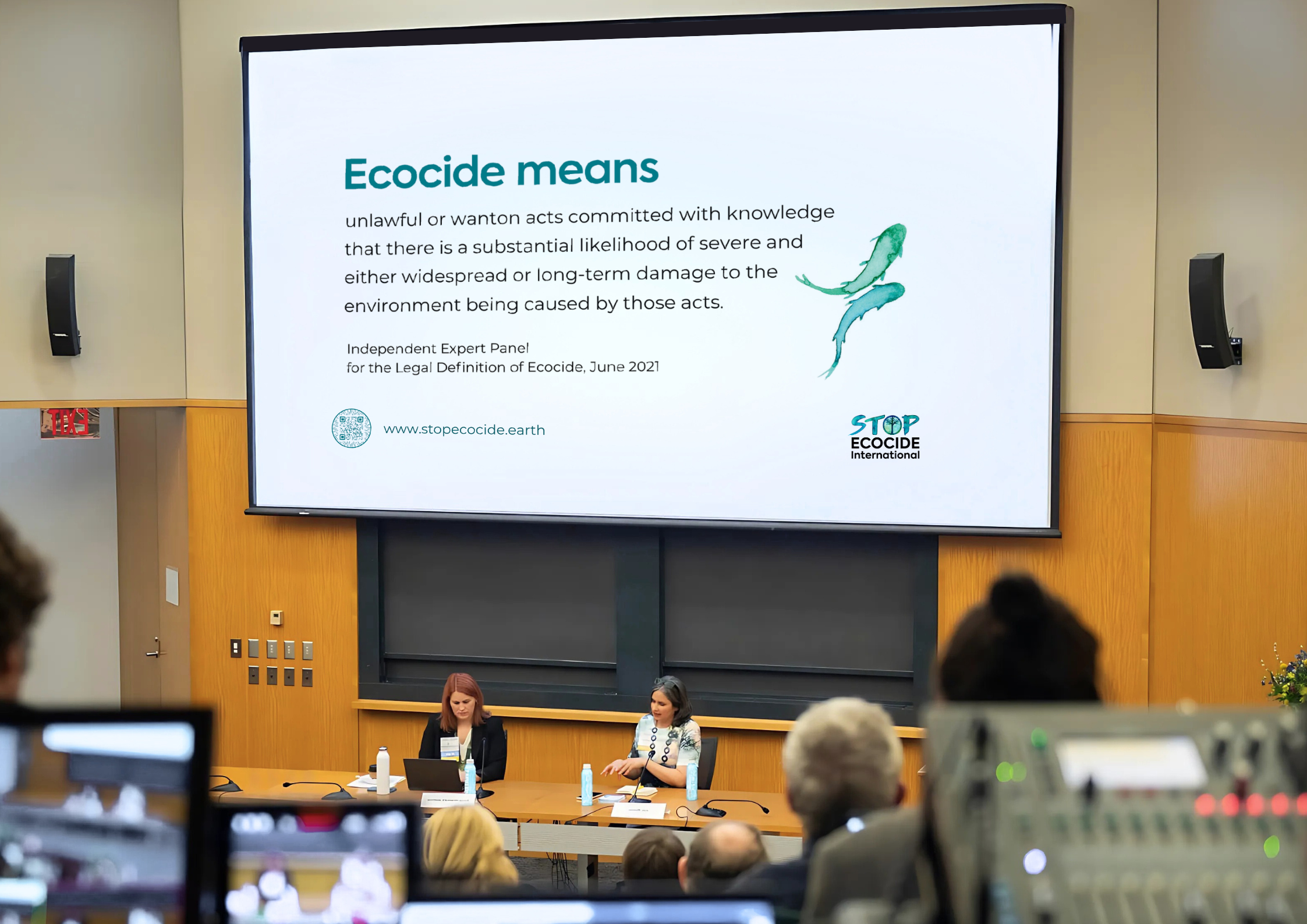
The consensus legal definition of ecocide proposed by an Independent Expert Panel in 2021.
Ecosystems persist through the interplay of land, water, air, and life. The biosphere consists of all ecosystems and the interactions among them, from which the conditions for life emerge. The question becomes: how much of what makes Earth “home” are we prepared to sacrifice?
Often, large-scale environmental devastation is built on countless smaller decisions, each dismissed as insignificant, acceptable, or necessary. Normalisation begins with minimal harm, quietly accepted, until greater harm no longer shocks.
If we fail to act when harm is “small,” we will not act when it becomes vast. Ecocide is not only a crime of scale; it is a crime of precedent.
Re-establishing the principle that life matters, ecologically, legally and morally is therefore essential to preventing ecocide.
Reinforcing this principle requires action on two complementary fronts: law and awareness.
The first is the “hard” path: law.
Law does not merely respond to moral taboos; it helps to create them. Even when imperfectly enforced, the formal naming of conduct as criminal reshapes expectations, limits what can be openly justified, and alters behaviour over time. Environmental protection therefore, depends on law not only to punish destruction, but to render it unacceptable.
This is why the recognition of ecocide as an international crime alongside genocide, crimes against humanity, war crimes, and aggression is so critical. It acknowledges that severe environmental harm is not a collateral issue; it is a threat to peace, security, and human survival. The rapid evolution of environmental and climate-related regulations worldwide reflects a growing understanding that ecological destruction is no longer peripheral… it is existential.
Law draws a line. It declares: this far, and no further.
The second path, the “soft” one, is: awareness.
Not superficial awareness, but deep, informed, emotionally resonant understanding that transforms behaviour.
True awareness is preventative. It compels people not to commit crimes because they choose not to. It also mobilises witnesses. Those who understand the consequences of environmental harm do not stand by in silence; they speak, advocate, and act.
Crucially, awareness takes many forms. It can be scientific, artistic, cultural, educational, or data-driven. When information is presented in ways that are relevant and intelligible to different audiences, it becomes persuasive. Conviction is the hardest step and once achieved, change follows.
Minamata: When Awareness Changed History
Few cases illustrate the power of awareness more starkly than Minamata, Japan. From 1932 to 1968, the Chisso Corporation discharged mercury-laced wastewater into Minamata Bay, poisoning ecosystems and communities even after the cause of Minamata disease was known. Responsibility was denied, evidence suppressed, and contamination allowed to spread. By the time accountability arrived in the 1970s, thousands had suffered and many had died.

Minamata, Japan, where widespread mercury poisoning gave rise to Minamata Disease.
Image Credit: Sanjo, Wikimedia Commons.
What shifted global attention was not a regulation or a report, but a photograph. W. Eugene Smith’s Tomoko Uemura in Her Bath transformed environmental harm from data into truth, mobilising international outrage and legal action — tragically late, but finally unavoidable.
Without that moment of awareness, the crime might have remained obscured indefinitely. This is the power of awareness: it turns invisible harm into collective responsibility.
At its core, awareness is inseparable from data and data has the potential to transform awareness into action.
This relationship is not one-directional. Once awareness is established, it actively generates more data. It prompts further inquiry, deeper analysis, and additional documentation that reveal dimensions previously unseen or unacknowledged.
And yet, the growth of data and awareness also exposes a deeper failure. Even when harm is visible, measured, and undeniable, it continues. This reveals that the challenge is no longer informational, but relational: we still act as though environmental destruction is separate from human survival.
Ecocide does not begin when destruction becomes visible from space. It begins earlier, in the decisions that determine what forms of harm are tolerated, excused, or normalised.
This is not a claim that every instance of environmental harm is equivalent, nor that scale does not matter. It is a recognition that large-scale destruction becomes possible only because smaller harms are repeatedly permitted to pass without consequence.
Recognising early harm, not as ecocide itself but as a warning signal, is not sentimental. It is strategic and preventative. Law matters here not because it protects every life in isolation, but because it sets limits before patterns of damage become entrenched and irreversible.
If we fail to set credible limits early, we will struggle to enforce them later. And if we succeed, we may yet redefine what counts as “bad enough” before intervention comes too late.