Ökozid: Internationales Recht gegen schwere Umweltzerstörung?
Sollte die massive Zerstörung von Umwelt und natürlichen Lebensgrundlagen als Verbrechen verfolgt werden? Im Rahmen eines Mittagsgesprächs diskutieren wir das Konzept von Ökozid und die Chancen und Herausforderungen seiner rechtlichen Umsetzung.
Die Zerstörung von Ökosystemen und massive Umweltverschmutzung können Menschen und Gesellschaften über Generationen hinweg betreffen. Vor diesem Hintergrund gewinnt die Forderung an Bedeutung, besonders schwere Formen der Umweltzerstörung als Ökozid anzuerkennen und Verantwortliche stärker in die Pflicht zu nehmen.
Vor diesem Hintergrund lädt die DGVN zu einem Mittagsgespräch zum Thema Ökozid ein.
Vorläufiges Programm
mit:
Wolf-Christian Hingst (Stop Ecocide Deutschland)
Moderation: Dr. Ekkehard Griep, DGVN-Vorsitzender
Anmeldung
Bitte melden Sie sich für die Veranstaltung über dieses Anmeldeformular an.
Die Veranstaltung wird online übertragen. Eine Teilnahme ist sowohl in Präsenz als auch Online möglich.
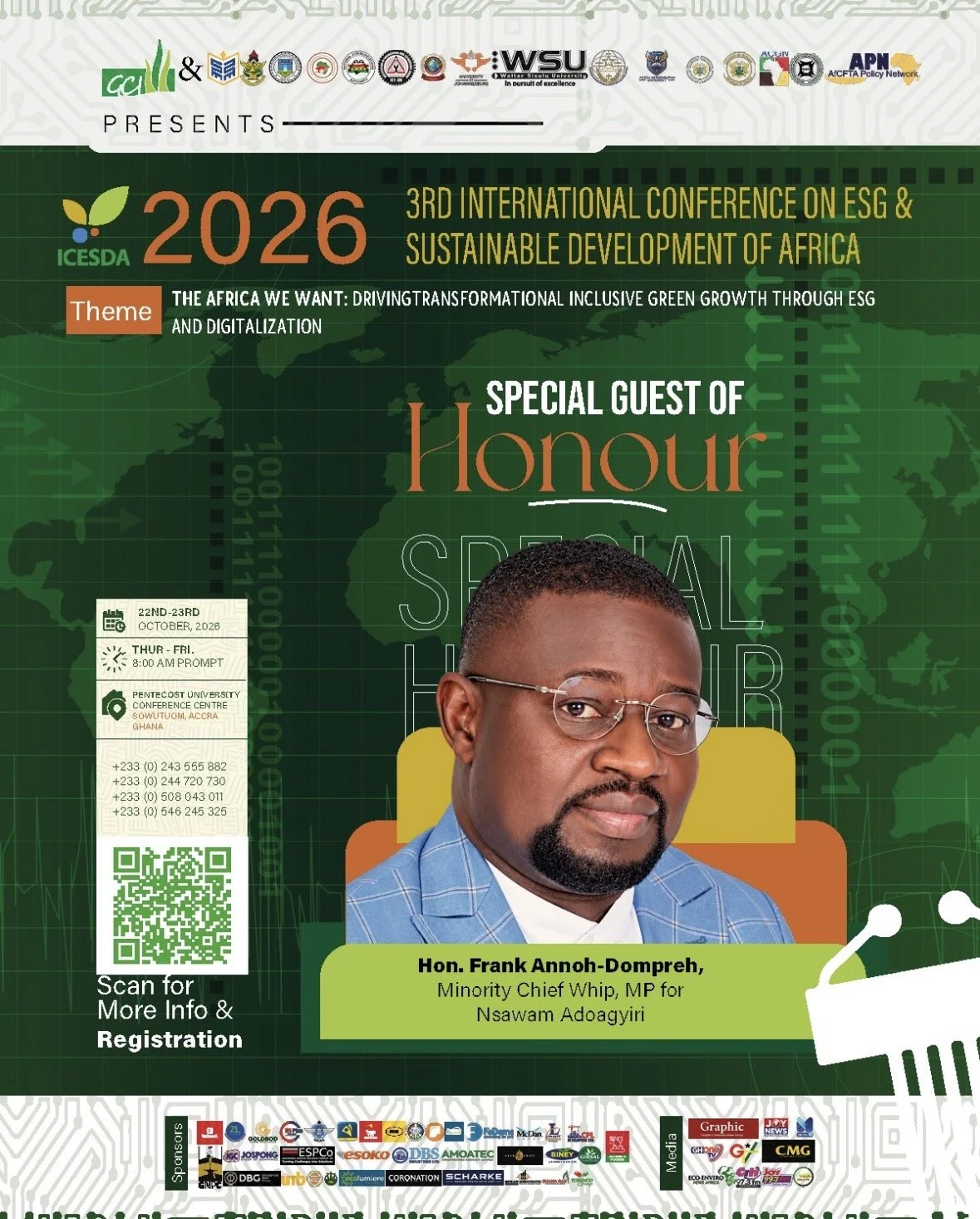
The Africa We Want: Driving Africa's Transformational Inclusive Green Growth through ESGs and Digitalization Considerations
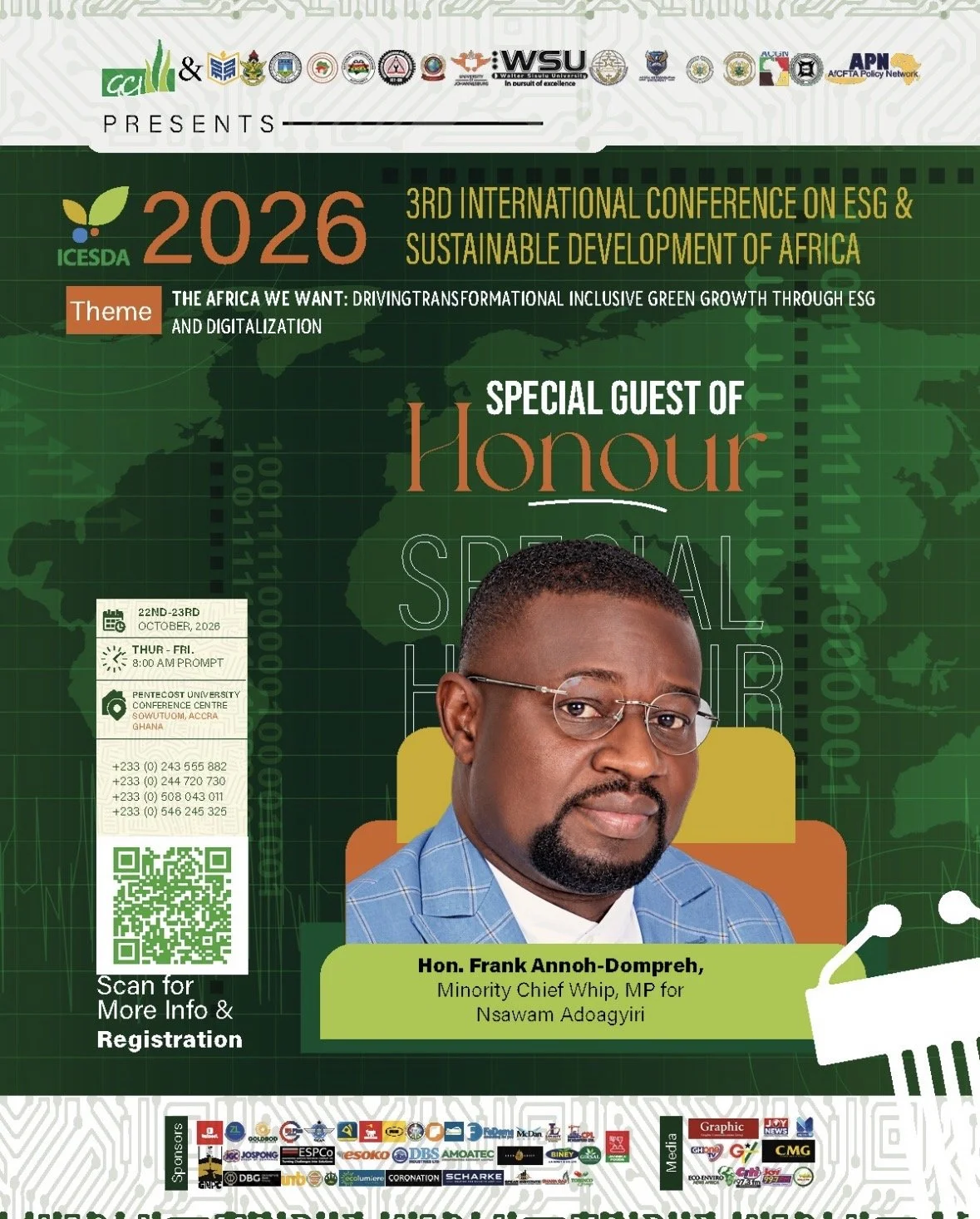
Welcome to ICESDA Conference, a joint academic-industry transformative gathering that seeks to address the pressing challenges facing Africa and our planet today. As we come together, we acknowledge that development and transformation efforts have not progressed as swiftly as anticipated in Africa. Despite numerous strategic programs and interventions, the realities of dwindling international aid and government budgets loom large, hampering our collective progress. The urgent crises of climate change, natural disasters, and threats to food, water, and energy security remind us that we stand at a critical crossroads. These global challenges call for a collaborative and concerted effort among business leaders, politicians, traditional authorities, religious institutions, and academic scholars. It is only through unity and innovative thinking that we can forge new paths toward sustainability and resilience. This conference is a clarion call to all stakeholders to engage in sustainable practices and community development. ICESDA represents a pioneering effort in Ghana, bringing together leaders from various sectors to discuss the vital role of corporate organizations in achieving the Sustainable Development Goals (SDGs) and Green Development Imperatives (GDI); while advancing Environmental, Social, and Governance (ESG) principles.
We aim to inspire dialogue around innovative strategies that promote responsible business actions, corporate giving, and a green mindset. We recognize that integrating ESG frameworks into business practices is essential for fostering sustainable growth and addressing the challenges we face. We invite you to share your knowledge, insights, and experiences, fostering an environment of collaboration and networking that will enrich our understanding and guide our actions.
This is a moment for us to explore actionable insights, develop practical solutions, and prepare for a sustainable future. We encourage scholarly contributions that encompass empirical research, case studies, and technical reports that address the complexities and challenges inherent in business management and sustainability, particularly through the lens of ESG. Together, let us harness this opportunity to design a better future where sustainability is integral to our practices, communities thrive, and we collectively contribute to a more equitable and resilient world. Thank you for being a part of this vital mission. Once again, we warmly welcome you to the ICESDA Conference!
Ecocentric Accelerants Under the KMGBF: Rights of Nature, Ecocide, and Legal Innovations for Nature
Organisers: Stop Ecocide International
Earth Law Center
Wetlands International
International Water Management Institute (IWMI)
European Broadcasting Union, Sustainability Summit 2026
The Sustainability Summit is an online event for all things broadcast sustainability. The full-day programme provides insights in areas such as production and technology.
The event will provide a mix of presentations and discussions from EBU Members and industry specialists sharing relevant insights. The highlights of this year are:
Are we handling climate emergency?
Our narrative
Transport impact reduction through innovation
Good news from tech
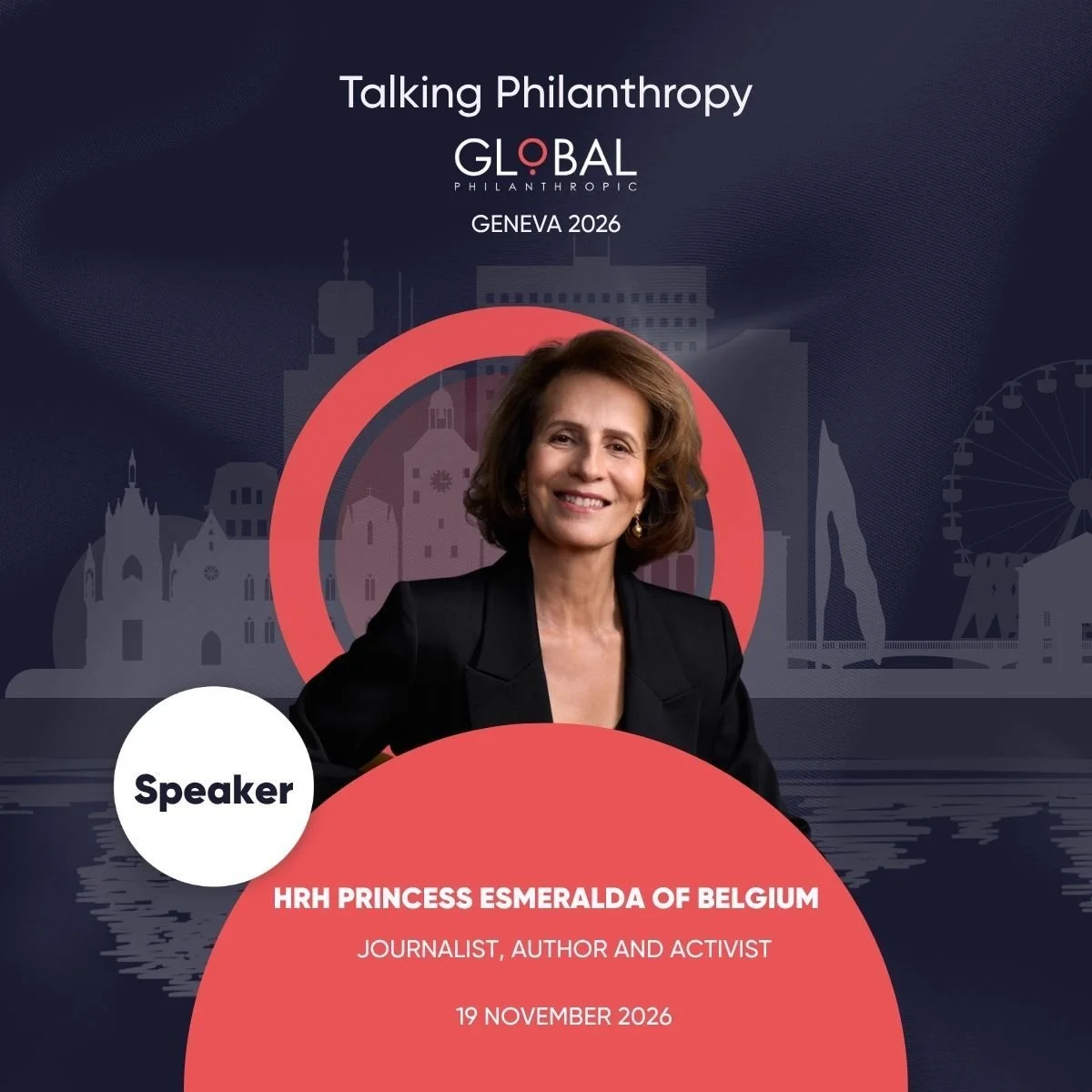
Talking Philanthropy Geneva Summit
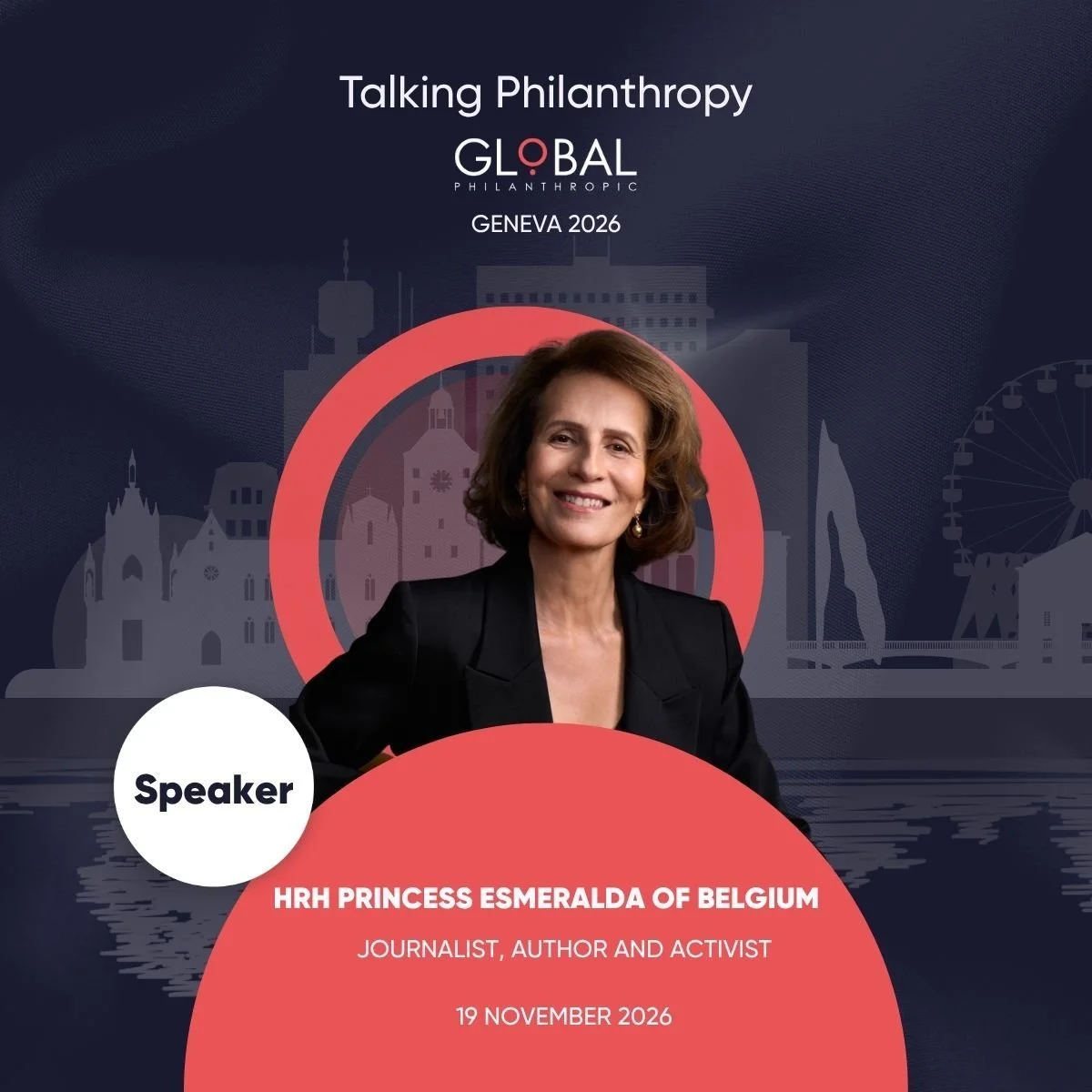
Relevant speaker: HRH Princess Esmeralda of Belgium as ambassador to Stop Ecocide International
The Fifth Crime: On Ecocide
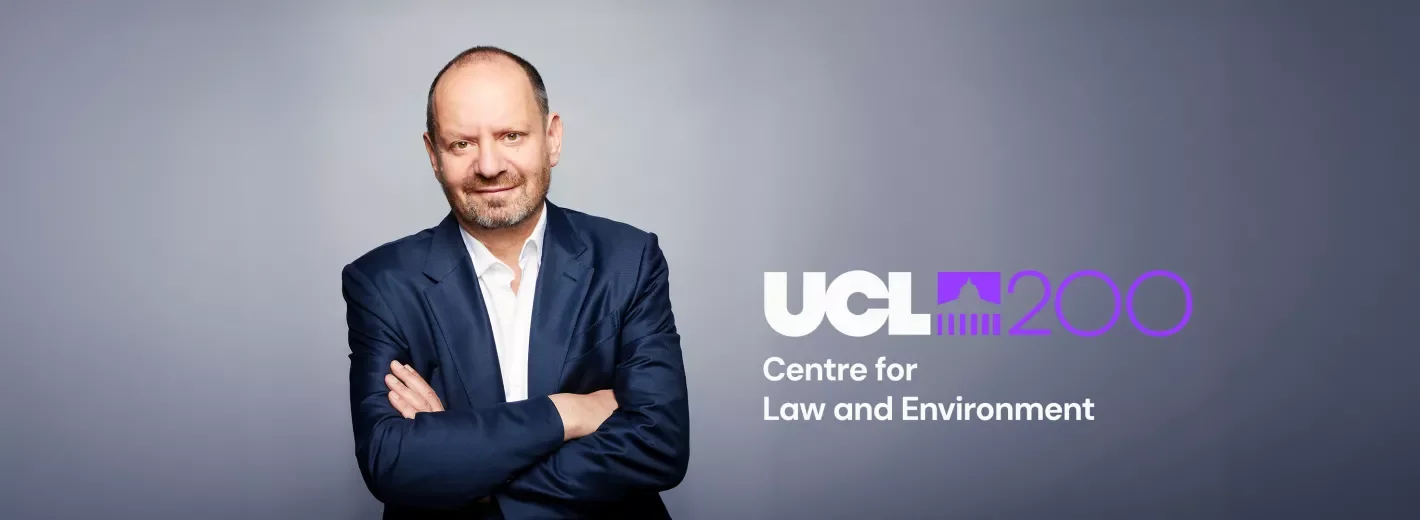
This is the UCL200 Centre for Law and Environment annual lecture. It is also the inaugural Polly Higgins Memorial Lecture, a global lecture series honouring pioneering barrister Polly HIggins (1968-2019), who dedicated her life to advancing the recognition of ecocide as an international crime.
About the speaker:
Professor Philippe Sands KC is Professor of the Public Understanding of Law at UCL Faculty of Laws (UK) and Visiting Professor at Harvard Law School, a practising barrister and arbitrator who has addressed environmental issues before international courts and tribunals, and an award-winning author.
About the event:
5.15pm - Drinks reception - all ticket holders are welcome
6.30pm-7.45pm - Lecture and Q&A
In 2020 Philippe Sands was invited to co-chair a working group to define a new international crime of ecocide. In this lecture, he will explore his own engagement with environmental issues, from childhood to the Chernobyl accident (the subject of his first book), to cases before the International Court of Justice and other tribunals. His next book, The Fifth Crime: On Ecocide, Justice and Hope, will be published by W&N on 8th April 2027.
Exchange of Knowledge: Biocentrism for Indigenous Peoples in the context of Climate Change & Rights of Nature
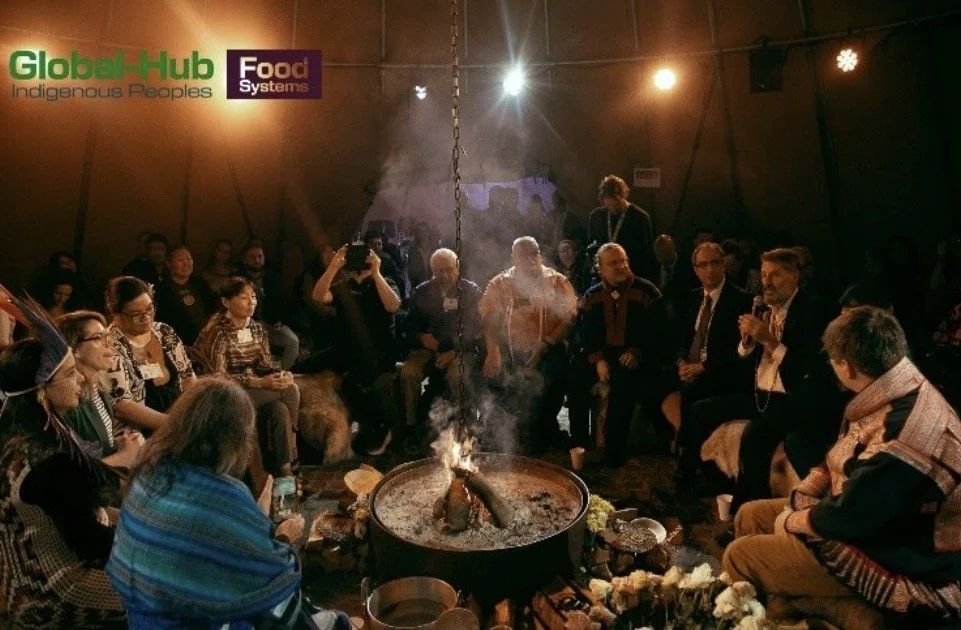
The session aims to explore the concept of biocentrism from Indigenous Peoples’ perspectives, its relationship with living in harmony with nature, and its links with current developments around the Rights of Nature, climate change and nature conservation.
The discussion will bring together different territorial, legal and knowledge perspectives, including the Rights of Mother Earth in Ecuador, the Rights of Nature in the Pacific, experiences from the Amazon and Xukuru territories, and broader reflections on biocentrism and ecocide.
Facilitation: Pablo Innecken, Indigenous Peoples Unit, FAO
Open discussion
* Open dialogue with participants on biocentrism, Indigenous Peoples’ worldviews, territorial stewardship and the Rights of Nature.
Closing reflections:
Yon Fernandez de Larrinoa, Head of Indigenous Peoples Unit, FAO
The session aims to explore the concept of biocentrism from Indigenous Peoples’ perspectives, its relationship with living in harmony with nature, and its links with current developments around the Rights of Nature, climate change and nature conservation.
The discussion will bring together different territorial, legal and knowledge perspectives, including the Rights of Mother Earth in Ecuador, the Rights of Nature in the Pacific, experiences from the Amazon and Xukuru territories, and broader reflections on biocentrism and ecocide.
Garden Court and LSE conference, Global and Domestic Litigation, Environmental Destruction & the Climate Crisis
This unique, practitioner-led conference brings together leading lawyers, academics, campaigners and policy experts for a deep dive into the latest trends and developments in using international and transnational law to tackle environmental destruction and climate change.
View the full programme here.
Insight for effective legal strategies
If you want expert discussion and practical insight into how legal principles might be translated into effective legal strategies and using of the law to protect communities and hold states and corporations to account, this conference is for you.
On the day
We will explore how legal strategies are evolving across jurisdictions, critical perspectives on the law and its utility for environmental justice, and what lessons can be learned.
The role of international criminal law in challenging climate and environmental harm, including:
The development and practical use of ecocide law
The role of the International Criminal Court, and domestic courts applying international law
The relationship between environmental destruction, protest, criminalisation and accountability
International civil and public law strategies, including:
Using international climate judgments and advisory opinions
How global climate principles can be made effective in domestic claims
Causation, attribution and responsibility in climate litigation
The use of evidence in cases involving environmental destruction
Remedies, reparations, loss and damage, and accountability
We will also look at the experiences of communities on the frontline of the climate crisis, including those living in Small Island States, where rising sea levels and environmental degradation present immediate and existential threats.
View the full programme here.
School of Advanced Study (SAS), University of London, Festival 2026, Senate House on Thursday 8 October, 10am - 3pm
Come along to SAS Festival of Research and Engagement 2026 on Thursday 8 October for a lively day of discovery, conversation and inspiration. Open to University of London and federation staff and students along with members of the public, the festival is a chance to meet the people behind SAS’s research, explore projects and collections, try out interactive activities and hear researchers share their work.
Prosecuting Environmental Harm as International Crimes
International criminal law is the most under-used tool in the fight against environmental damage and climate harm. Serious environmental destruction is too often treated as an unfortunate by-product of conflict or industrial activity, when it may in fact constitute an international crime. The June 2026 Manual on Prosecuting International Environmental Crimes, drafted by UCLA’s The Promise Institute for Human Rights and Climate Counsel, aims to reshape understanding and practice, showing in practical terms how environmental harm can be prosecuted under existing international criminal law, either as a war crime in conflict situations or as a crime against humanity in peacetime. This panel will discuss the Manual and its application to serious environmental harm in both conflict and peacetime situations, with specific examples from real-life situations.
Moderator: Xuchen Zhang, Legal Advisor, The Promise Institute for Human Rights
Donna Cline, International Criminal Lawyer
Kate Mackintosh, Executive Director, UCLA’s The Promise Institute for Human Rights
Rosemary Mwanza, Lecturer at Kabarak University School of Law
Richard Rogers, Executive Director, Climate Counsel
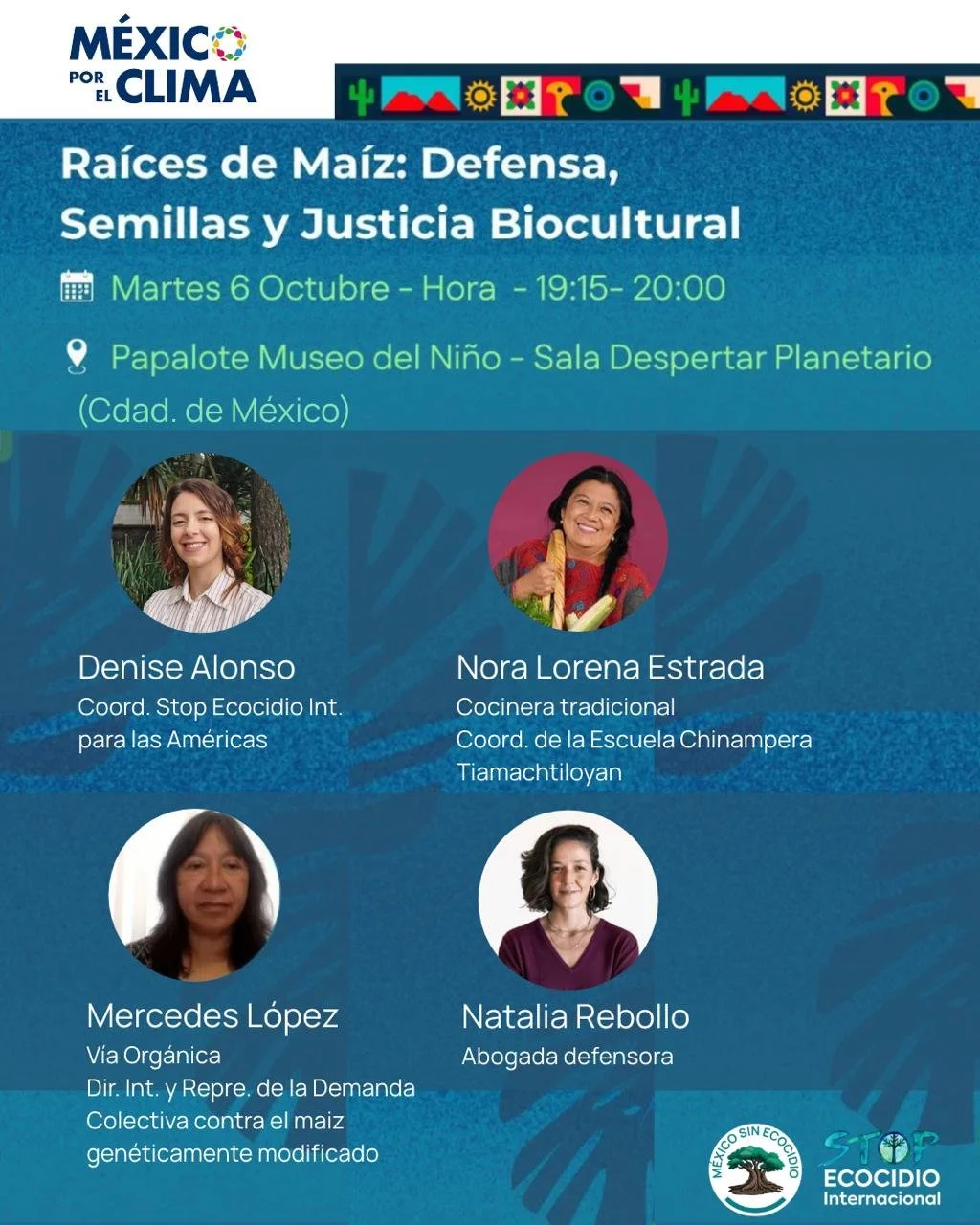
Raíces de Maíz: Defensa, Semillas y Justicia Biocultural
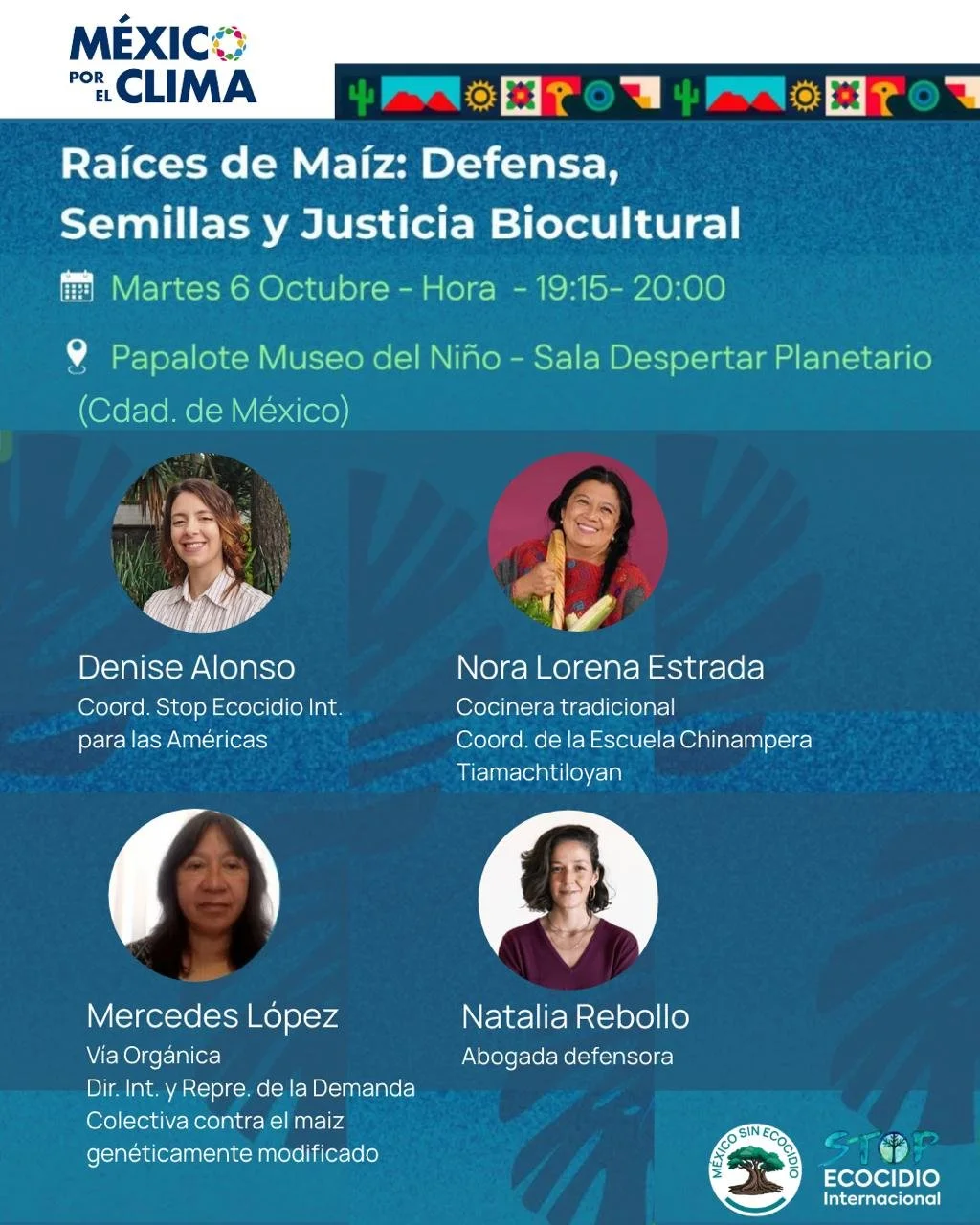
El maíz nativo, el sistema milpa y los suelos vivos de México enfrentan la presión sostenida del agronegocio, los paquetes tecnológicos dependientes de agrotóxicos y las presiones corporativas en los tratados de comercio internacional. Frente a esta amenaza, la protección del patrimonio genético y biocultural requiere trascender la separación entre el campo, la alimentación y la justicia legal.
La resistencia se sostiene en tres trincheras simultáneas: en los tribunales y las parcelas, donde el litigio estratégico de la Demanda Colectiva Maíz y las redes de agricultura regenerativa defienden la agrobiodiversidad y restauran la vitalidad de la tierra; en los fogones, donde las cocineras tradicionales mantienen viva la memoria biocultural al transformar las razas de maíz en sustento e identidad comunitaria; y en el ámbito del derecho global, donde la iniciativa contra el ecocidio busca establecer límites penales a la destrucción a gran escala de los ecosistemas. Este panel reúne el surco, la cocina y la defensa jurídica para debatir cómo garantizar una soberanía alimentaria duradera.
El objetivo de este evento es articular la defensa integral del sistema milpa, los maíces nativos y los suelos vivos mediante el cruce de tres frentes interconectados: el litigio colectivo, la agroecología comunitaria, la preservación biocultural desde la cocina tradicional, y el avance del derecho internacional ambiental a través de la tipificación del ecocidio.
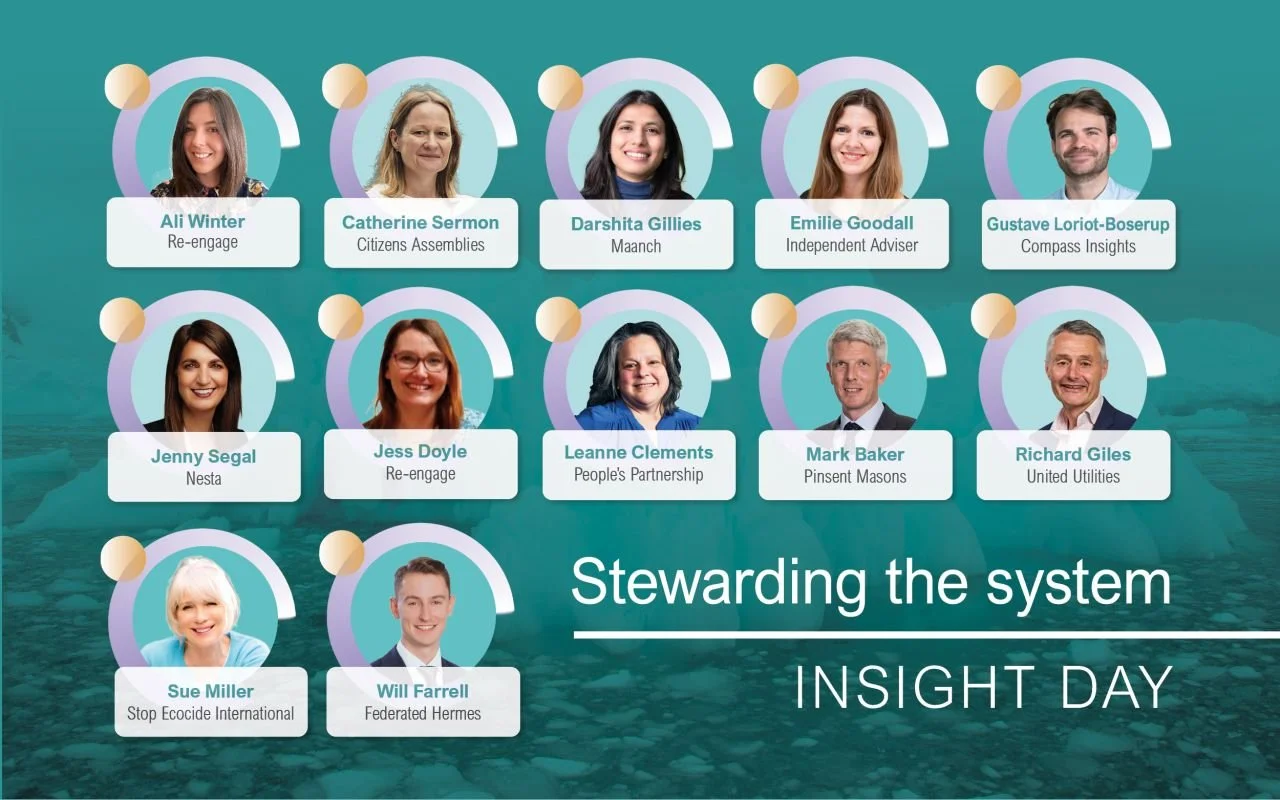
INSIGHT DAY: Stewarding the system for positive outcomes
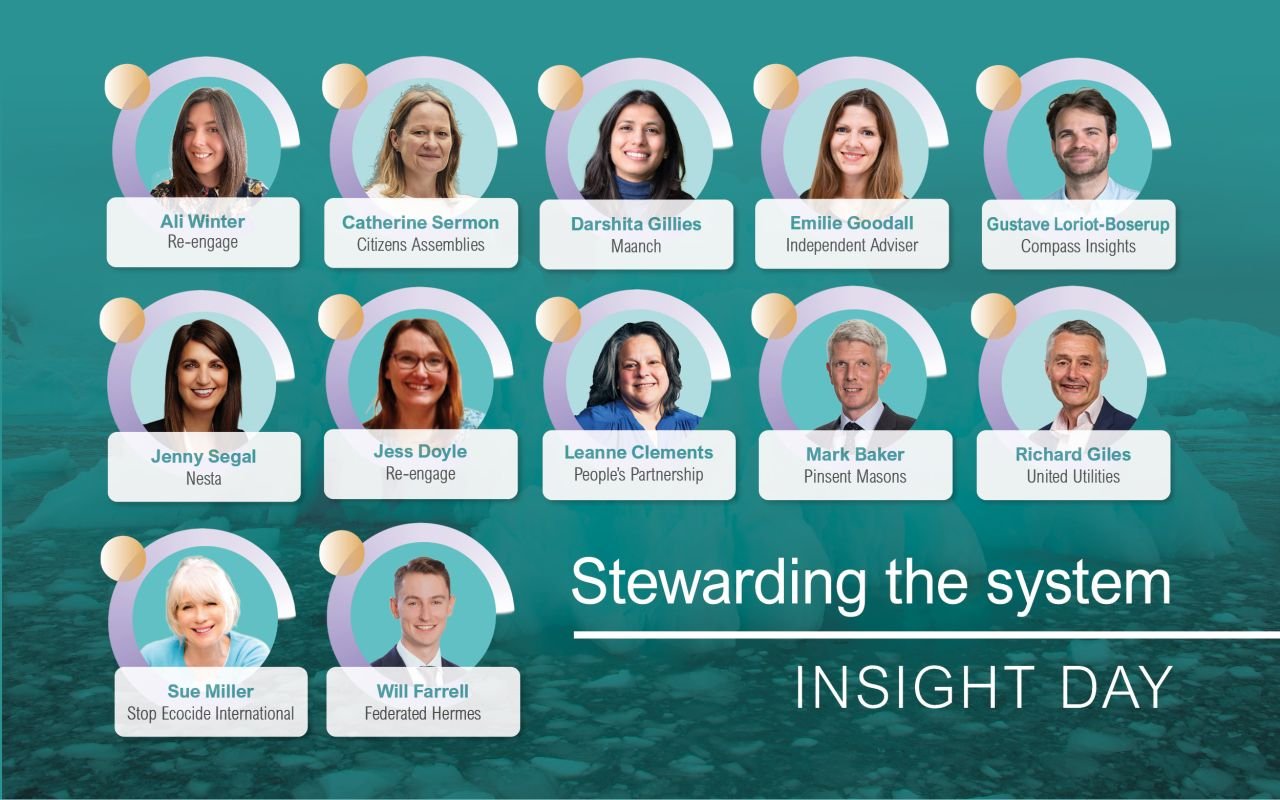
A half-day interactive event with policy masterclass focused on fiduciary duty, panels on stewardship and system-level investment approaches, and an interactive roundtable session with case study.
The Investors for Purpose Insight Day, ‘Stewarding the system for positive outcomes’, will bring together asset owners, advisers, investment managers, policymakers and industry stakeholders to explore how policy and practice can come together to address systemic challenges.
There is growing recognition investors, particularly as a result of shifts in policy, fiduciary duty interpretation and thinking, have a unique ability and agency to influence the system to create beneficial outcomes for people and planet. This Insight Day will examine how the institutional investment system can be used to strengthen long-term value creation and improve investment outcomes.
Through a focused masterclass and collaborative sessions, participants will explore the implications of a wider interpretation of investor agency and gain an increasing understanding of systemic risks and opportunities for new and evolved approaches to investment. Come ready to take part and work through real case studies!
Relevant Speaker: Sue Miller, Chief Networks and Alliances Officer, Stop Ecocide International
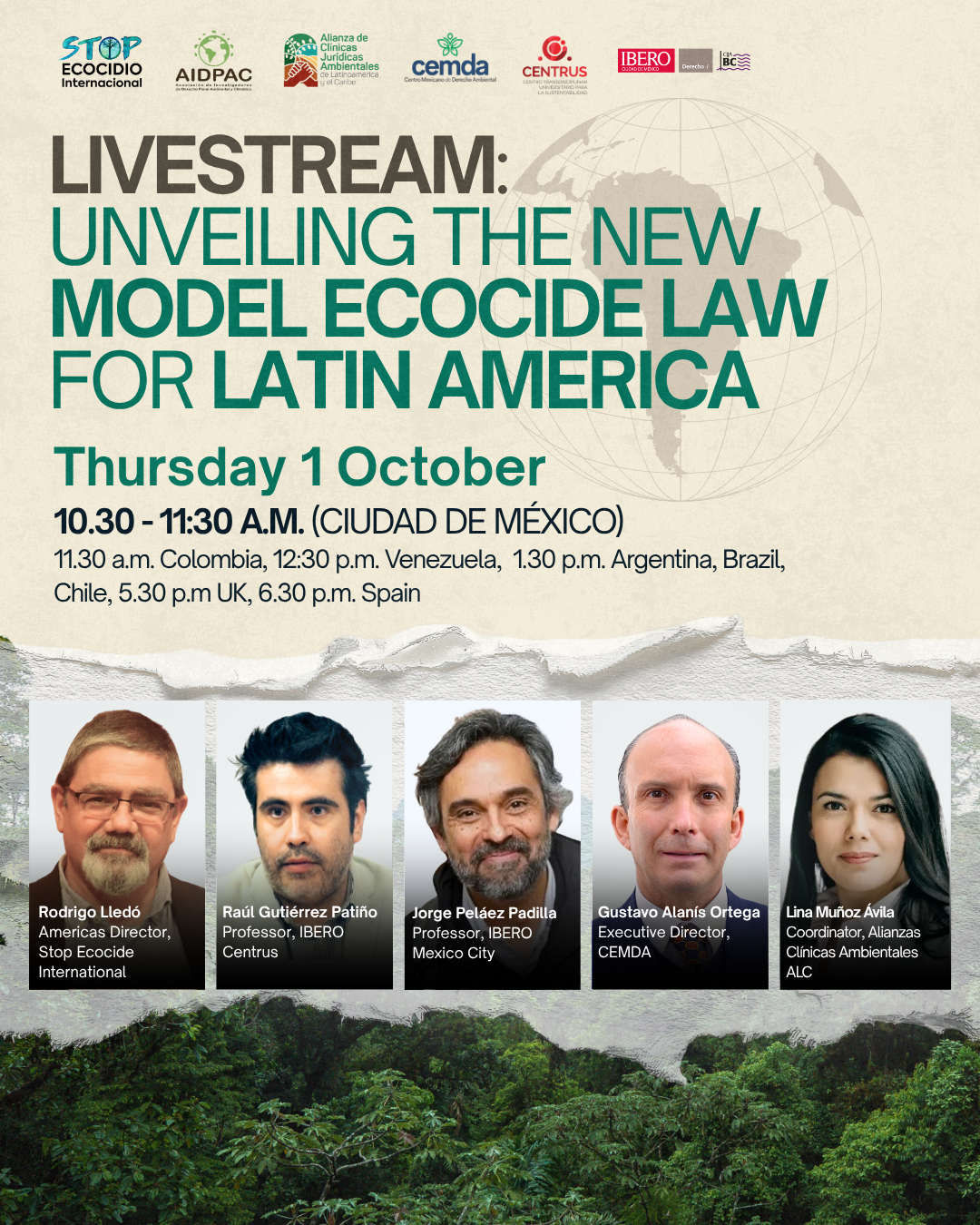
Livestream: Unveiling the New Model Ecocide Law for Latin America
The Model Ecocide Law for Latin America is now in its final stage following a rigorous consultation process, with legal experts convening to formulate the final draft at a conference in Mexico City. Join LIVE on Thursday 1 October as key members of the drafting committee reveal the final text of the Model Law!
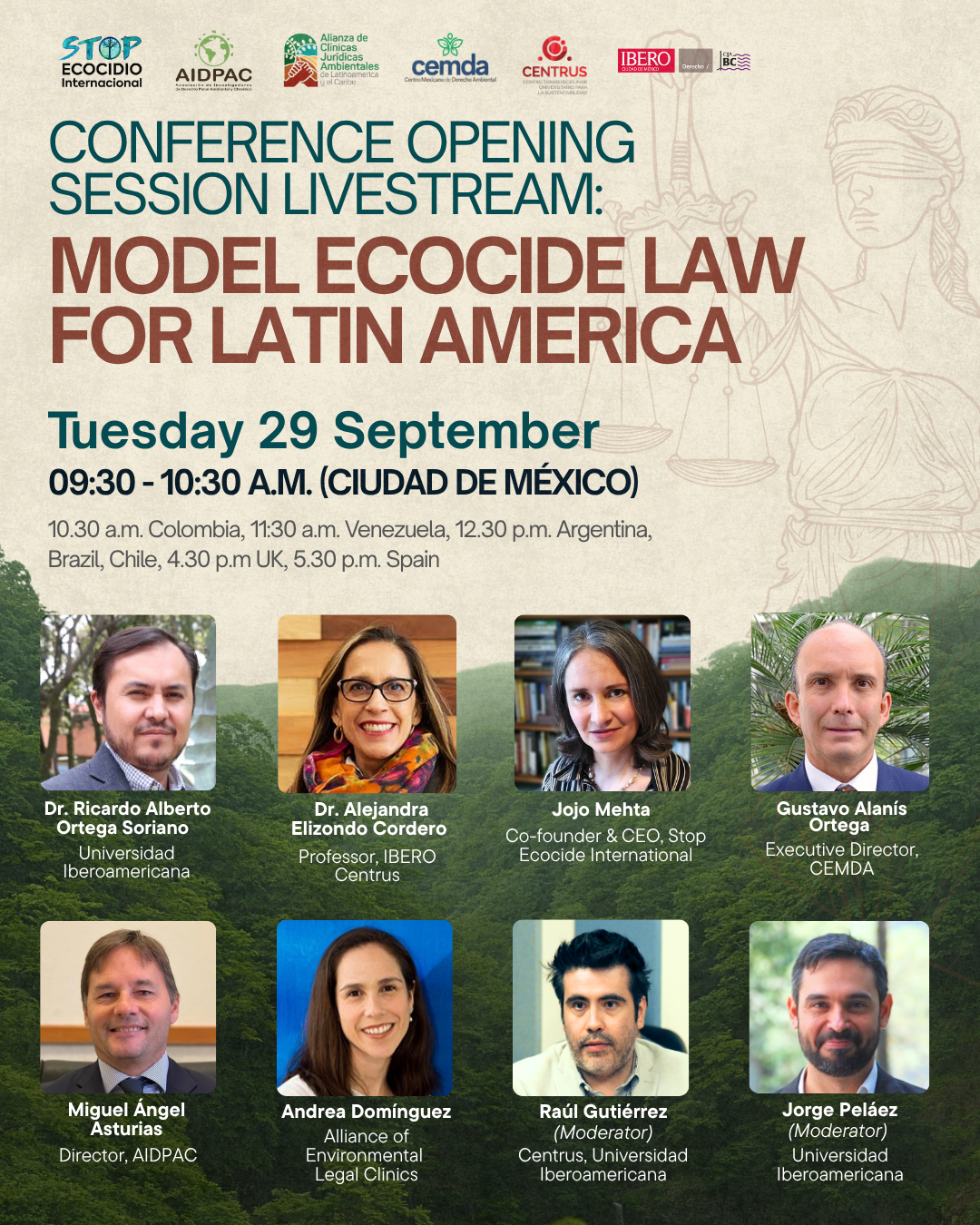
Conference Opening Session Livestream: Model Ecocide Law for Latin America
Date: Tuesday September 29
Time: 9:30 a. m. – 10:30 a.m. (Mexico City time)
Location: Fernando Bustos Auditorium, Ibero-American University (IBERO), Mexico City
Format: In-person with live broadcast
This event opens the Model Ecocide Law Conference in Mexico City, where a final draft of the model law will come together. This opening event will formally begin the technical drafting sessions. Speakers will discuss the inter-institutional and transdisciplinary work of the organisations involved, and the significance of the Model Ecocide Law initiative.
This event is organised by Stop Ecocide International, Asociación de Investigadores de Derecho Penal Ambiental y Climático (AIDPAC), Centro Mexicano de Derecho Ambiental (CEMDA), Iberoamerican University (Mexico City), Centro Transdisciplinar Universitario para la Sustentabilidad (CENTRUS) and Alianza de Clínicas Jurídicas Ambientales.
Speakers:
Dr Ricardo Alberto Ortega Soriano – Head of the Department of Law, Universidad Iberoamericana
Dr Alejandra Elizondo Cordero – Director of Centrus, Universidad Iberoamericana
Jojo Mehta – CEO of Stop Ecocide International
Gustavo Alanís – Executive Director of CEMDA
Miguel Ángel Asturias – Director of AIDPAC (via video link)
Andrea Domínguez – Representative of the Alliance of Environmental Legal Clinics
Moderators:
Raúl Gutiérrez - Centrus, Universidad Iberoamericana
Jorge Peláez - Law Department, Universidad Iberoamericana
About the Conference
The Model Ecocide Law for Latin America is now in its final stage following a rigorous consultation process, with legal experts convening to formulate the final draft at a conference in Mexico City.
This is a critical milestone. For lawmakers across Latin America, the Model Ecocide Law is set to offer a ready-made foundation for legislation that will criminalise the gravest harms to nature.
What is the Model Ecocide Law for Latin America?
In 2021, an Independent Expert Panel formulated a fully workable international legal definition of Ecocide. This definition formed the basis of the 2024 formal proposal by Vanuatu, Fiji and Samoa to amend the Rome Statute of the International Criminal Court.
However, for this legal concept to be effective in the civil law systems of Latin America, it is not enough to transpose the international definition; it must be adapted to respect the principles of continental law. This has given rise to the initiative to formulate a Model Ecocide Law for Latin American countries.
The Model Law follows in the footsteps of initiatives like UNCITRAL's Model Law on International Commercial Arbitration and the Latin American and Caribbean Parliament (PARLATINO)’s model laws, offering parliaments a reference text they can adopt in full or adapt to their own context.
The technical and legal reference point that a model law provides can strengthen future legislative initiatives across the region, tackle impunity for the most serious destruction of ecosystems, and ensure that ecocide can be effectively prosecuted and penalised.
The development of this Model Law involves three phases: a regional public consultation, technical roundtables, and a final drafting conference in Mexico City.
The Model Law initiative is the product of a collaboration between Stop Ecocide International, Asociación de Investigadores de Derecho Penal Ambiental y Climático (AIDPAC), Centro Mexicano de Derecho Ambiental (CEMDA), Iberoamerican University (Mexico City), Centro Transdisciplinar Universitario para la Sustentabilidad (CENTRUS) and Alianza de Clínicas Jurídicas Ambientales.
Learn more about the Model Ecocide Law here.
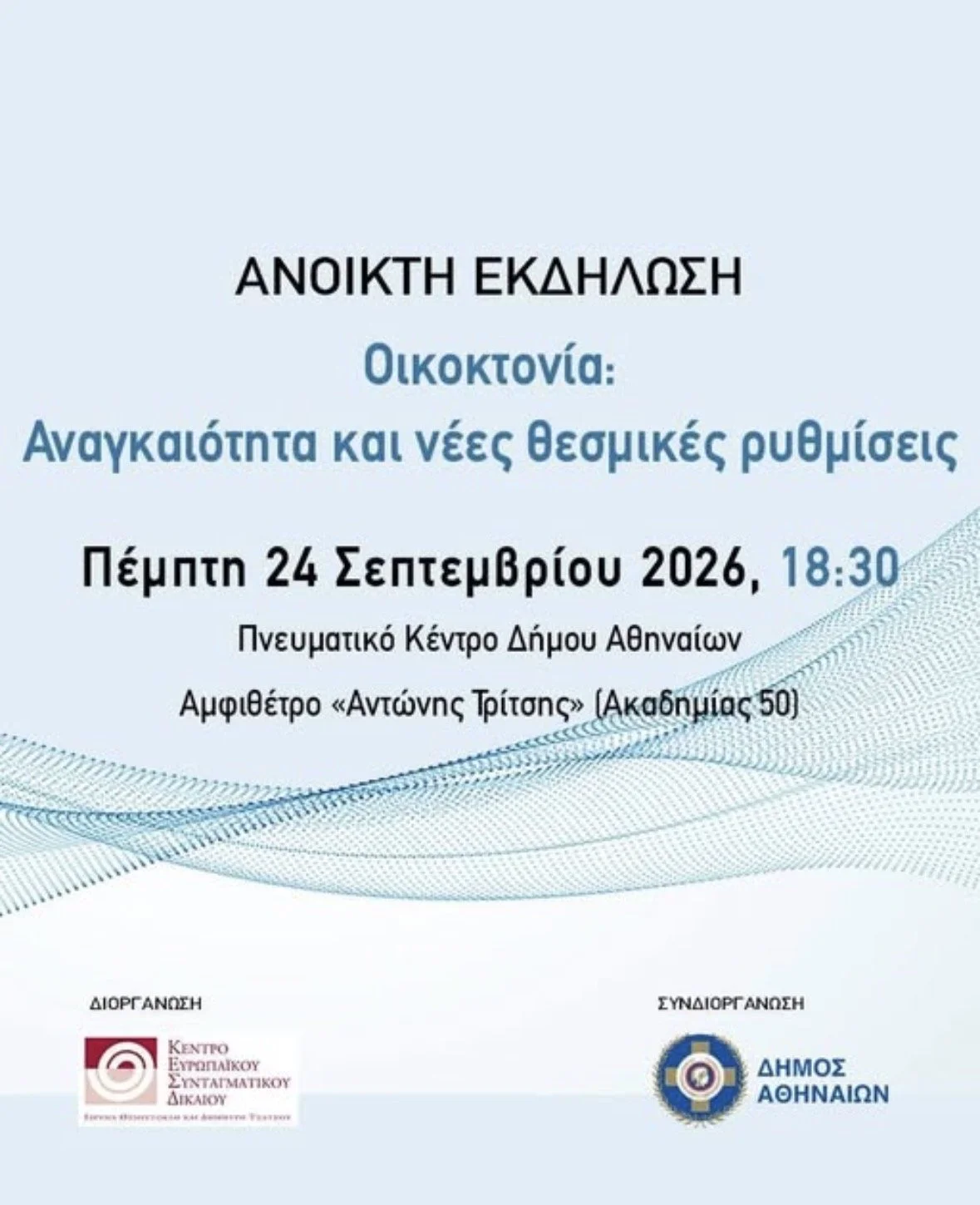
Ecocide: Necessity and New Institutional Arrangements
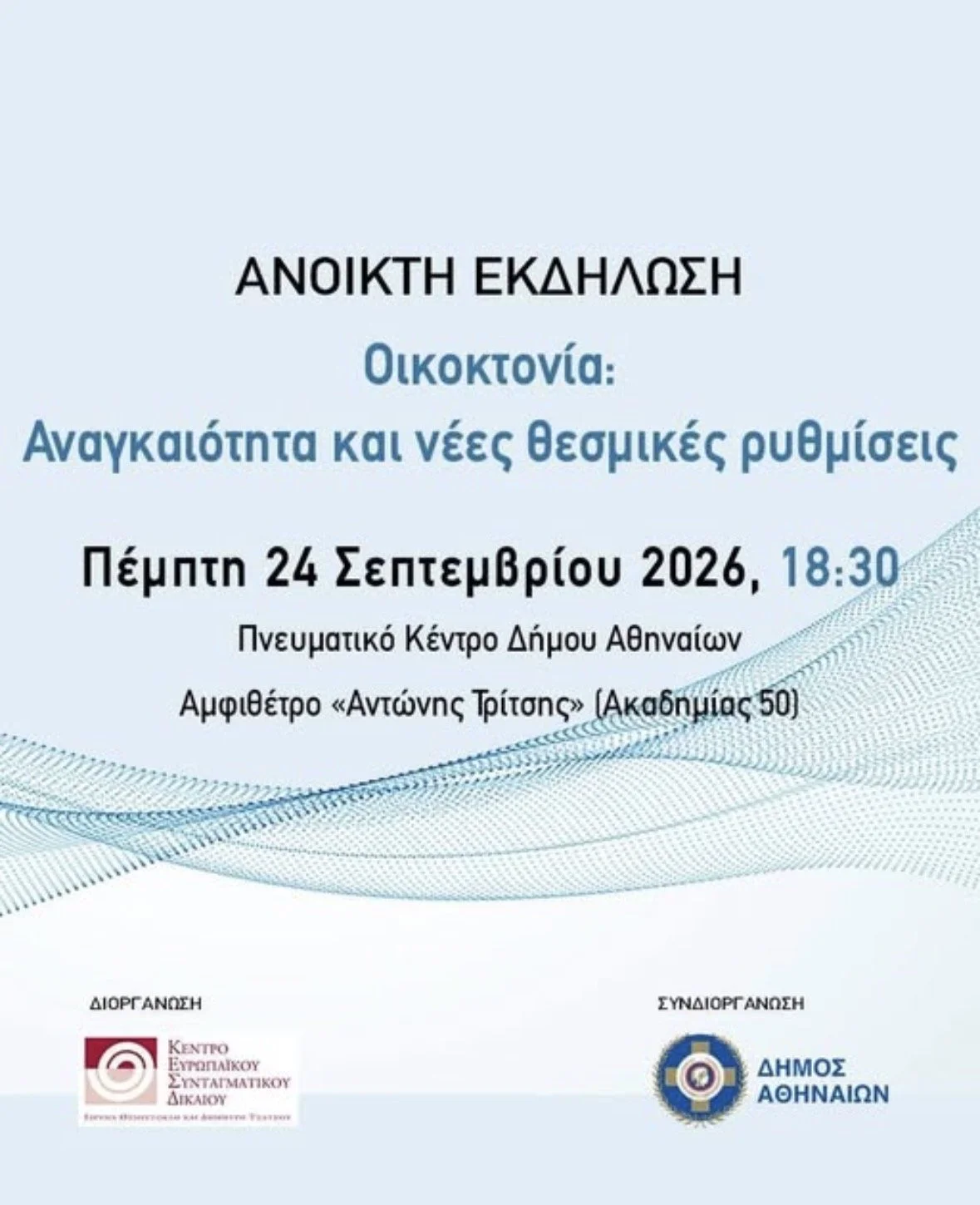
The Municipality of Athens and the Themistocles & Dimitris Tsatsos Foundation – Center for European Constitutional Law invite you to an event titled “Ecocide: Necessity and New Institutional Arrangements,” on Thursday, September 24, 2026, at the “Antonis Tritsis” Amphitheater of the Athens Municipality Cultural Center, 50 Akademias Street, Athens, at 6:30 p.m.
Speakers:
Haris Doukas, Mayor of Athens
Christina Efthymiatou, chemical engineer, coordinator of End Ecocide Greece
Ioannis Morozinis, Assistant Professor of Criminal Law at the Athens Law School
Lucy Ellen Rees, National Campaigns Coordinator for Stop Ecocide International
Nikos Charalambidis, Director General of the Greek office of Greenpeace
Moderated by Xenophon Kontiadis, Professor of Public Law at Panteion University, President of the Center for European Constitutional Law
Ecocide refers to serious, widespread, or long-term damage to the environment and has been at the center of an international debate in recent years regarding its treatment as a standalone criminal offense.
In light of the upcoming transposition of Directive (EU) 2024/1203 into criminal law, the discussion will cover recent international and European developments, as well as the issues arising from its incorporation into the Greek legal system.
Email: www.cecl.gr
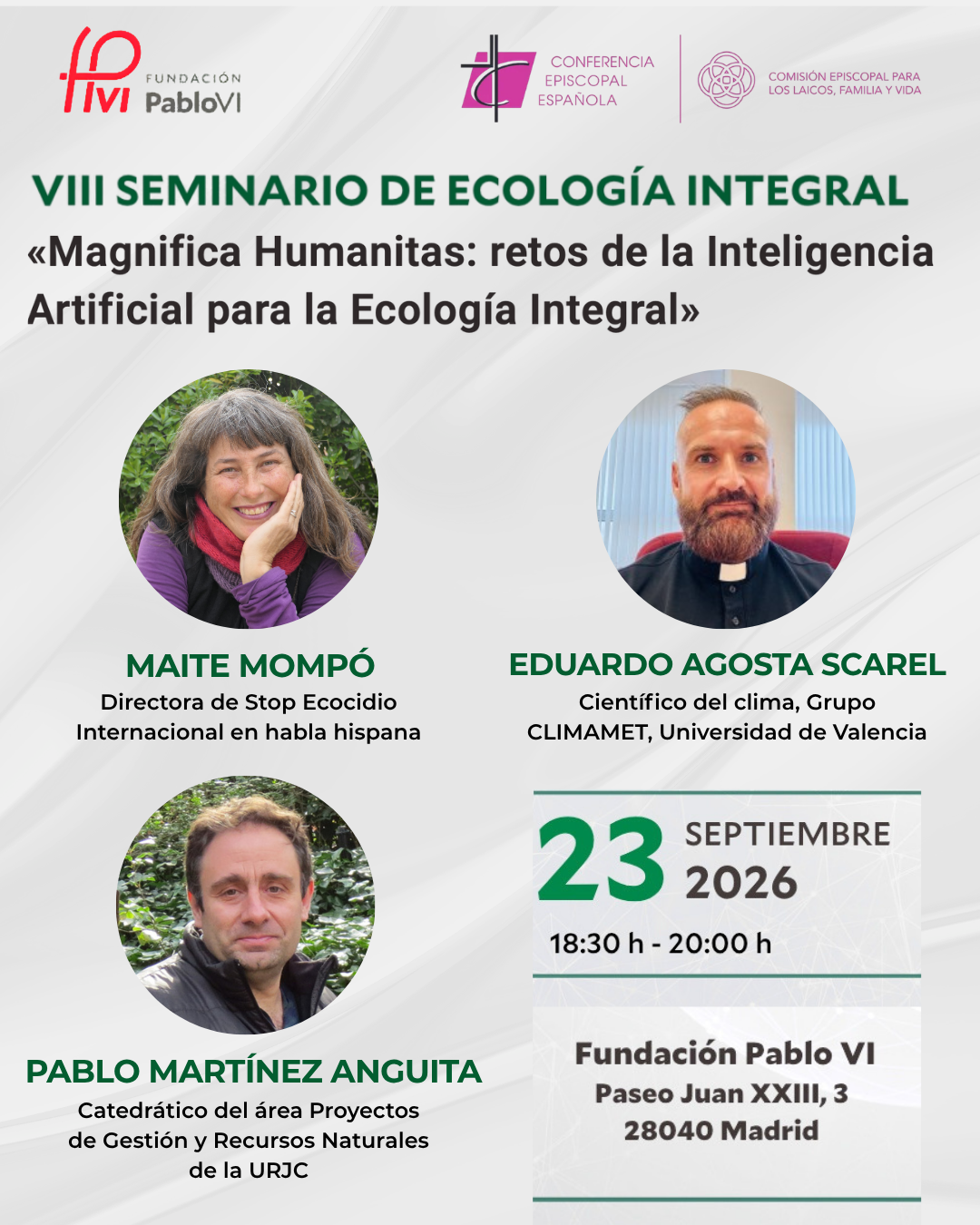
IX Seminario de Ecología Integral
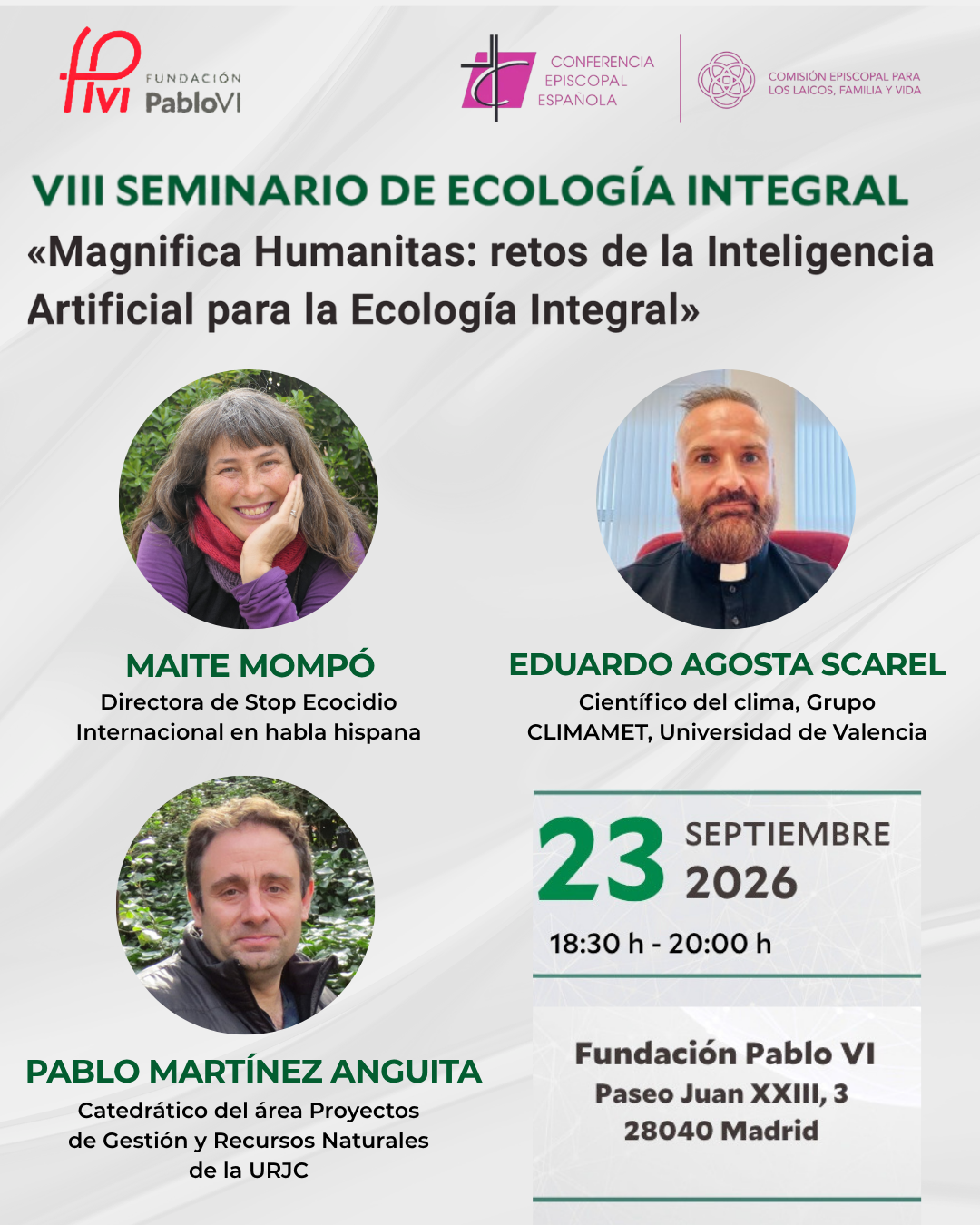
📍Sala de grados. Fundación Pablo VI. Paseo Juan XXIII, 3 28040 Madrid (España).
Coorganizado por la Fundación Pablo VI y el Departamento de Ecología Integral de la Conferencia Episcopal Española.
Maite Mompó, directora de Stop Ecocidio Internacional en habla hispana participará en un seminario para dialogar sobre la Encíclica ̈Magnífica Humanitas ̈ del Papa Leon VI, en la que el pontífice aborda algunos de los impactos de la inteligencia artificial en la Naturaleza y en los derechos humanos.
Estamos en un momento en el que prevenir la destrucción del ambiente es totalmente necesario. Bienes naturales tan básicos para la vida, como por ejemplo el agua, no pueden depender de un desarrollo tecnológico que promete objetivos brillantes a su costa.
La criminalización del ecocidio es una herramienta clave para prevenir daños graves al ambiente con independencia de la actividad que pueda provocarlos, por eso, es también una salvaguarda fundamental para la vida en la Tierra en el futuro.
En Stop Ecocidio Internacional trabajamos en la construcción de una sólida red de Fes por la Ley del Ecocidio.
OUR FUTURE: Moving Society from Ego-centrism to Eco-centrism (Climate Week NYC)
A discussion about the movement to recognise ecocide as a serious crime, featuring Anna Maddrick, Legal Adviser on Climate Matters at the Permanent Mission of Vanuatu to the United Nations.
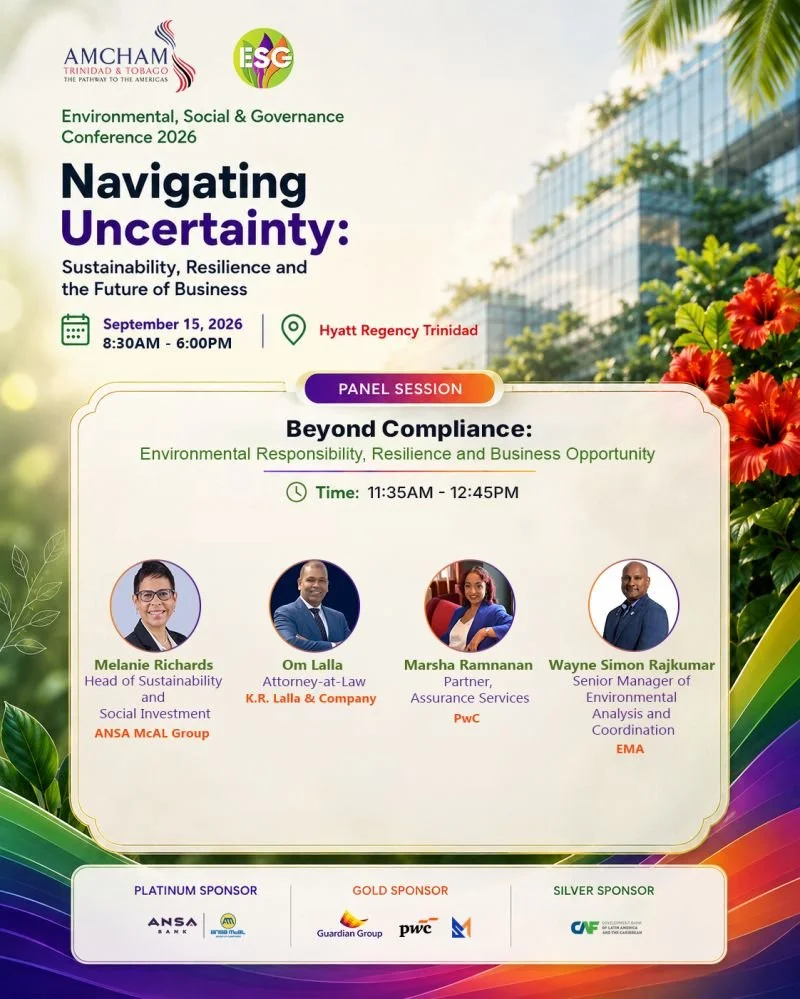
AMCHAM Environmental, Social and Governance Conference
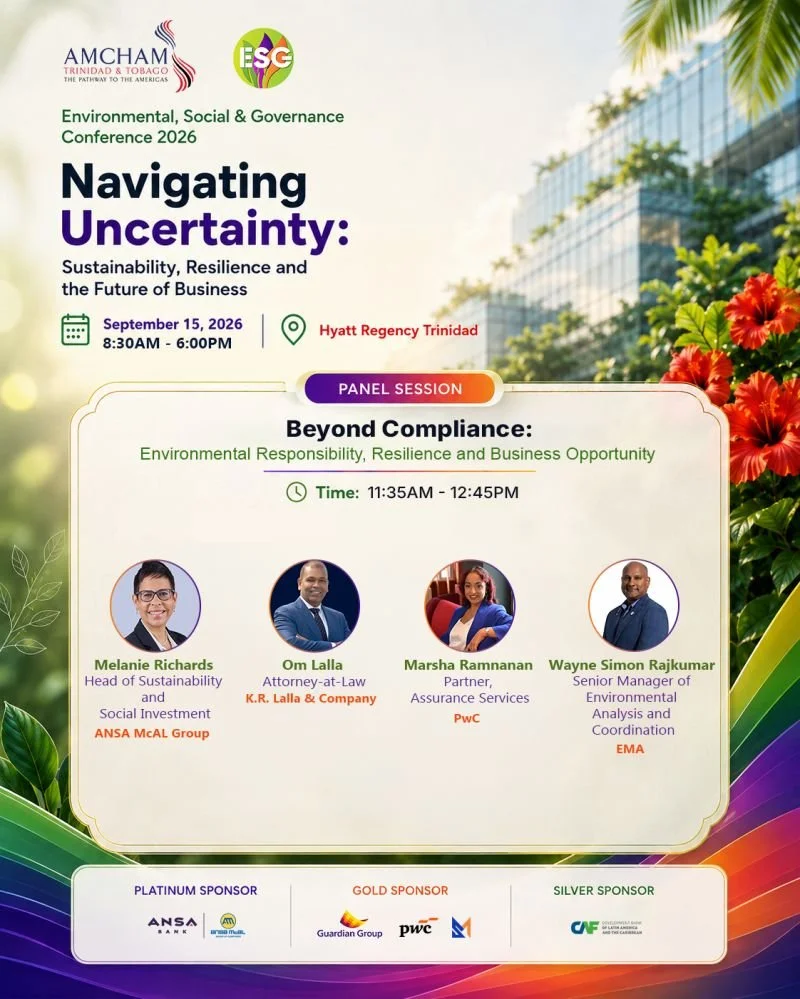
🌱 AMCHAM T&T ESG CONFERENCE 2026🌱
THEME: Navigating Uncertainty: Sustainability, Resilience and the Future of Business
Beyond Compliance: Environmental Responsibility, Resilience & Business Opportunity 🌎
How can businesses move beyond compliance to turn environmental responsibility into resilience, efficiency and competitive advantage? Join this timely panel discussion exploring environmental regulation, risk management, resource efficiency and the business opportunities created by sustainable action.
PANELISTS:
• Melanie J. Richards — Head of Sustainability & Social Investment | ANSA McAL Group
• Om Lalla — Attorney-at-Law | K.R. Lalla & Company
• Marsha Ramnanan — Partner, Assurance Services | PwC
• Wayne Simon Rajkumar — Senior Manager, Environmental Analysis & Coordination | EMA
📅 September 15, 2026
📍 Hyatt Regency Trinidad
Special thanks to our SPONSORS:
Platinum Sponsors: ANSA Bank; The ANSA McAL Group
Gold Sponsors: Guardian Group Trinidad and Tobago; PwC Trinidad and Tobago; Media 22
Silver Sponsor: CAF -banco de desarrollo de América Latina y el Caribe- (CAF Development Bank of Latin America and the Caribbean)
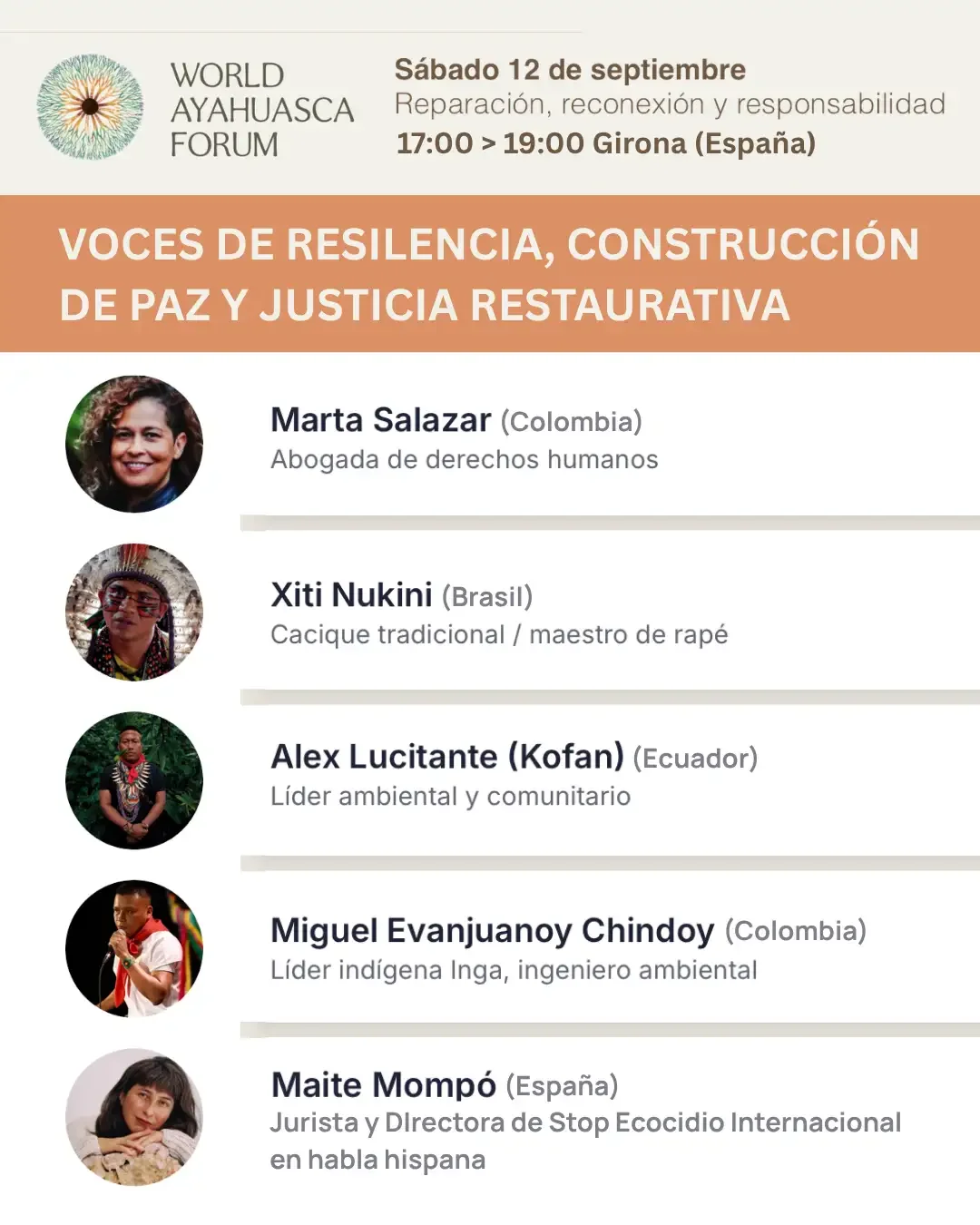
Voces de Resiliencia, Construccíon de paz y Justica Restaurativa
📍 Palau de Congressos de Girona (España). Passeig de la Devesa, 35, (17001).
📅 12 de Septiembre. Jornada ¨Reparación, Reconexión y responsabilidad¨
🕔 17:00-19:00. Sesión: ¨Voces de resiliencia: resiliencia, construcción de paz y justicia restaurativa¨
Web del Foro Mundial de Ayahuasca: https://www.ayahuasca2026.com/es/
Este foro es un formato renovado que surge tras cinco ediciones previas de las llamadas Conferencias Mundiales/Indígenas de Ayahuasca, que reúne a voces ancestrales, comunidades, investigadores, profesionales, artistas y aliados de todo el mundo con experiencia ampliamente reconocida a nivel internacional.
Stop Ecocidio Internacional tiene el honor de participar en la sesión ¨Voces de resiliencia: resiliencia, construcción de paz y justicia restaurativa¨, para converger con voces resilientes de liderazgos Indígenas defendiendo sus territorios, profesionales de la salud protegiendo la vida en medio de conflictos y constructores de paz trazando caminos de justicia restaurativa.
Como comunidad global, se nos invita a reflexionar sobre cómo podemos actuar de manera ética junto a quienes asumen la profunda responsabilidad de cultivar y proteger nuestra conexión con la vida, la Naturaleza y todos los seres.
Moderadora: Juliana Sepúlveda Acevedo. (Colombia)
Profesional especializada en la Jurisdicción Especial para la Paz (JEP) de Colombia y doctoranda de la Universidad del Rosario. Es magíster en Derecho, con especialización en Derecho Constitucional, Derecho Ambiental, Derechos Humanos y Derecho Internacional Humanitario, y fue becaria de la Universidad de Oklahoma para cursar Derecho Norteamericano Indígena. A lo largo de su trayectoria ha trabajado en la defensa de los derechos de la Naturaleza y el territorio, apoyando las primeras providencias judiciales en Colombia que declararon al territorio víctima del conflicto armado y contribuyendo a la imputación de crímenes ambientales en el marco de la JEP. Cuenta con amplia experiencia de campo en derechos fundamentales y conflicto armado con pueblos étnicos y comunidades rurales y campesinas.
Voces:
Marta Salazar, Abogada de derechos humanos. (Colombia)
Abogada de la Universidad de Cartagena y especialista en Derechos Humanos de la Universidad Complutense de Madrid. Con más de quince años de experiencia, ha acompañado a comunidades campesinas y pueblos étnicos víctimas del conflicto armado en la defensa de sus derechos en el marco de los mecanismos de justicia transicional y restaurativa.
Ha participado en procesos de investigación y elaboración de informes presentados a la Comisión para el Esclarecimiento de la Verdad (CEV) y a la Jurisdicción Especial para la Paz (JEP), dirigidos a la identificación de dinámicas del conflicto armado y patrones de victimización en los territorios, sus causas estructurales, caracterización de daños colectivos y territoriales y construcción de acciones de reparación integral y no repetición.
Fue directora de la Unidad para las Víctimas en el departamento de Bolívar y San Andrés Islas durante el período noviembre 2022-septiembre 2024. Fue asesora del Ministerio del Interior para el cumplimiento de las órdenes de la Sentencia T-025 de 2004 y sus Autos de Seguimiento expedidos por la Corte Constitucional, que declaró el Estado de Cosas Inconstitucional (ECI) en materia de desplazamiento forzado. Su trabajo se ha centrado en el acompañamiento a comunidades campesinas y pueblos étnicos en la promoción y defensa de la permanencia digna en sus territorios.
Xiti Nukini, Cacique tradicional / maestro de rapé. (Brasil)
Cacique tradicional y maestro de rapé del pueblo Nukini, de la familia lingüística Pano, en la Tierra Indígena Nukini, región del Alto Juruá, Acre, Brasil. Como líder de la comunidad Recanto Verde, se ha dedicado al resurgimiento cultural de los Nukini —el «pueblo del jaguar»— tras casi extinguirse durante el auge del caucho, preservando y transmitiendo las técnicas del rapé, los cantos sagrados y las prácticas espirituales.
Alex Lucitante (Kofan), Líder ambiental y comunitario. (Ecuador)
Reconocido líder indígena de la nacionalidad A’i Kofán (Ecuador), destacado defensor de los derechos humanos y activista comprometido con la protección de los derechos de la Naturaleza y de los territorios ancestrales. Su incansable labor en defensa de la Amazonía le ha convertido en una de las voces más influyentes en la lucha mundial contra la crisis climática.
En 2022, fue galardonado con el Premio Goldman del Medio Ambiente, considerado el «Nobel Verde», en reconocimiento a su liderazgo y valentía en la defensa del medio ambiente. También ha sido reconocido en tres ocasiones como uno de los 100 latinoamericanos más comprometidos con el planeta, lo que reafirma su impacto y dedicación ante los retos medioambientales actuales.
Alex es heredero de un profundo linaje de sabios guardianes de los conocimientos ancestrales de su pueblo. También es reconocido como discípulo de la sabiduría del yagé (ayahuasca), una ciencia espiritual que ha fortalecido su conexión con la Naturaleza y con su propósito en la vida. De esa raíz espiritual surge también su trabajo como compositor de música medicinal, a través de la cual comparte mensajes de sanación, conciencia y armonía con la Tierra.
Actualmente, a sus 33 años, Alex sigue inspirando a personas de todo el mundo a través de sus acciones y su mensaje. Afirma que su compromiso con la defensa de la selva nace del conocimiento ancestral del yagé, que enseña la relación sagrada e inseparable entre los pueblos indígenas y sus territorios. Según su punto de vista, si el bosque desaparece, los pueblos indígenas desaparecerán con él; y, si los pueblos indígenas desaparecen, el bosque también se perderá.
Para Alex, la Amazonía no es sólo un ecosistema, sino un espacio sagrado, el hogar común de toda la humanidad. Por eso, defiende que su protección no es responsabilidad exclusiva de las nacionalidades indígenas, sino un deber colectivo de toda la sociedad.
Miguel Evanjuanoy Chindoy, Líder indígena Inga, ingeniero ambiental. (Colombia) Líder indígena Inga del Putumayo, ingeniero ambiental y defensor de los territorios, los conocimientos ancestrales y la medicina tradicional amazónica. Nacido y criado en el resguardo de Yunguillo, ha dedicado su vida al fortalecimiento de la organización comunitaria, la protección de la biodiversidad y la preservación de la medicina tradicional del yagé (ayahuasca), de la cual ha sido practicante desde la infancia.
Como vocero de la Unión de Médicos Indígenas Yagéceros de la Amazonía Colombiana (UMIYAC), ha promovido el diálogo intercultural, la defensa de los derechos de los pueblos indígenas y la protección de los conocimientos tradicionales frente a las presiones del extractivismo y la apropiación cultural.
Ha representado a los pueblos indígenas en foros nacionales e internacionales sobre ayahuasca, conservación biocultural, espiritualidad indígena y derechos colectivos, además de contribuir a reflexiones y publicaciones sobre los principios éticos de las medicinas tradicionales. Su labor se centra en la protección de la Amazonía, el fortalecimiento de la memoria y la espiritualidad indígena, y la construcción de relaciones más justas y respetuosas entre los pueblos indígenas, la sociedad y la Madre Tierra. Miguel cuenta además con una especialización en Derechos Humanos por la Universidad de Cali, Colombia.
Maite Mompó, Jurista y Directora de Stop Ecocidio Internacional en habla hispana. (España) Licenciada en Derecho y especializada en ética ecológica, sostenibilidad y educación medioambiental por la
Universidad Politécnica de Valencia. Ha dedicado años a impartir conferencias sobre temas medioambientales y a desarrollar proyectos de sensibilización medioambiental para centros educativos.
Desde 2019, forma parte del equipo de Stop Ecocidio Internacional, impulsando el debate global sobre la tipificación del ecocidio como forma de contribuir a un cambio de paradigma ético y social en la relación de los seres humanos con el planeta que habitan.
Maite ha dedicado toda su vida a los derechos humanos, la paz y el medio ambiente. Ha participado directamente en diferentes causas y organizaciones, especialmente en Amnistía Internacional y Greenpeace. Tras trabajar casi una década como marinera en los barcos de Greenpeace, escribió el libro ¨Rainbow Warriors, Historias legendarias de los barcos de Greenpeace¨, una importante herramienta de divulgación y sensibilización sobre los principales problemas medioambientales del planeta en las últimas décadas
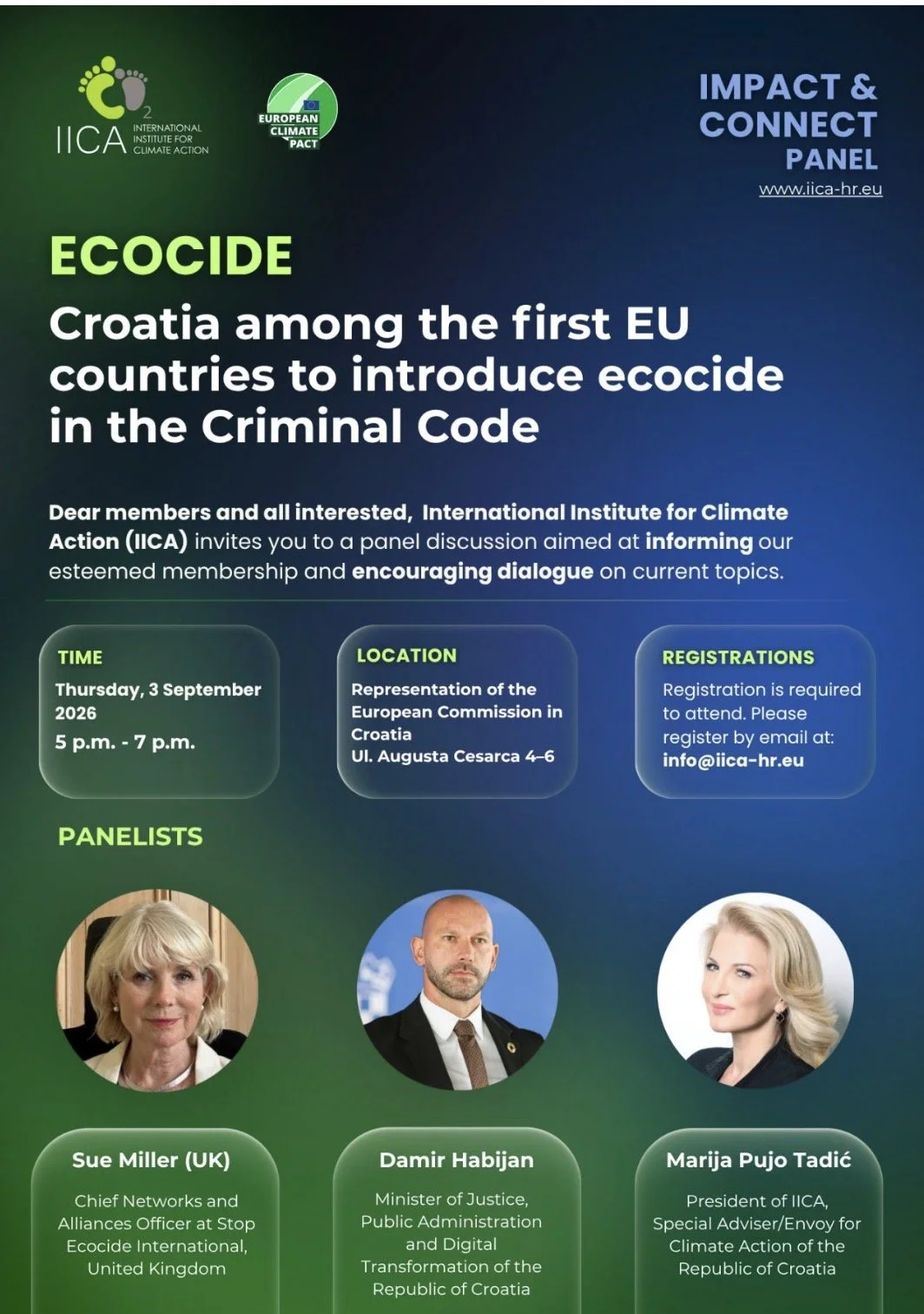
Impact and Connect Panel: Croatia among the first EU countries to introduce ecocide in the Criminal Code
Thursday September 3rd, 5pm - 7pm
European Commission Representation in Croatia, Ul.
Augusta Cesarca 4–6, Zagreb
Croatia is among the first EU countries to propose ecocide law legislation.
How is the legal framework for environmental protection evolving, and what could the introduction of a particularly serious environmental crime – ecocide – mean for Croatia, institutional accountability and the future of climate policy?
At the upcoming Impact & Connect Panel, organised by International Institute for Climate Action (IICA), the panel will explore these developments and open a discussion on one of the increasingly important issues in environmental and climate policy.
Panelists:
Sue Miller (UK) – Chief Networks and Alliances Officer, Stop Ecocide International
Damir Habijan – Ministarstvo pravosuđa, uprave i digitalne transformacije RH
Marija Pujo Tadić – President of IICA, Special Adviser/Envoy for Climate Action of the Republic of Croatia
REGISTRATION IS REQUIRED TO ATTEND.
Register by email at: info@iica-hr.eu
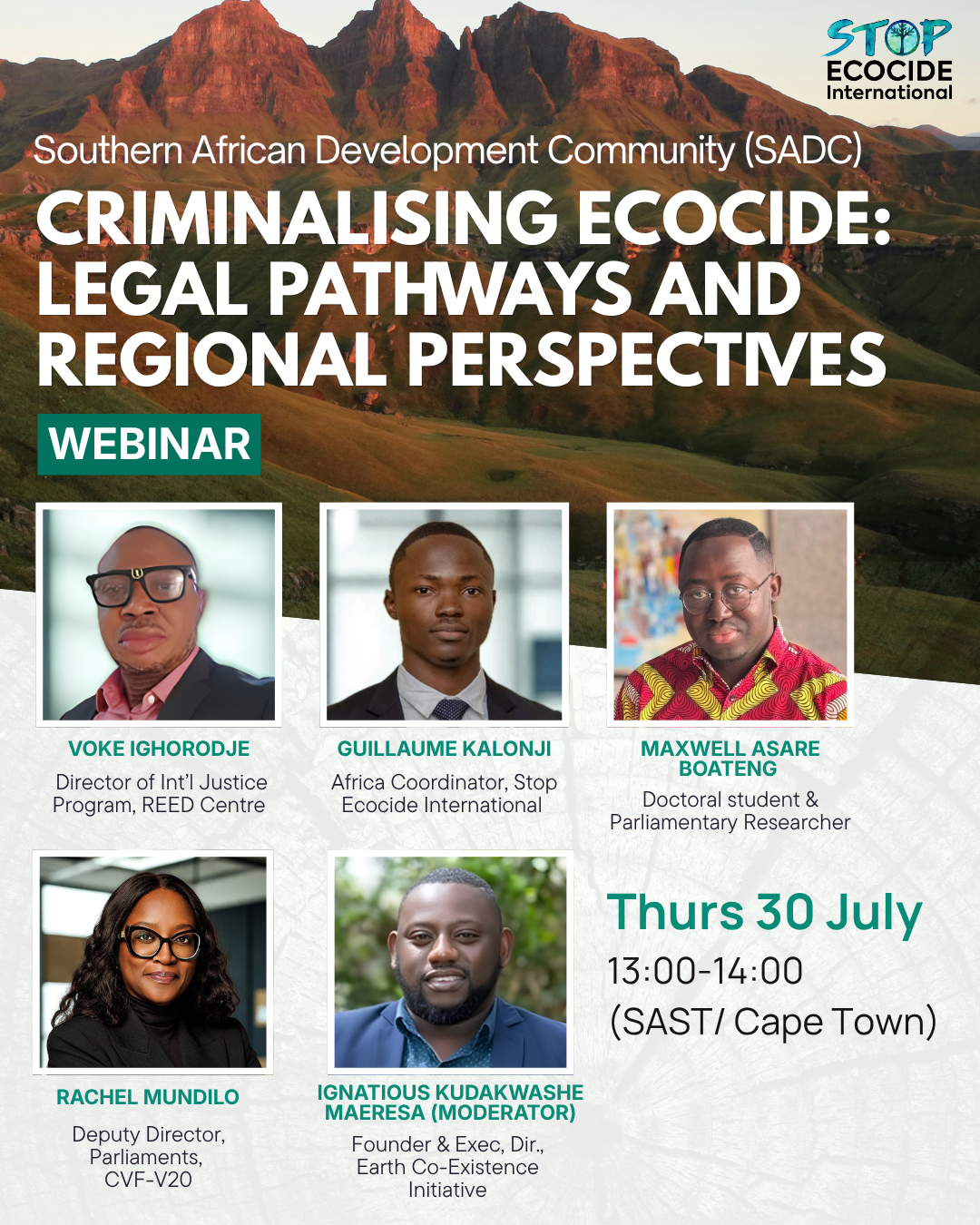
Criminalising Ecocide: Legal pathways and regional perspectives
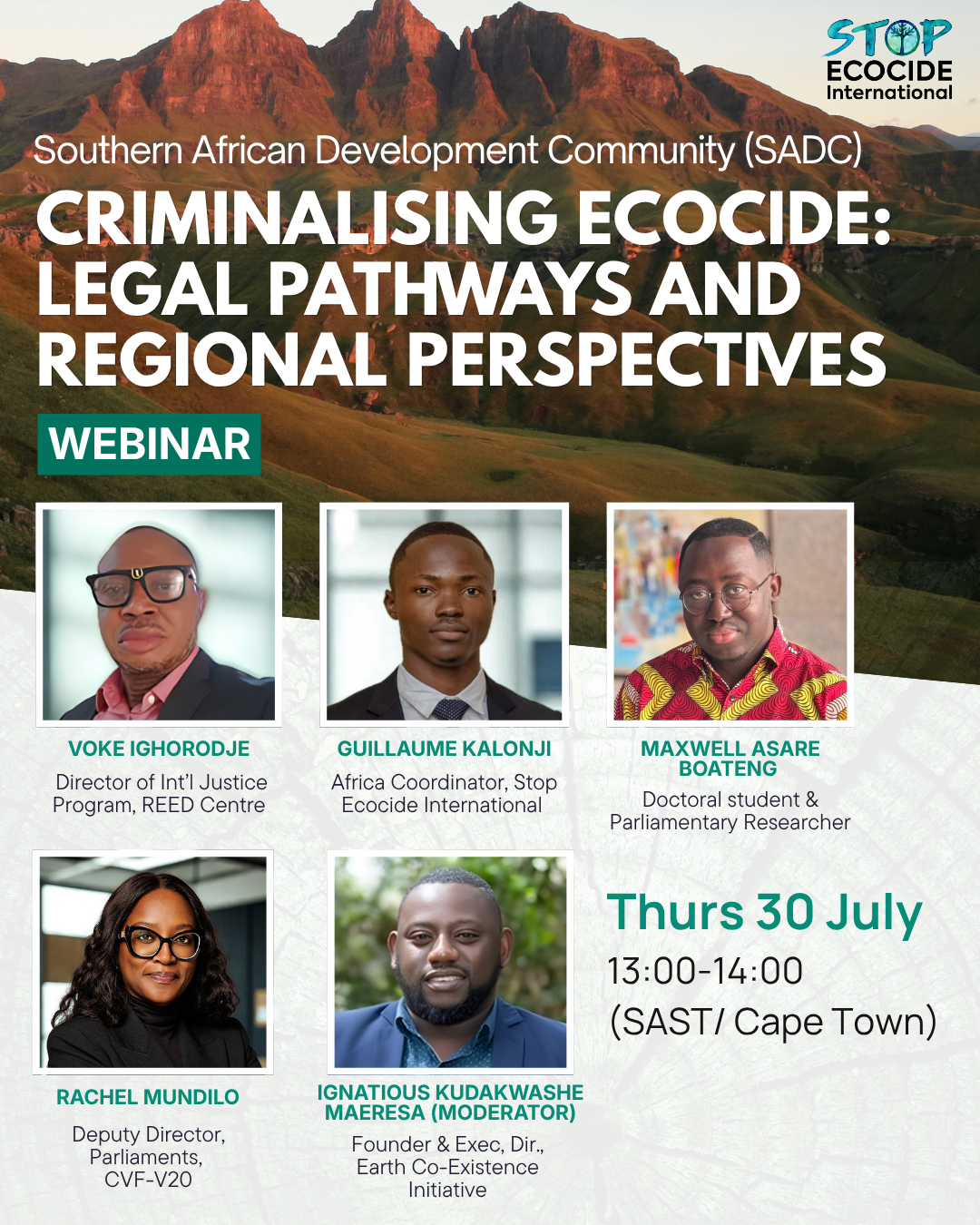
Zoom: 13.00 - 14.00 (Southern African Standard Time SAST) UTC +2
This webinar responds to a critical policy window. Across Africa, discussions on ecocide are increasingly taking place at the national level, with several States exploring legislative and policy approaches to addressing severe environmental destruction. Recent developments in Mauritius where a domestic law on ecocide took place, the Democratic Republic of the Congo and Ghana where bills are discussed and created illustrate growing interest in strengthening environmental accountability mechanisms, while regional institutions and processes, including those of the African Union, the African Ministerial Conference on the Environment (AMCEN) and the African Commission on Human and Peoples’ Rights, continue to provide important platforms for dialogue and legal development.
Speakers:
• Voke Ighorodje – Director of the International Justice Program at the REED Centre for Social Change
• Guillaume Kalonji – Africa Coordinator at Stop Ecocide International
• Maxwell Asare Boateng – Doctoral student and Researcher, Parliament of Ghana
• Rachel Mundilo – Deputy Director of Parliaments at the Climate Vulnerable Forum: Vulnerable 20 (CVF-V20)
• Ignatious Kudakwashe Maeresa - Founder and Executive Director, Earth Co-Existence Initiative
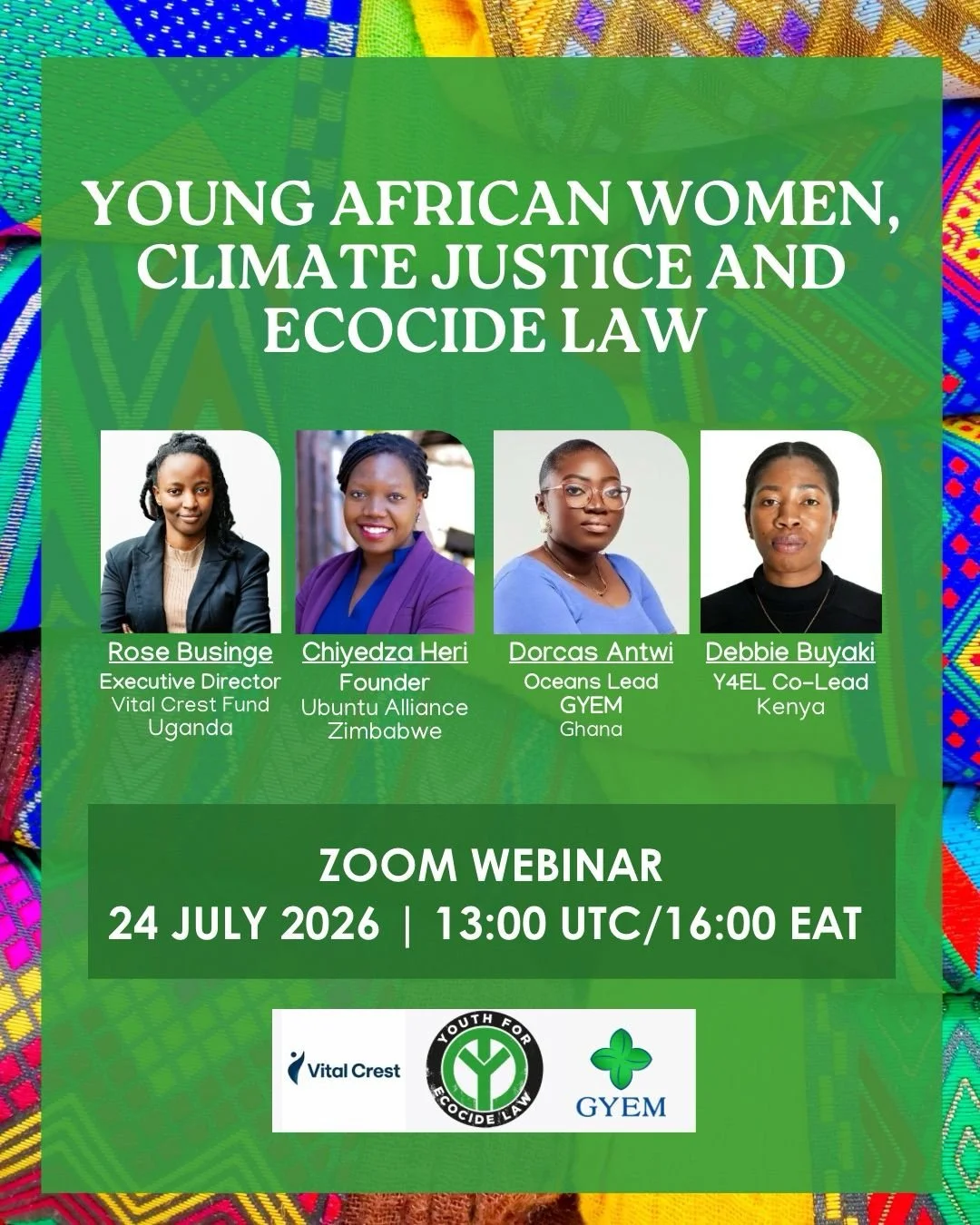
Young African Women, Climate Justice and Ecocide Law
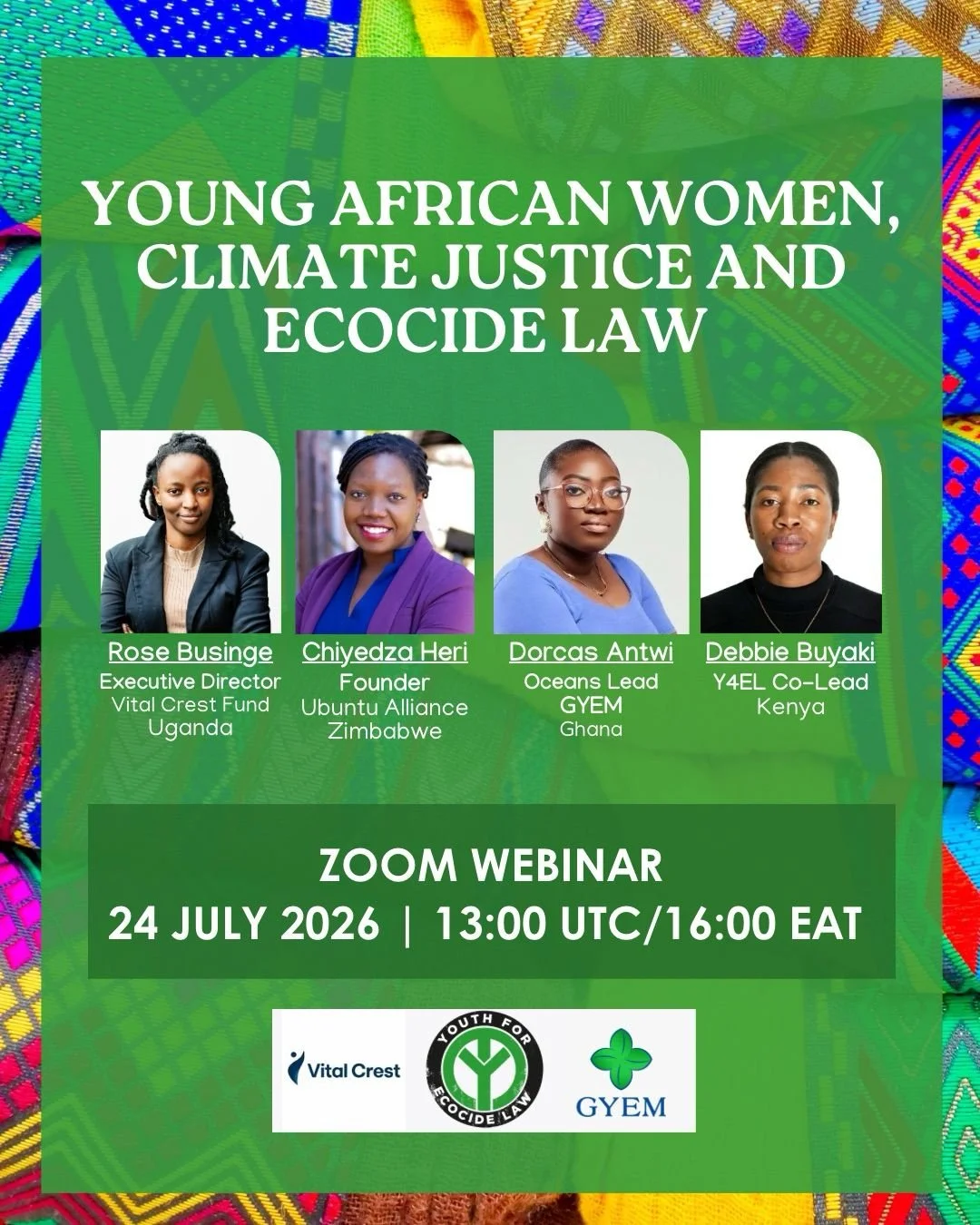
Friday, 24 July 2026, 3:00 PM (WAT)/ 5:00 PM (EAT)
To mark the International Day of Women and Girls of African Descent, Youth for Ecocide Law (Y4EL) and the Vital Crest Foundation (VCF) are convening a strategic panel discussion exploring the nexus of land governance, environmental degradation, and emerging legal frameworks.
This webinar explores how criminalizing ecocide can safeguard ecosystems and the women who steward them. The panelists aim to address these interconnected challenges by bridging grassroots experiences with international legal avenues.
Our Panel:
Rose Kobusinge (Moderator) – Executive Director, VCF.
Debbie Buyaki – Global Co-Lead, Y4EL.
Chiyedza Heri – Founder & CEO, Ubuntu Alliance.
Dorcas Antwi -- Oceans Lead, Ghana Youth Environmental Movement
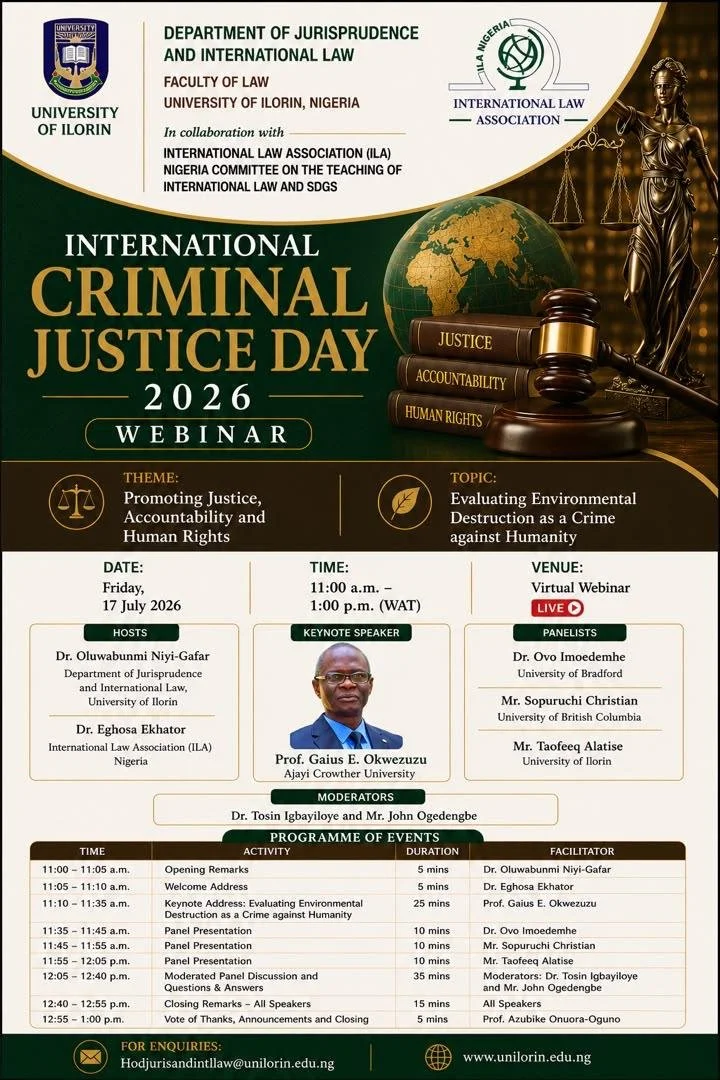
Promoting Justice, Accountability and Human Rights; Evaluating Environmental Destruction as a Crime against Humanity
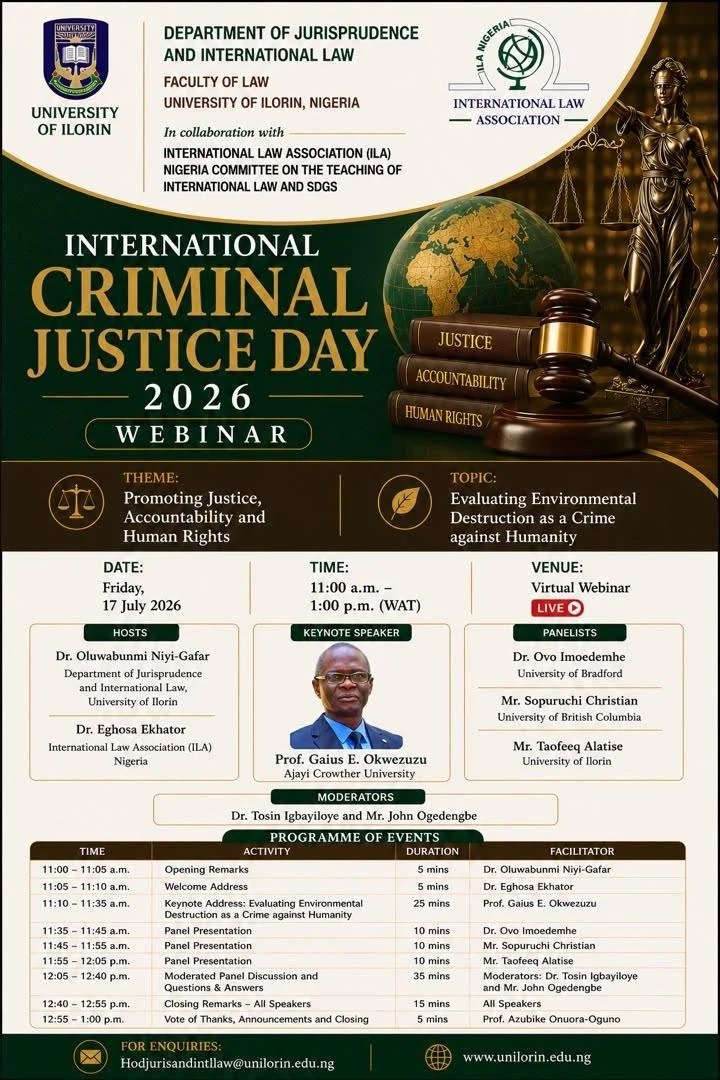
Friday, 17th July 2026, 11am - 1pm (WAT)
To mark International Criminal Justice Day 2026, the Department of Jurisprudence & International Law at the University of Ilorin, Nigeria, in collaboration with the International Law Association (ILA) and the Nigeria Committee on the Teaching of International Law & SDGs, will host a special panel event exploring environmental destruction as a crime against humanity, as part of this year’s theme, ‘Promoting Justice, Accountability and Human Rights’.
Hosts:
Dr Oluwabunmi Niyi-Gafar, Department of Jurisprudence and International Law, University of Ilorin
Dr Eghosa Ekhator, International Law Association (ILA) Nigeria
Moderators:
Dr Tosin Igbayiloye
Mr John Ogedengbe
Keynote Speaker:
Professor Gaius Okwezuzu from Ajayi Crowther University and Co-founder End Ecocide Nigeria
Panelists:
Dr Ovo Imoedemhe, University of Bradford
Mr Sopuruchi Christian, University of British Columbia
Mr Taofeeq Alatise, University of Ilorin
After registering, you will receive a confirmation email confirming joining instructions.
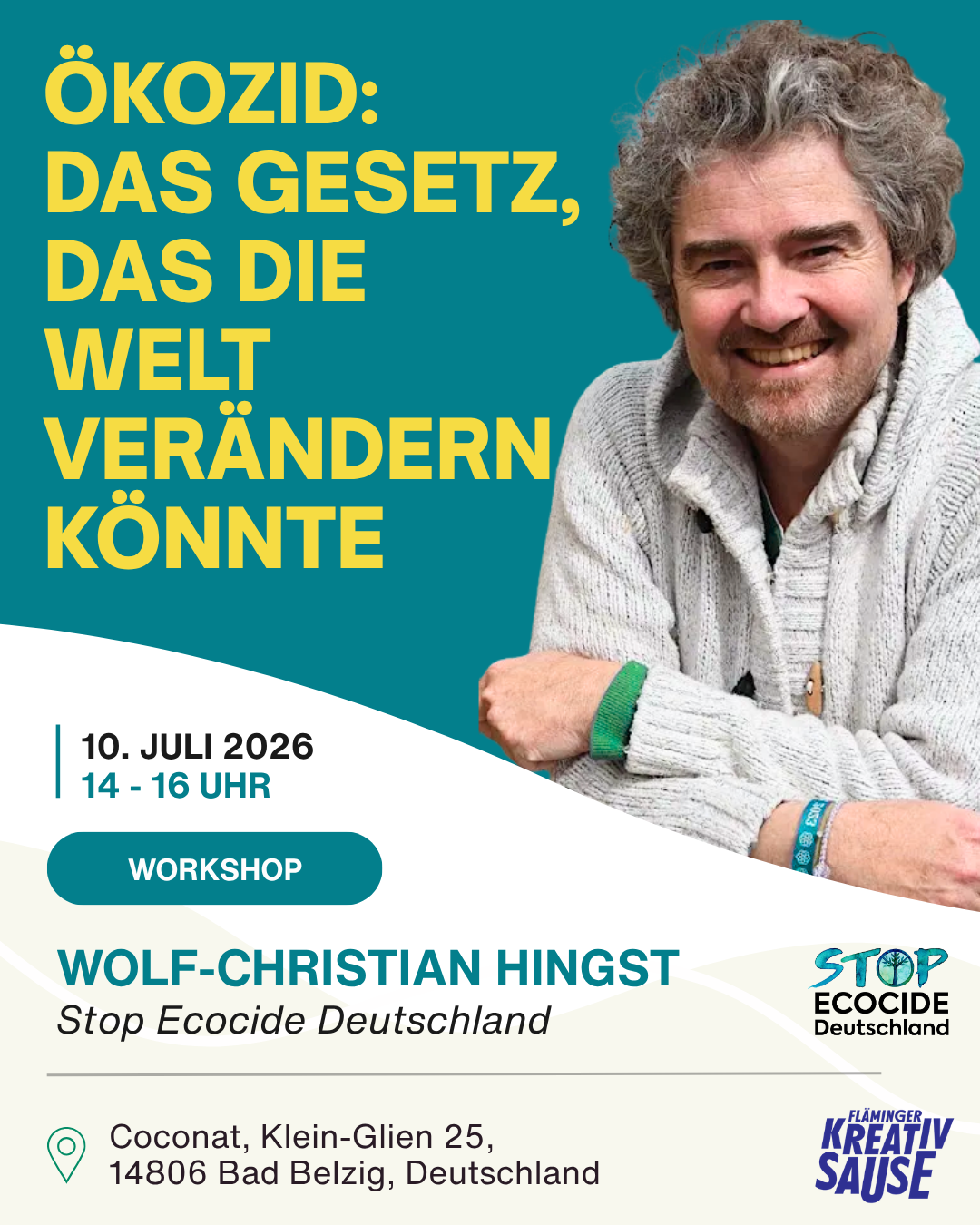
Ökozid: Das Gesetz, das die Welt verändern könnte
Stell dir vor, die großflächige Zerstörung der Natur wäre kein bloßes 'Vergehen' mehr, sondern ein internationales Verbrechen – auf einer Stufe mit Völkermord. Genau das ist das Ziel des internationalen Ökozid-Konzepts. Wir tauchen tief ein in das Konzept von Stop Ecocide. Die Definition, der Schutzfaktor, der Hebel für Deutschland.
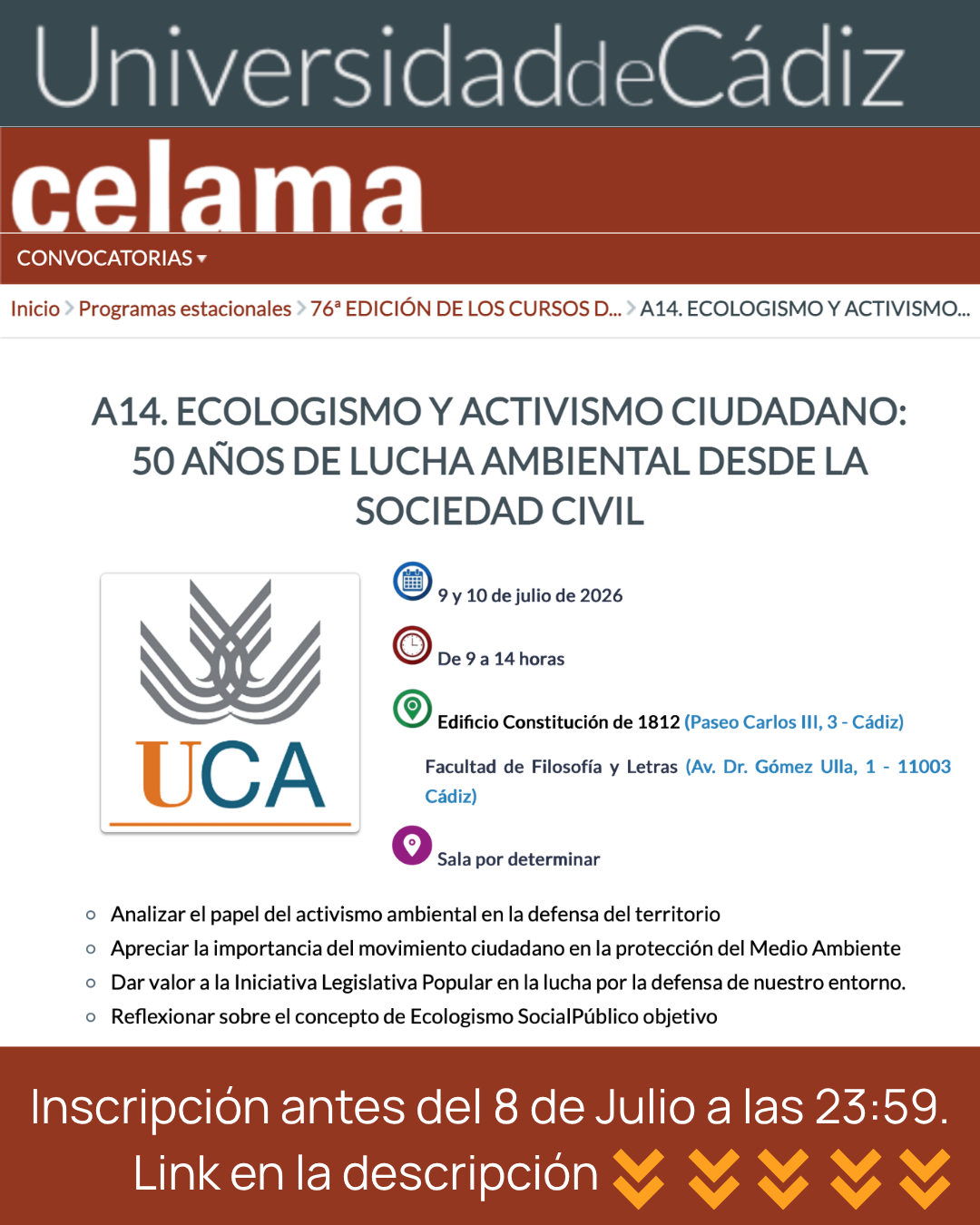
ECOLOGISMO Y ACTIVISMO CIUDADANO: 50 AÑOS DE LUCHA AMBIENTAL DESDE LA SOCIEDAD CIVIL
El ecologismo ha sido uno de los movimientos sociales más relevantes de las últimas décadas, articulando respuestas ciudadanas frente a la degradación ambiental, el cambio climático y la pérdida de biodiversidad. En Andalucía, el movimiento ecologista ha tenido un papel clave en la defensa del territorio, los espacios naturales y la justicia ambiental. En este contexto, el 50 aniversario de AGADEN- Ecologistas en Acción representa una oportunidad para reflexionar sobre la evolución del ecologismo, su dimensión social y su papel en la construcción de alternativas sostenibles.
German Parliament: Hearing on the amendment of environmental criminal law
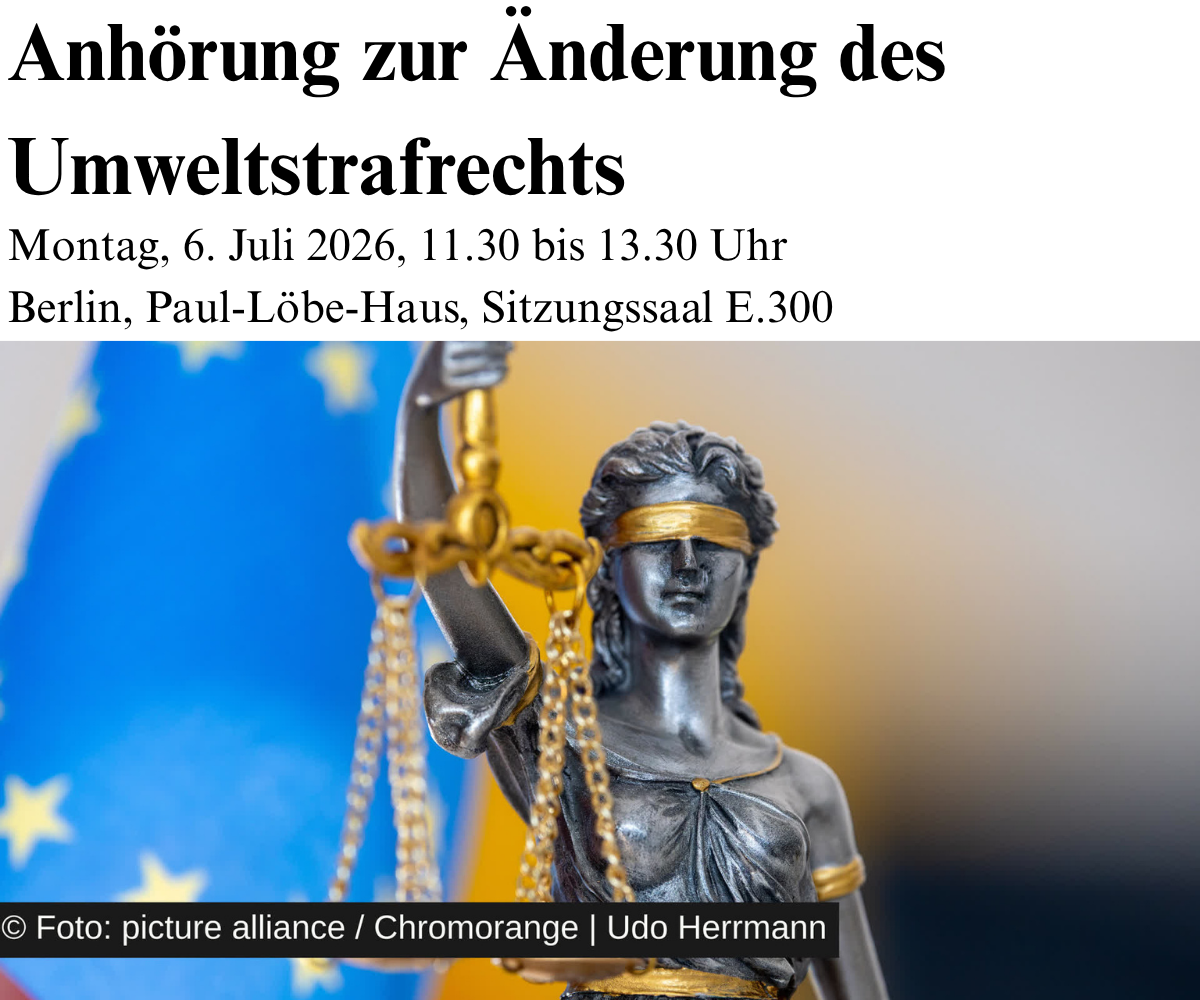
Der Ausschuss für Recht und Verbraucherschutz hat sich am Montag, 6. Juli 2026, in einer zweistündigen öffentlichen Anhörung mit dem Gesetzentwurf der Bundesregierung zur Änderung des Strafrechts – Umsetzung der Richtlinie (EU) 2024/1203 über den strafrechtlichen Schutz der Umwelt sowie zur Änderung der Zustellungspauschalen und Gebühren im Gesetz über Ordnungswidrigkeiten und in den Justizkostengesetzen (21/6133) befasst. Der Entwurf stieß bei den sieben eingeladenen Sachverständigen auf ein geteiltes Echo. Strittig war vor allem die Frage, ob die Umsetzung in deutsches Recht über das europarechtlich gebotene Maß hinausgehen solle.
Der Entwurf sieht die Umsetzung von EU-Vorgaben im Umweltstrafrecht vor. Unter anderem besteht laut Bundesregierung Umsetzungsbedarf im Kernstrafrecht sowie in einigen strafrechtlichen Nebengesetzen. So müsse für die meisten der vorhandenen Tatbestände eine Versuchsstrafbarkeit eingeführt und das Strafmaß angehoben werden. Einige Elemente der Richtlinie seien zudem neu für das deutsche Strafrecht, so zum Beispiel die Einbeziehung von „Ökosystemen“ als zusätzliches Umweltmedium.
Gegenstand der Anhörung war zudem ein Antrag der Fraktion Die Linke mit dem Titel „Unsere Zukunft schützen – Ökozid verhindern“ (21/6362). Darin fordert die Fraktion unter anderem, Ökozid – also die systematische Zerstörung von Ökosystemen sowie die schwere und langwierige Beschädigung oder Zerstörung der Umwelt – als Straftatbestand in das deutsche Umweltstrafrecht aufzunehmen.
Eingeladene Experten:
Wolf-Christian Hingst, Stop Ecocide Deutschland
Peer Cyriacks, Programmleiter Wald, WWF Deutschland
Hauke Dierks, DIHK | Deutsche Industrie- und Handelskammer
Prof. Dr. Dr. h.c. Martin Heger, Lehrstuhl für Strafrecht, Strafprozessrecht, Europäisches Strafrecht und Neuere Rechtsgeschichte, Humboldt-Universität zu Berlin
Prof. Dr. Dr. h.c. Michael Kubiciel, Universität Augsburg, Lehrstuhl für Deutsches, Europäisches und Internationales Straf- und Strafprozessrecht, Medizinund Wirtschaftsstrafrecht
Felix Rettenmaier, Rechtsanwalt
Dr. Stephan Sina, Ecologic Institut
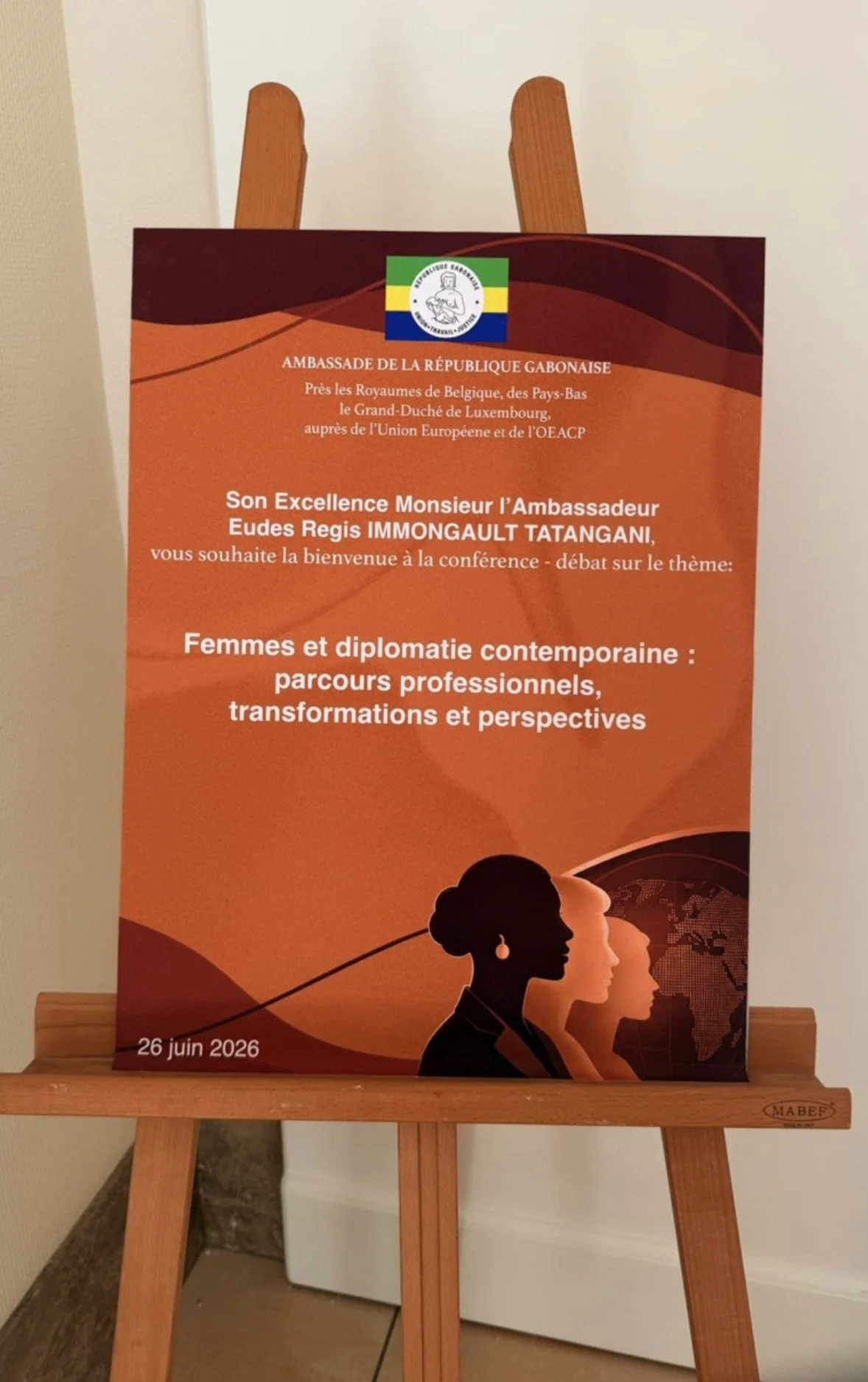
Women and Contemporary Diplomacy: Career Paths, Changes, and Prospects
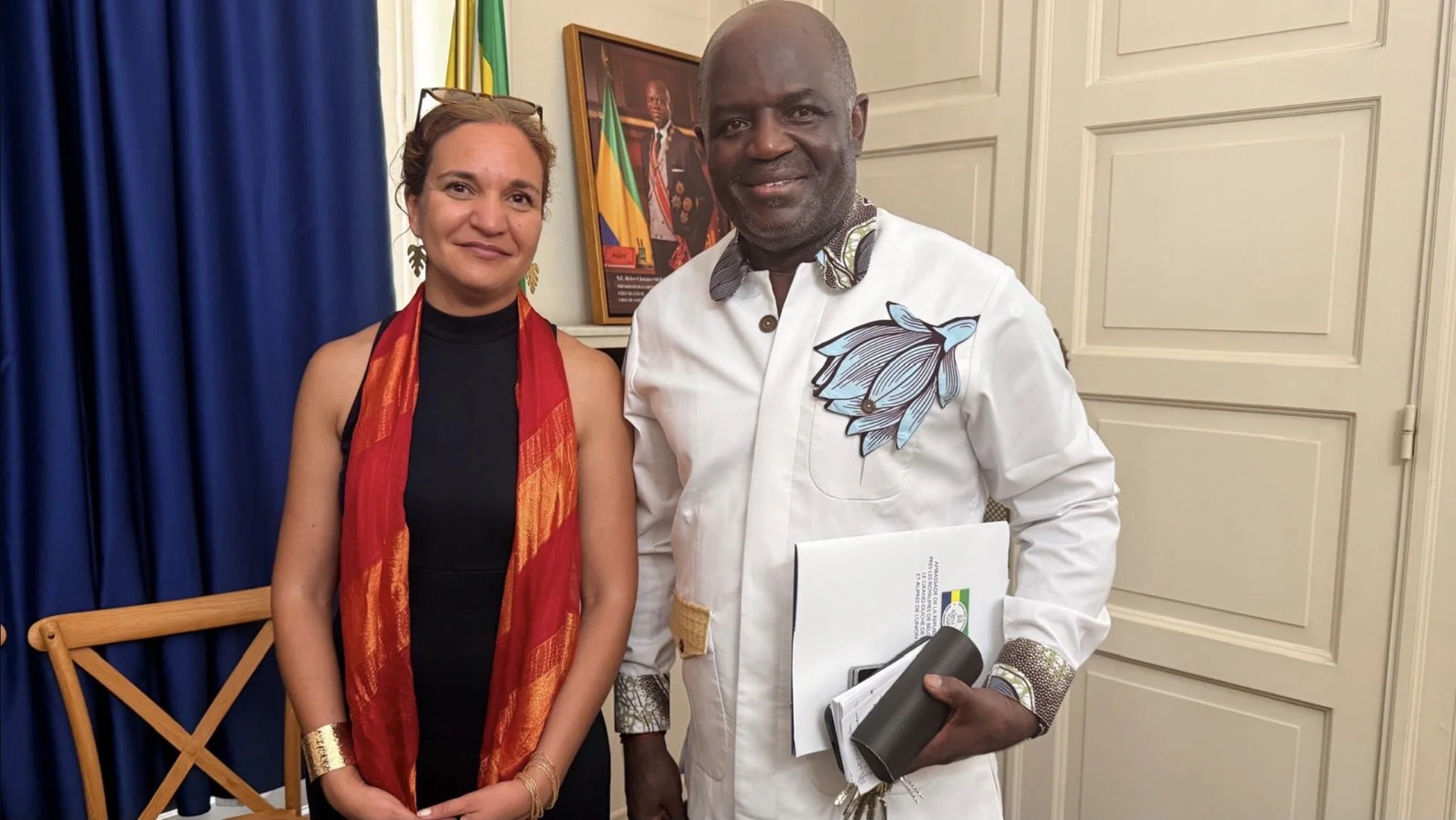
Organised by the Embassy of Gabon in Belgium
Recognising ‘Ecocide’ as a Crime: Local and Regional Governance on the Front Line of Severe Environmental Destruction
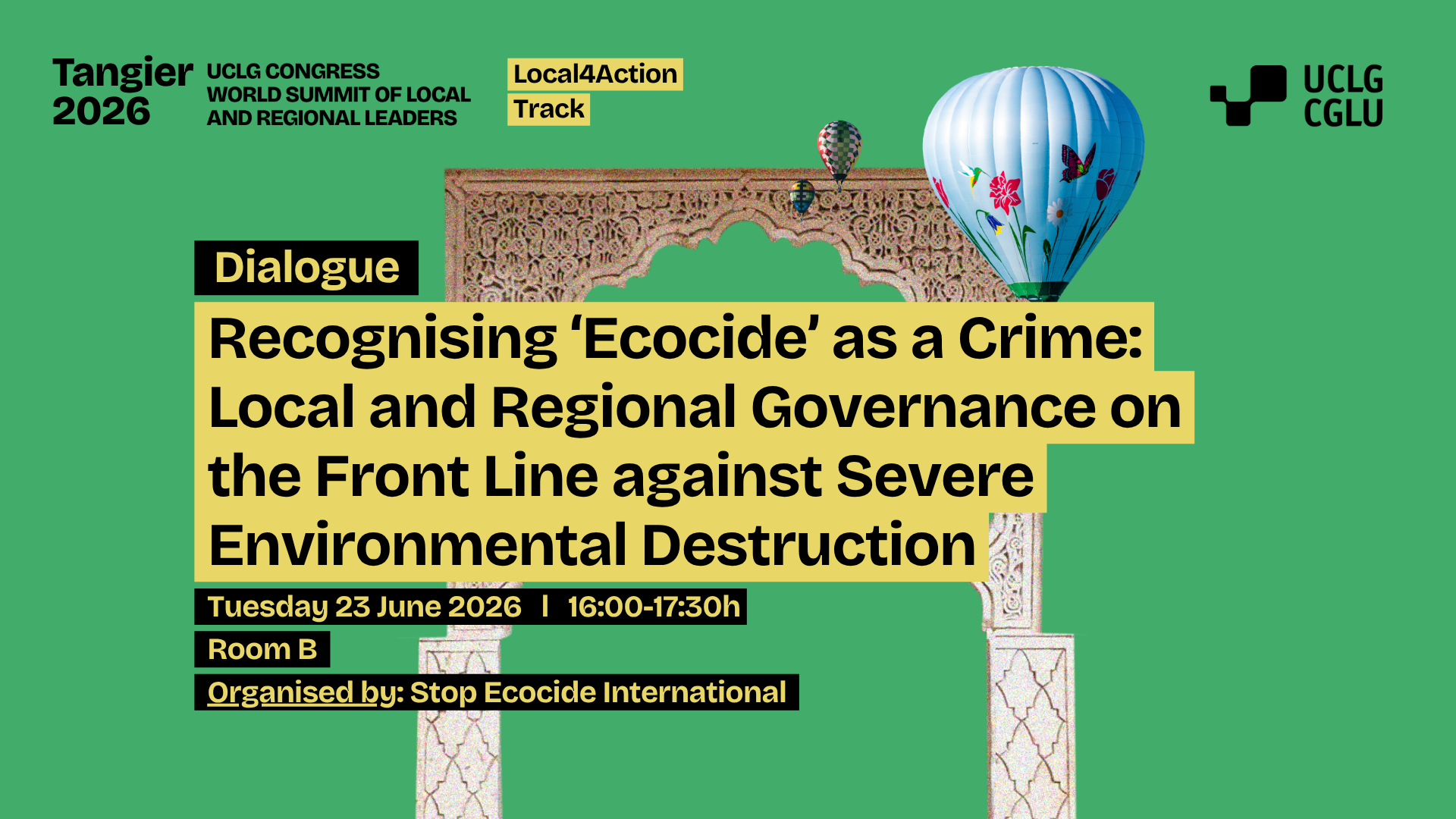
This interactive dialogue aims to highlight the role of local and regional government in preventing, criminalising and responding to severe environmental destruction (ecocide). It is the aim of this session to platform the perspectives and expertise of both organisations working at the intersection of local governance, climate justice and conflict prevention, as well as political representation, with first-hand knowledge of the impact of environmental destruction and international law.
By platforming these perspectives, the session aims to dispel the misconception that severe ecological harm happens in remote locations and only impacts nature, instead outlining the catastrophic consequences of ecocide on communities, situating LRG on the front line of response to environmental disasters. Using an interactive thinking exercise and structured dialogue, the session will give attendees a clear understanding of what ecocide law is and the role it could play in preventing environmental destruction and ensuring accountability for harm.
Moderator: Lauren Banham, Stop Ecocide
Speakers:
Jai-Ayla Sutherland, Peace in Our Cities
Mayor Cristian Zamora, Mayor of Cuenca, Ecuador
Abdallah Anati, Association of Palestinian Local Authorities (APLA)
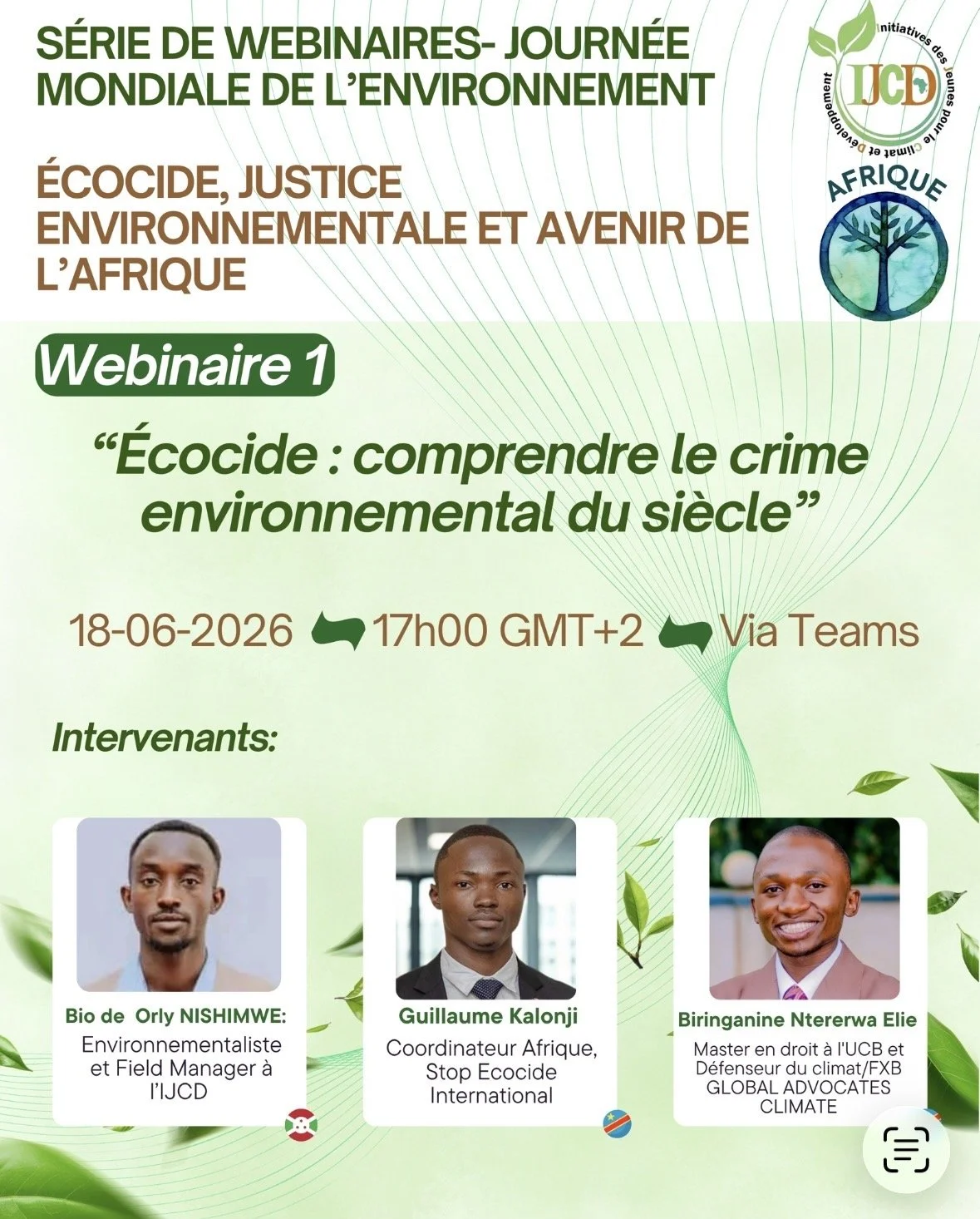
Écocide : comprendre le crime environnemental du siècle
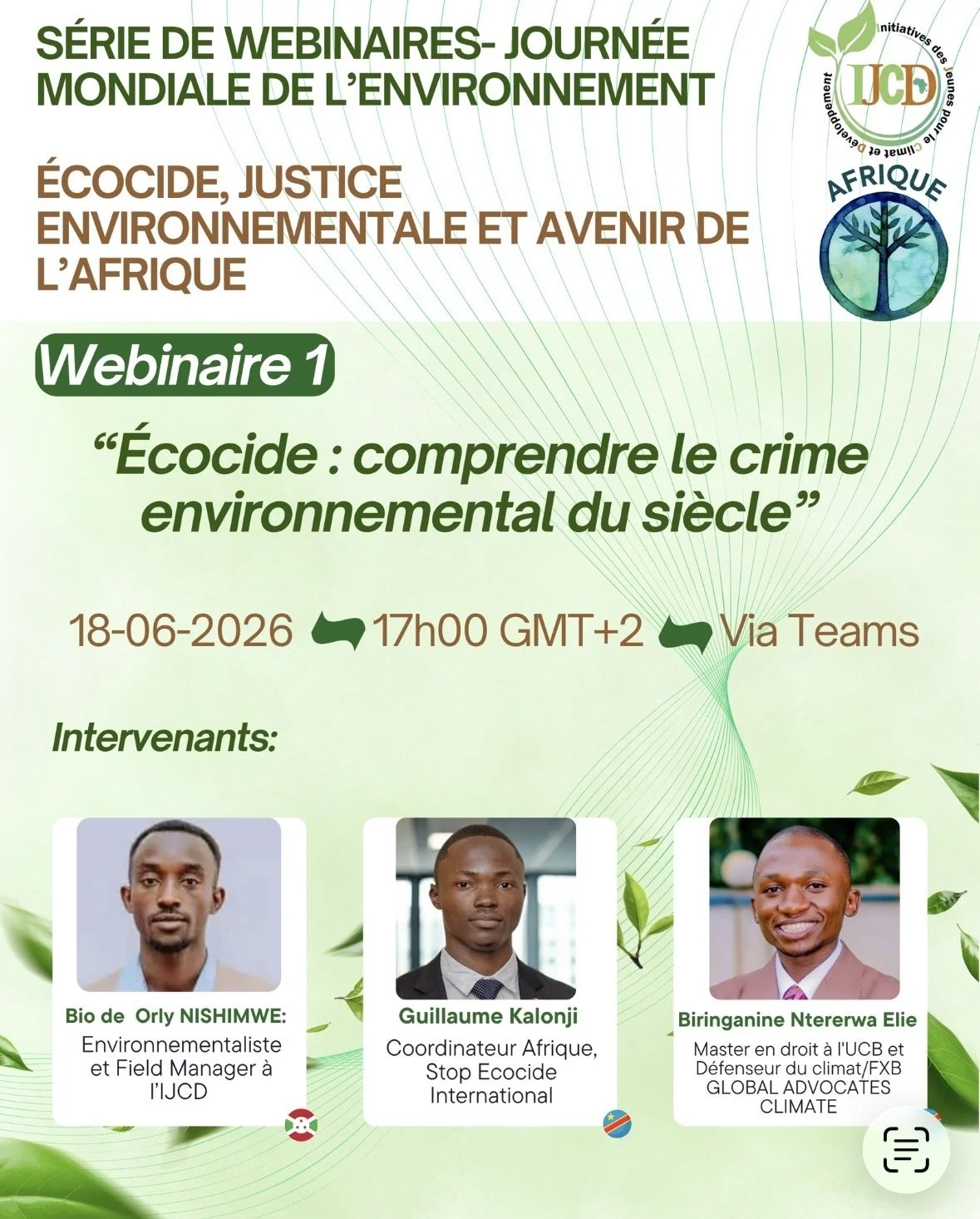
As part of the celebration of World Environment Day this June, Burundian civil society, through the Initiative des Jeunes pour le Climat et le Développement (IJCD), is organizing a series of three webinars dedicated to the Stop Ecocide campaign.
This initiative aims to help young people and local communities better understand the concept of ecocide, the progress achieved by the campaign across Africa, and the critical role that Burundian and African youth can play in advancing this cause.
The three sessions will focus on introducing the concept of ecocide, highlighting recent developments and achievements of the movement across Africa, and exploring the various ways in which young people can engage in advocacy and environmental protection efforts.
These webinars are part of broader efforts to support ongoing government initiatives aimed at exploring pathways for the formal recognition of ecocide as a crime at both the national and international levels.
The webinars will bring together young people from different sectors of Burundian civil society, while also benefiting from the participation and support of youth leaders from other African countries, including the Democratic Republic of the Congo, Senegal, Cameroon, and several others committed to environmental protection and climate justice.
Through this webinar series, IJCD seeks to strengthen awareness, inspire youth engagement, and contribute to building a strong African movement advocating for the recognition of ecocide as an international crime.

Our Ocean Conference 2026: Gallifrey Foundation Exhibition

Our Ocean Conference is an invitation-only conference, bringing together leaders from government, science, civil society and the private sector to accelerate Ocean action and turn collective ambition into meaningful progress.
With a group of other Ocean-focused allies, co-ordinated by Gallifrey Foundation, Stop Ecocide International will be taking part in an exhibition which pairs major Ocean threats with the organisations and movements actively working to reverse them. As well as spotlighting ecocide law and corporate accountability, it will explore the legal architecture of Ocean rights, shark depletion, deep seabed mining, plastic pollution and gender inequality in Ocean governance.
Aside from the coordinators, Gallifrey Foundation, our partners in this exhibition are Ocean Vision Legal, The Ocean and Us, She Changes Ocean, Sharkline and Pave Nigeria.


Young People Shaping Ecocide Law: Keynote Address by Jojo Mehta, CEO of Stop Ecocide International
About Youth for Ecocide Law
Youth for Ecocide Law (Y4EL) is the youth constituency within the global movement to recognise ecocide as the fifth international crime at the International Criminal Court. Founded in 2021, Y4EL operates under Stop Ecocide International and unites youth advocates across Europe, Africa, the Americas, Asia, and Oceania. It translates legal and policy debates on ecocide into accessible campaigns, webinars, and creative material, and sustains a global network dedicated to environmental justice.
Context
World Environment Day 2026 arrives at a moment when international environmental law moves faster than at any point in the last decade. On 18 April 2026, Mauritius criminalised ecocide through section 135A of its Environment Act, with penalties of up to ten years' imprisonment. Mauritius joins a growing list of jurisdictions that have moved to criminalise severe environmental destruction. The Vanuatu, Fiji, and Samoa proposal to add ecocide as the fifth crime under the Rome Statute, formally tabled in September 2024, now sits before the ICC Working Group on Amendments. The 2025 ICJ and IACtHR advisory opinions confirm that states carry binding obligations to prevent severe environmental harm.
Africa and Small Island Developing States lead the way. At the 20th African Ministerial Conference on the Environment in 2025, governments named ecocide a continental priority for 2025 to 2027. At the UN Africa Summit in July 2025, the Democratic Republic of Congo, the Republic of Congo, Burundi, Ghana, Zambia, and Zimbabwe advanced their alignment with ecocide law through domestic or diplomatic pathways. The DRC’s 2024 endorsement of the Pacific-led ICC proposal opened the door to broader African engagement. Pacific Small Island Developing States continue to anchor the international track.
Multiple legal frontiers now converge. The Pacific Islands Students Fighting Climate Change and World Youth for Climate Justice campaigns drove the ICJ Advisory Opinion process from the start, and the UN General Assembly adopted the founding resolution by consensus for the first time. The First International Conference on Transitioning Away from Fossil Fuels, held in Santa Marta in April 2026, drew 57 countries and signalled the road to a binding fossil fuel treaty. The High Seas Treaty entered into force on 17 January 2026, with the first Conference of the Parties to follow. Criminal law sits at the intersection of these processes.
Objectives
This webinar brings together a keynote address and youth voices from Africa, Latin America, and Europe on the day the international community sets aside to protect the planet. The webinar aims to:
• Hear directly from Jojo Mehta on the latest institutional, diplomatic, and legislative advances in the movement to criminalise ecocide.
• Connect the keynote to youth perspectives on recent breakthroughs from advocates within the Y4EL network, drawing on legal, regional, and intergovernmental perspectives.
• Launch the call for the 2027 Y4EL Core Team and invite young advocates to join the movement.
Speakers
Jojo Mehta, Co-Founder & CEO, Stop Ecocide International
Samira Ben Ali, World Youth for Climate Justice; European Climate Pact Ambassador, Mayotte/France
Thomas Csillag Finger, Stop Ecocide Student Ambassador, Brazil
Guillaume Kalonji, Y4EL Africa; Stop Ecocide International, DRC
Debbie Buyaki, Y4EL Co-Lead and Co-Founder, Y4EL Africa, Kenya
Niccolò Delporto, Y4EL Core Team Member, Italy
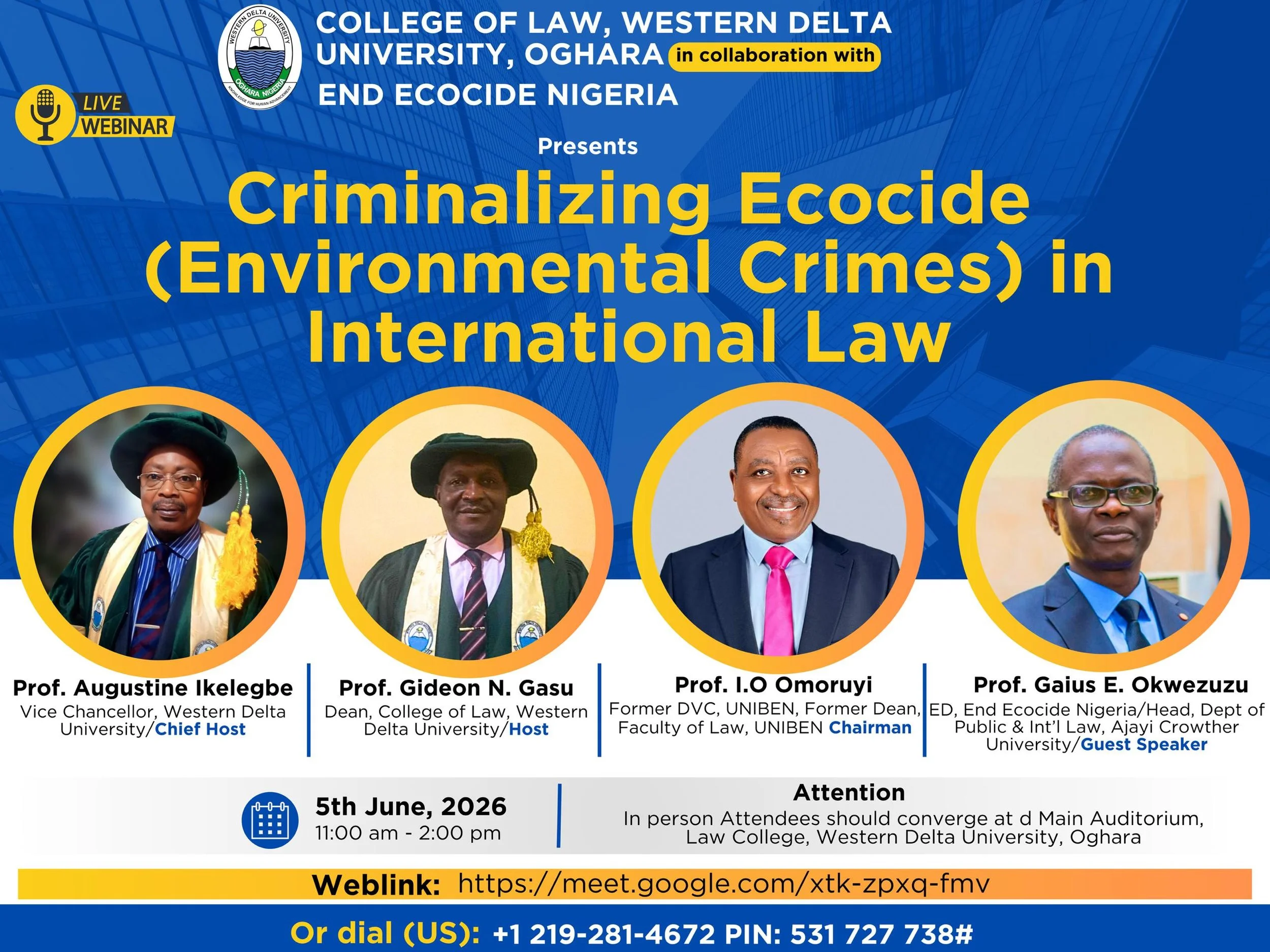
Criminalizing Ecocide (Environmental Crimes) in International Law
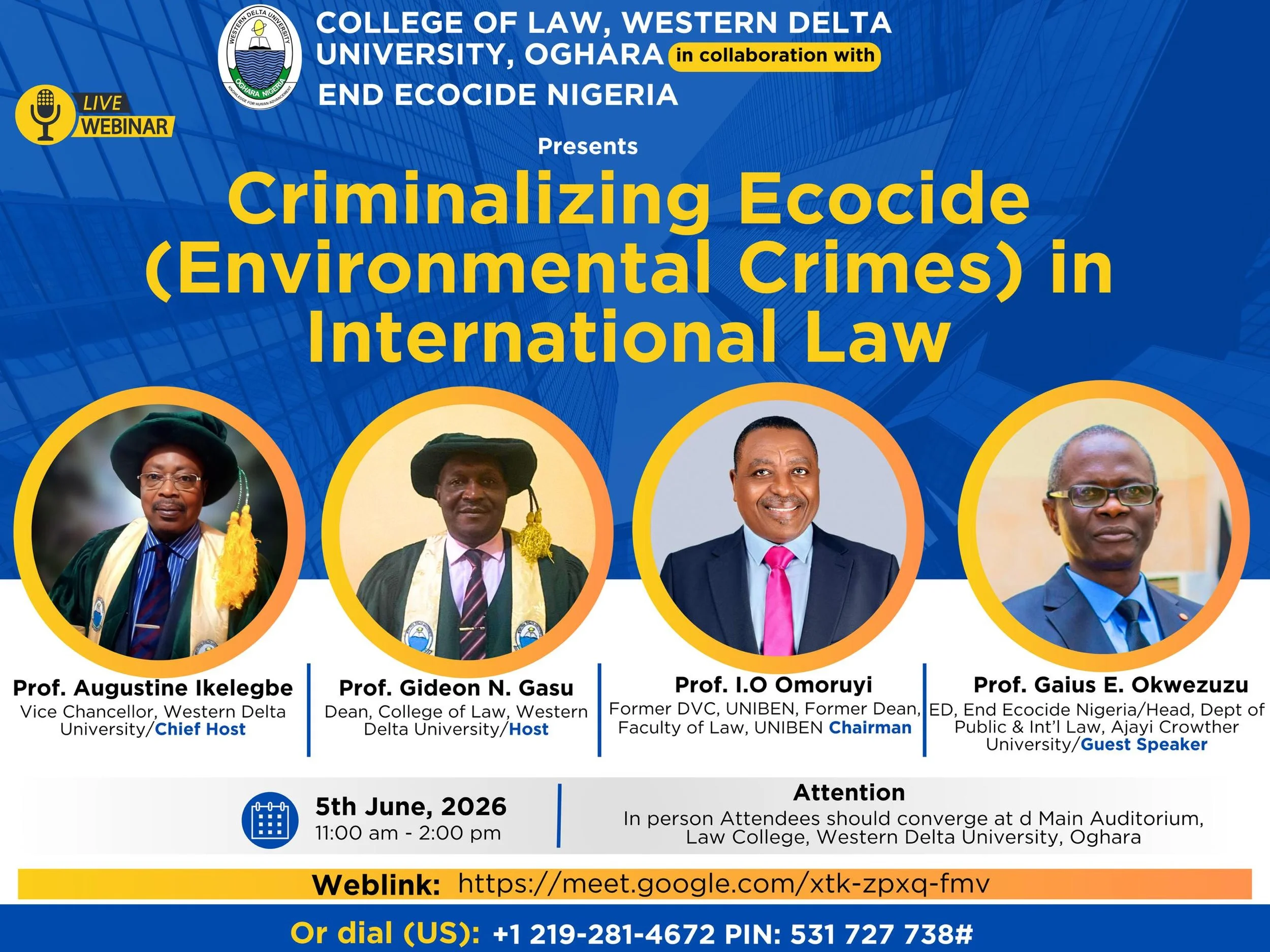
COLLEGE OF LAW, WESTERN DELTA UNIVERSITY, OGHARA in collaboration with END ECOCIDE NIGERIA
Date and time: 05/06/2026 11:00-14:00 (BST)
Event type: Hybrid (webinar/in person)
Hosted by: COLLEGE OF LAW, WESTERN DELTA UNIVERSITY, OGHARA in collaboration with END ECOCIDE NIGERIA
In person Attendees should converge at Main Auditorium, Law College, Western Delta University, Oghara.
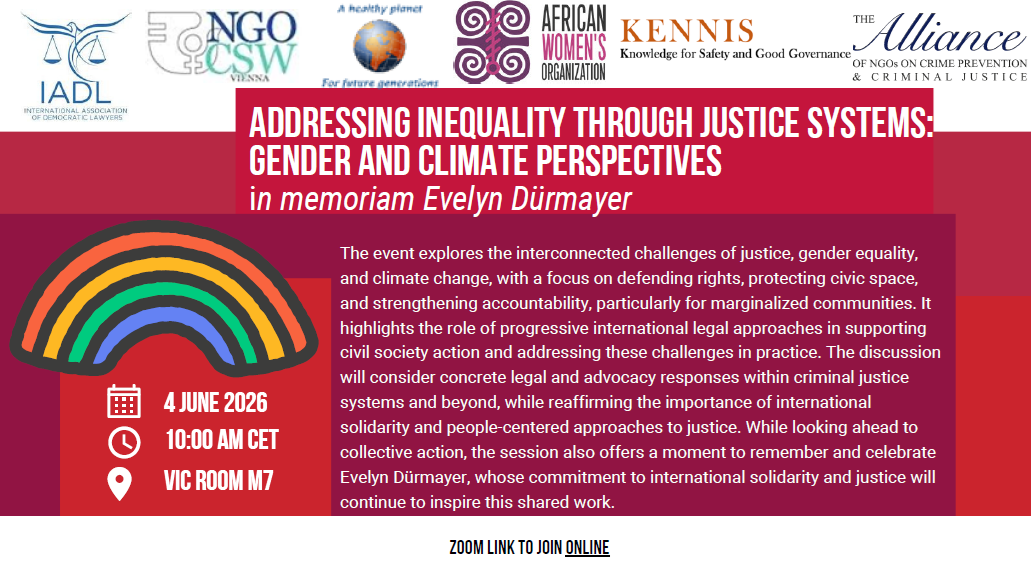
Addressing Inequality Through Justice Systems: Gender and Climate Perspectives. In Memoriam Evelyn Dürmayer
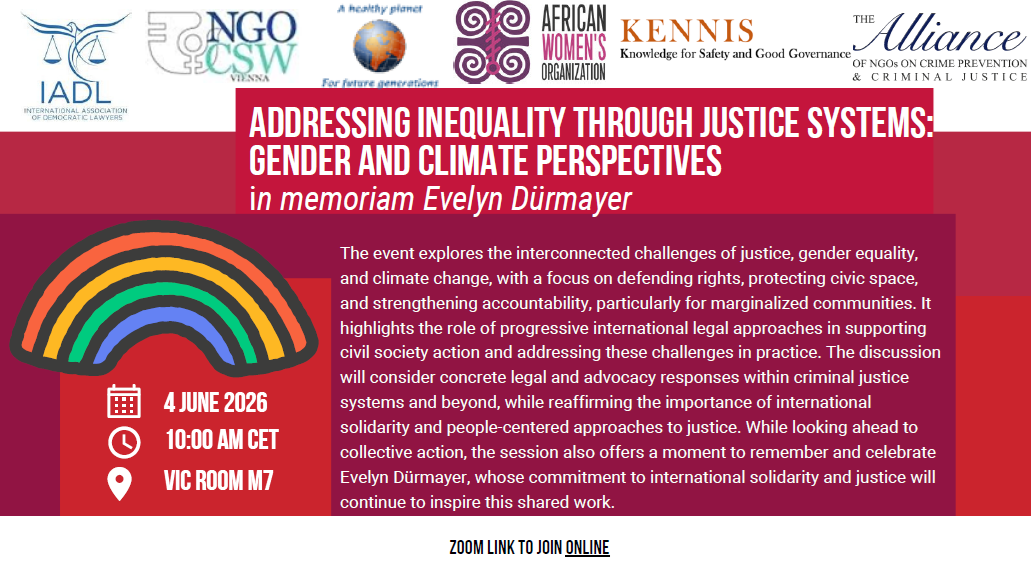
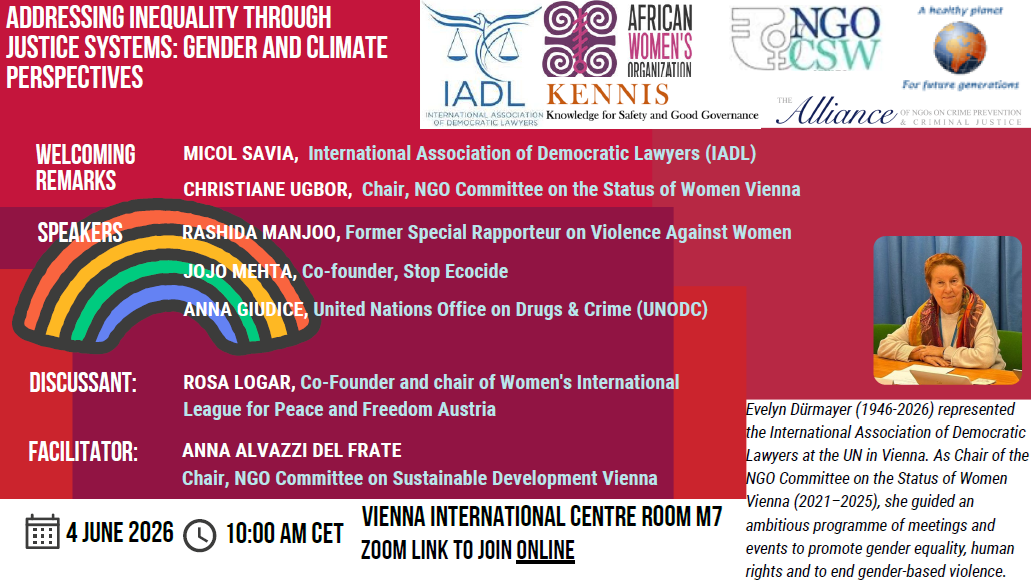
Side event at CCPCJ 2026, Thursday 4 June, 10 -11am CET.
Vienna International Centre, Room M7, hybrid event.
Co-organizers: Afrikanische Frauenorganisation, Alliance of NGOs on Crime Prevention and Criminal Justice, NGO Committee on the Status of Women Vienna, NGO Committee on Sustainable Development Vienna, Kennis: Knowledge for Safety and Good Governance
The event explores the interconnected challenges of justice, gender equality, and climate change, with a focus on defending rights, protecting civic space, and strengthening accountability, particularly for marginalized communities. It highlights the role of progressive international legal approaches in supporting civil society action and addressing these challenges in practice. The discussion will consider concrete legal and advocacy responses within criminal justice systems and beyond, while reaffirming the importance of international solidarity and people-centered approaches to justice. While looking ahead to collective action, the session also offers a moment to remember and celebrate Evelyn Dürmayer, whose commitment to international solidarity and justice will continue to inspire this shared work.
Speakers:
Rashida Manjoo, Former Special Rapporteur on Violence Against Women
Jojo Mehta , Co-founder, Stop Ecocide, Stop Ecocide International
Anna Guidice , United Nations Office on Drugs & Crime (UNODC)
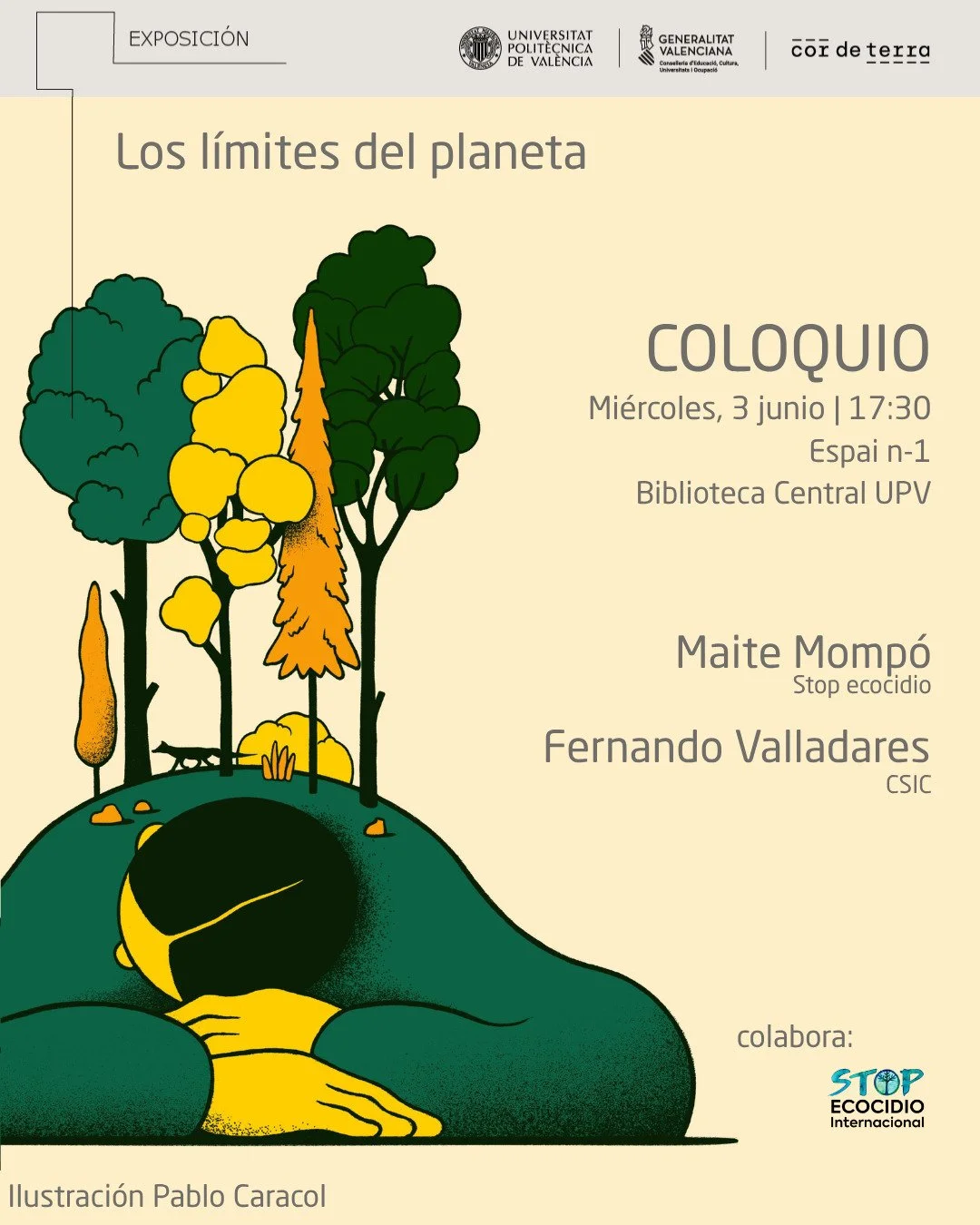
Los límites del planeta
Time: 17:30 CET
Venue: Espai n-1, UPV Central Library
Panel title: Discussion Panel on the Planet Boundaries
Speakers:
• Fernando Valladares (PhD in Biology, CSIC researcher and lecturer at Rey Juan Carlos University, Madrid)
• Maite Mompó (Director of Stop Ecocide International’s Spanish language)
This Discussion Panel is part of the programme of events organised during the two-month run of the ‘Planetary Boundaries’ exhibition, hosted at the Polytechnic University of Valencia.
A special community screening: The People’s Emergency Briefing
Organisers: School of Advanced Study University of London, Institute of Commonwealth Studies
Moderator: Professor Damien Short, Professor of Human Rights and Environmental Justice
Speakers:
Professor Paul Behrens, British Academy Global Professor and expert in food system transformations
Angela Francis, Policy expert in green economics
Jojo Mehta, Co-founder and CEO of Stop Ecocide
International Festival of Wild & Kind Ideas

A 6-day festival featuring 40 inspiring thinkers, doers and creatives from around the world exploring wild and kind ideas.
This event is hosted by Morag Gamble, an acclaimed permaculture educator, speaker, designer, writer, filmmaker, podcaster and humanitarian – founder of the Permaculture Education Institute and the Permaculture Educators Program.
In all of her work, Morag explores how we can live more peacefully and simply so that we may thrive together on this beautiful blue planet.
Speakers:
PELLA THIEL
Creating a bioregional embassy
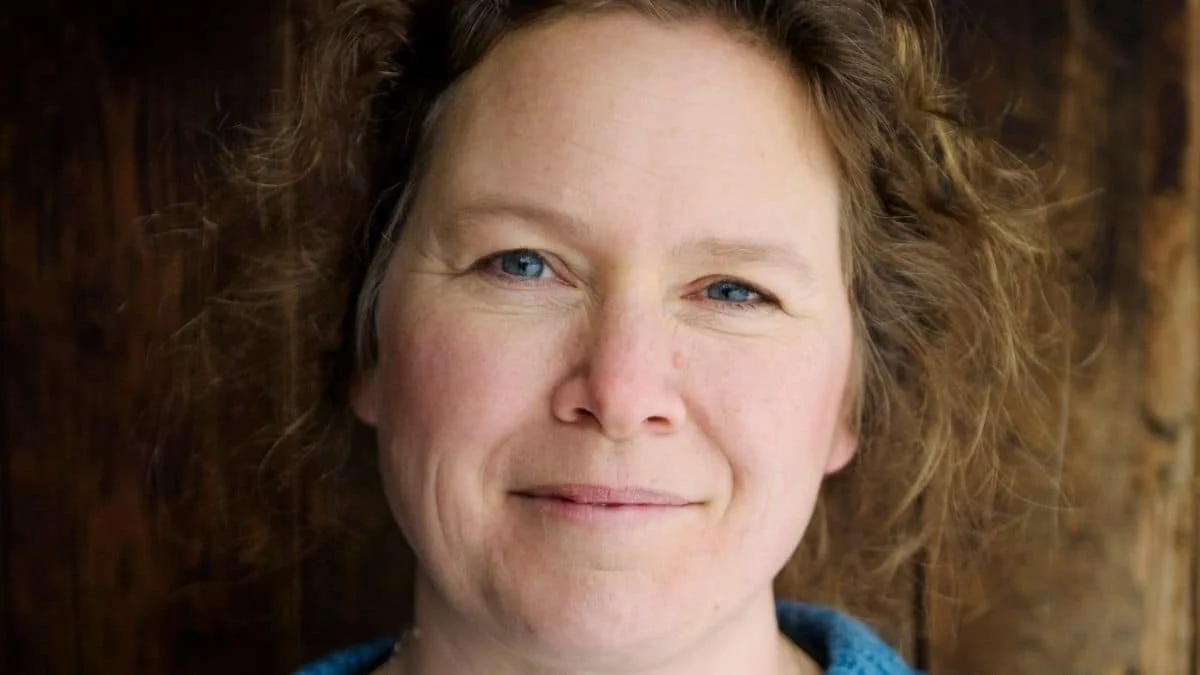
Pella Thiel is a Swedish ecologist, educator, and advocate for the rights of nature. She co-founded End Ecocide Sweden and Transition Sweden, working to integrate ecological perspectives into legal and societal frameworks. As a UN Harmony with Nature expert and author of Naturlagen, Pella promotes Earth-centered governance and has been instrumental in advancing the recognition of ecocide as an international crime. Her efforts have earned her accolades, including the 2023 Martin Luther King Prize and WWF Sweden’s Environmental Hero of the Year in 2019. Through her work, Pella inspires a shift towards a more harmonious relationship between humanity and the natural world.
She is creating the bioregional Embassy of the Baltic Sea focussing on interconnected wellbeing of human society and nature in the Baltic Sea watershed, through recognition of the rights of the sea to flourish, and representation of its more-than-human voices in decision-making.
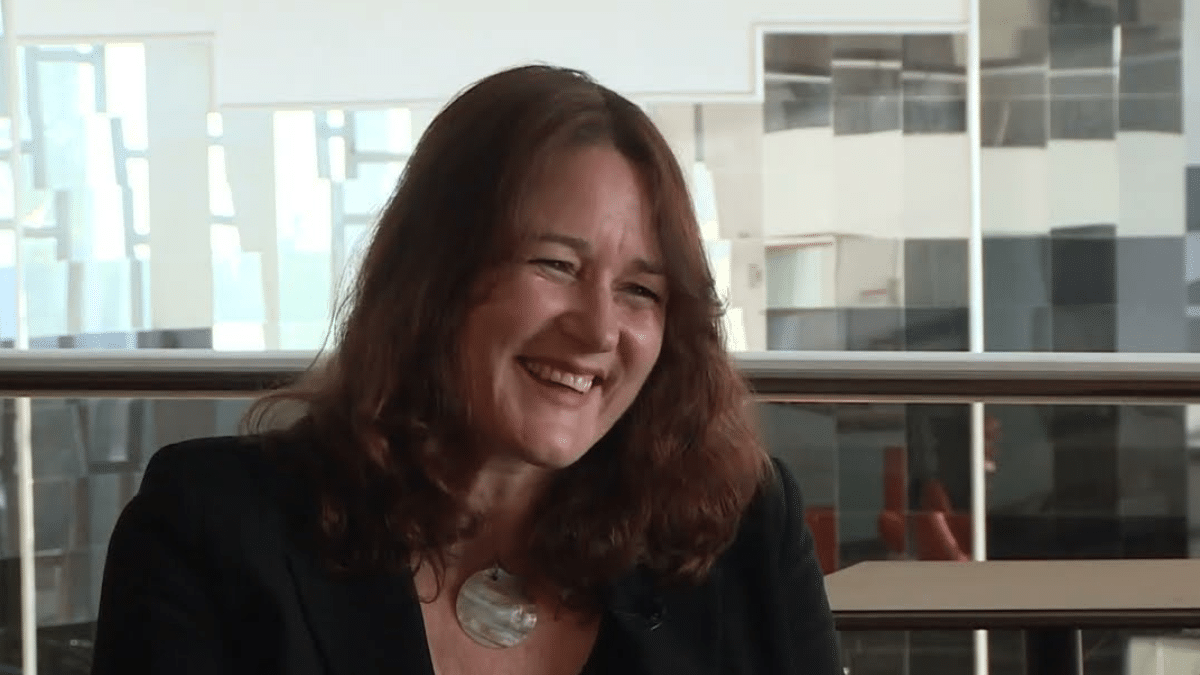
MICHELLE MALONEY
Bioregions and Rights of Nature
Michelle Maloney (PhD) is an Australian Earth lawyer and advocate for bioregional and Earth-centred governance. She is the Co-Founder and National Convenor of the Australian Earth Laws Alliance (AELA), Co-Founder and Director of Future Dreaming Australia, an Indigenous and non-Indigenous partnerships initiative; a UN Harmony with Nature Expert; a member of the Advisory Council of the Global Alliance for the Rights of Nature and an Adjunct Fellow at UTS and Griffith University.
Michelle won an International Peace Women’s Award in 2024 and is widely recognised for her three decades of advocacy for climate action, Rights of Nature and First Laws, bioregioning and Earth-centred initiatives.