
Where the Wildflowers Went: Protecting Living Farmland with Ecocide Law
This guest blog is authored by Lars Veraart, a veterinary surgeon and agroecological peasant farmer. He is the Co-founder of agro-ecological non-profit ALPA, and the Co-founder and director of Provision Transylvania, an example farm and centre for agroecology and non-violence.
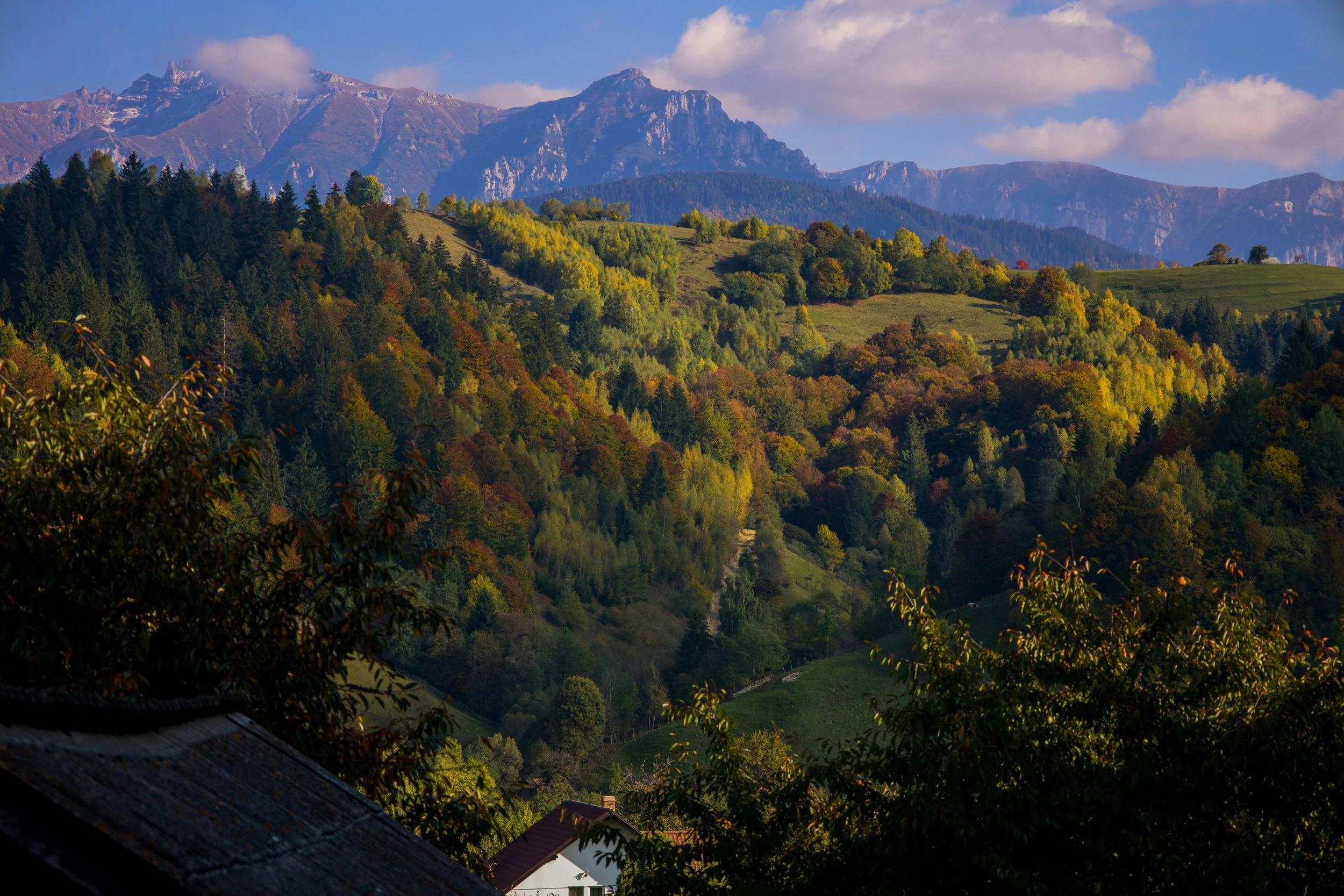
Transylvania. Image credit: Caras Jr via Unsplash.
We have had ecologists from the UK in this field, who cried when they counted the amount of species they found per square meter. I have been told that in the UK there are only 6000 hectares left of such rich biodiversity, most of them created and maintained with high financial input. I try to explain this to one of my neighbours in our Transylvanian village at the foothills of the Western Carpathian Mountains, as he was praising the local, ever-expanding, large-scale farm which has managed to turn the biodiverse hay meadow into a grass monoculture.
I tried to explain the importance of intact ecosystems, of a multitude of wildflowers, herbs, and grasses, of the insects, birds, soil life and how unique such biodiverse hay meadows are in Europe. I try to inform him that we are living inside of an unrecognised treasure here in Transylvania. I tell him that ecologists from western Europe go crazy when doing fieldwork in the hay meadows of Romania and call them the ‘Amazon of Europe.’ I tell him how, as a large animal veterinarian, I came to learn how important a plant medicine rich diet is for animals and that creating a monoculture fodder will result in countless health problems which then need to be solved with big pharma expenses. My neighbour nodded and pointed to the place where a hedgerow used to grow in between the fields we were looking at, which has been taken away by the large farm. “It is a shame that it is gone,” he said. Did I manage to convey my message?
Contemporary, conventional, industrial, large-scale farming is the largest contributor to biodiversity loss and ecosystem destruction. Globally, almost half of all habitable land surface is registered as agricultural land. To me it is clear that the direction we have taken on a global scale with industrial large-scale farming becoming the norm is one of the main areas to focus on when looking at biodiversity loss, mass extinction and ecocide.
Approximately 30% of farmlands in the EU are associated with a high species and habitat diversity and/or the presence of species of European conservation concern. Farming on these lands is called “High Nature Value Farming” and a small portion of the EU subsidies are directed to support low intensity farming that may happen in these areas. If one calls some areas (in this case a minority of 30%), ‘high nature value’, that implies that the majority (70%!) is considered “low nature value.” I then ask myself the questions: “can anyone point out to me which part of nature is of low value?” “Which millions of hectares are considered low value nature?” And how did it happen that we, as a whole, lost to recognition of this value? How did this happen to our perception?” I think that these are essential questions to ponder as we turn toward any potential future we may have with our farming systems, and thus of life on our planet. Why do we make a distinction in law and governance between ‘agriculture land’ and ‘natural areas’?
Why is not all land considered of the highest importance? Why do we not start with the understanding that ALL farming is done in nature that is high in value and that the greatest care for living systems is needed on every single meter square that we live and farm?
I personally don’t know any person who appreciates massive destruction of nature or mass extinction being caused by the way we farm pollution of soil, water and air in disastrous proportions, high chemical farming input which causes health hazards for all life including ourselves. Yet, the farming systems that create exactly these receive the largest bulk of EU subsidies. How did this come to be, that public contributions (taxes) are directed to practices in principle that nobody wants? How has it come to pass that one person, a random large-scale industrial farmer, is pushed, motivated, supported and allowed to single-handedly decide to spray carcinogenic and ecocidal chemicals on tens of thousands of hectares of agricultural land and receive heaps of our collective money for this?
Living in a biodiversity-rich and unique area of Europe and becoming aware of the multitude of damages industrial agriculture is causing, I co-founded ALPA, a non-profit organization which aims to bring back agricultural land into common stewardship and searches for a new generation of agroecological farmers to build localized nature inclusive food systems. We take land out of the commodity market of investments, speculation, and private ownership and make it available for the ones who are willing to bring alternative (life-supporting instead of ecocidal) ways of land use and food production. ALPA stands for “Acces La Pǎmânt pentru Agroecologie”, which translates to ‘Access to Land For Agroecology’.
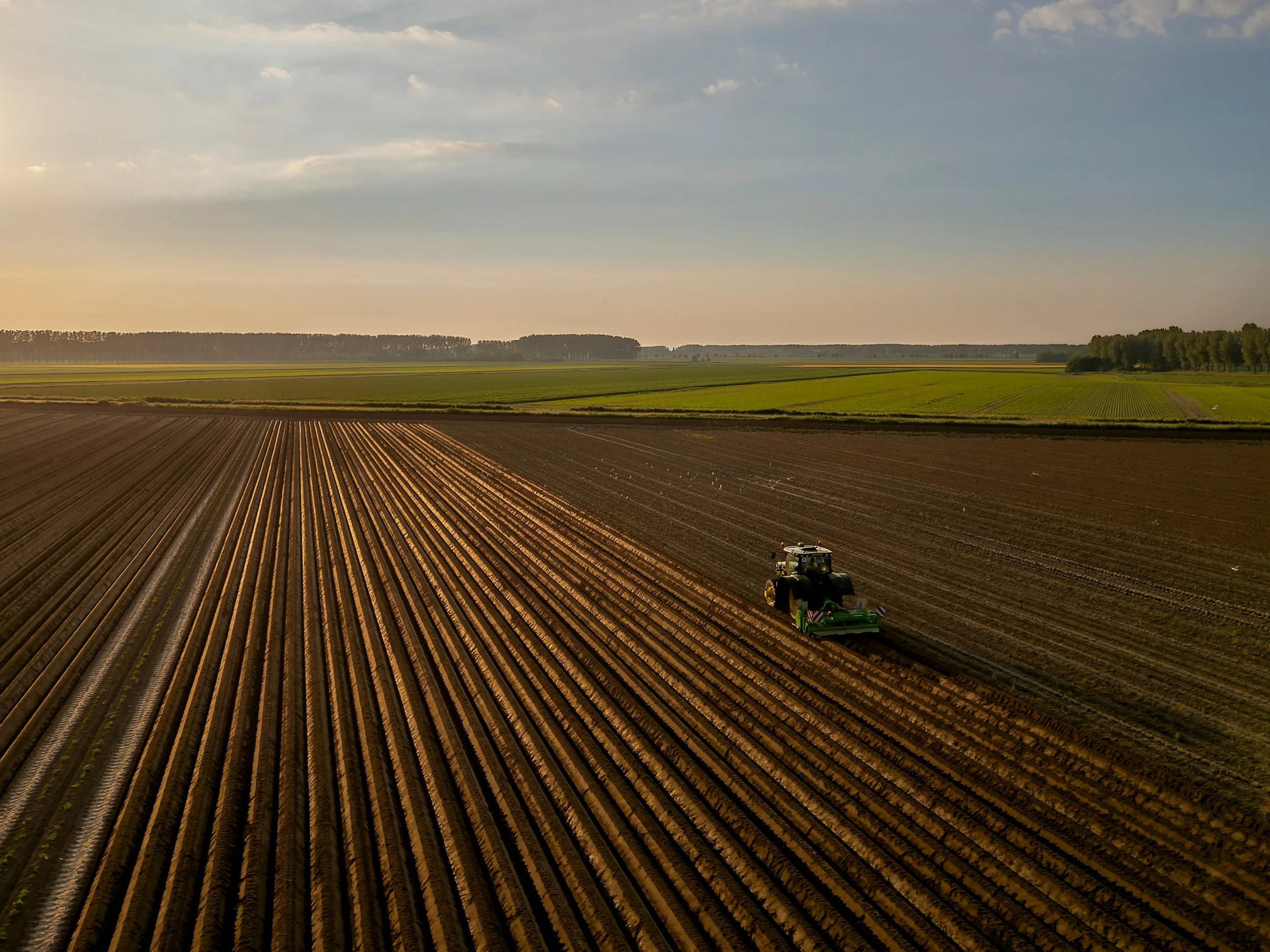
Raised planting beds being prepared on a modern large-scale arable farm in Koewacht, the Netherlands. Image credit: Tom De Decker via Unsplash.
I believe that transitioning on a global scale into local agroecological food systems is crucial in avoiding total ecosystem collapse and that local projects like ALPA are key actors in making such transition happen. That is why I choose to direct my life energy toward such a project. A farmer who is financially obliged and driven by a global food system of international trade laws, corporate food agglomerates and chemical and bioengineering giants, is currently rewarded with loads of our collective financial support. Everything is done to keep this system going in the interest of corporate gain.
What if systems could change. What if the small scale agroecological farmer who produces healthy food while caring for the living environment would be rewarded for this life-saving effort? Such a system change looks like it would help to support nature, while lowering hospital visits… who would not want that?
Every society draws legal lines. We do not rely on education campaigns alone to prevent murder, fraud or slavery; we recognise these acts as so profoundly harmful that we design laws to deter them and hold those responsible to account. The accelerating destruction of the living world raises the same question: at what point does environmental harm become so severe that it, too, brings the strong response that law can offer? Ecocide law is an answer to that question.
Ecocide law is not about criminalising ordinary farmers or honest mistakes. Like the laws against genocide or crimes against humanity, it establishes an outer legal boundary against the gravest harms. Its purpose is to prevent and deter decisions that carry a substantial likelihood of causing severe and either widespread, long-term or irreversible environmental damage, directing accountability towards those with the greatest power to authorise or profit from such destruction. By changing the legal and economic incentives at the top of the system, ecocide law can help create fairer conditions for farmers and land managers who are already working to restore soils, biodiversity and resilient food systems, rather than competing with practices whose environmental costs are borne by everyone else.
My neighbour looks once more at the monoculture grassland. I see his thoughts traveling to his youth and see the images of many small-scale farming villagers working the small parcels of land, creating a mosaic of biodiversity-rich landscape, now almost unrecognizable. The elders are gone, the small agricultural plots are gone, the hedgerows are disappearing, the insects and birds are about to follow. He takes his wooden hayfork and returns to his orchard, where he is manually making species-rich hay, for his last remaining 3 sheep.
It reminds me that another way of farming has never disappeared entirely. The task now is to build legal and economic systems that reward those who keep life flourishing, rather than those who profit from its destruction. Ecocide law can help create that future.