
Changing Our Minds to Change The Law; Changing The Law To Change Our Minds
This guest blog is authored by Kerry Hudson, M.F.A., J.D., co-founder of Earth Law Alliance, social-justice lawyer, and climate writer.
I am not an advocate for frequent changes in laws and constitutions, but laws and institutions must go hand in hand with the progress of the human mind…with the change of circumstances, institutions must advance also to keep pace with the times. We might as well require a man to wear still the coat which fitted him when a boy as civilized society to remain ever under the regimen of their barbarous ancestors. -Thomas Jefferson
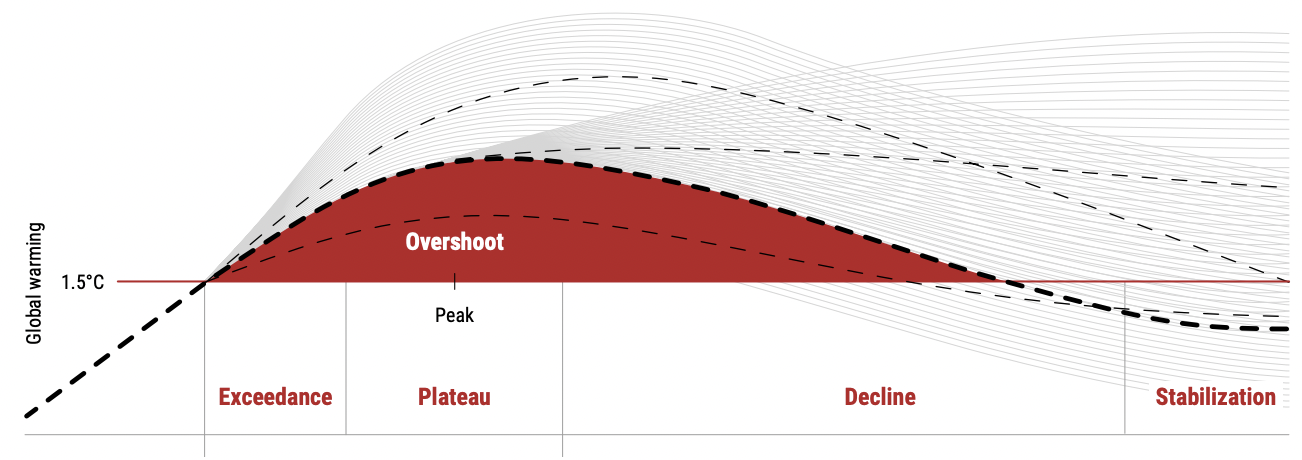
Illustration of the ‘overshoot, peak and decline’ pathway. Credit: United Nations Environment Programme (2026), Limiting Overshoot Spotlight Report.
Here’s some recent news: On September 2, the UN Environment Programme released a report titled “Limiting overshoot: Navigating exceedance of 1.5°C and pathways towards return.” The report acknowledges that the target temperature rise of 1.5°C established in the 2015 Paris accords will be breached. It is unavoidable. The report, with a kind of breathless and blithe optimism, coins in response a new strategy it calls “overshoot, peak and decline.”
There is a slight disconnect between the cold hard data the report presents, particularly the prediction that “even an optimistic scenario of current government pledges puts expected peak temperature rise at 1.8°C” (emphasis mine) and the positive outlook conveyed by this “overshoot, peak and decline” plan. It also ignores the harsh reality that an (acknowledged minimum of) 1.8°C rise will result in a furthering of intensified weather, the disruption of agricultural production, ecosystem loss, sea level rise displacing huge swaths of the global population, an increase in the incidence of zoonotic diseases, and so much more.
It is hard to know, with each fraction of a degree rise, exactly what the results will be, but the fact that certitude is a shadow flickering on the wall is cause not for comfort, but alarm.
Perhaps it is the job of the UN to both—with candour and blunt honesty—present us with the facts, and to also convey them in a way that brings forth hope. The report openly calls for a renewed sense of cooperative international coordination, although as Bill Hare, head of the science and policy institute Climate Analytics, points out, the report barely mentions the need to phase out fossil fuels or cites how any “real zero” emissions might happen.
In a reaction post to the UNEP report, after pointing out that “everything and everyone we love is at stake,” Greta Thunberg concluded with, “And maybe I’m supposed to end with an inspiring slogan or catchphrase now, but the time for that is passed. So…yeah. That’s that.
So…yeah, say I. Yeah, I get it. It can be difficult to retain any optimism, to forestall a sense of futility.
But now I’m done being a bearer of bleak news, because there are two movements forging a path to a future that honours all life, human and non-human. The first is the drive to establish ecocide as a prosecutable, punishable criminal offence. In 2021, an Independent Expert Panel launched a proposed definition, characterising ecocide as “unlawful or wanton acts committed with knowledge that there is a substantial likelihood of severe and either widespread or long-term damage to the environment being caused by those acts.” The core goal of the movement is for ecocide to be recognised as a serious crime all over the world. Second is the Rights of Nature movement, which aims to grant legal personhood to ecosystems and species (in much the same way that most modern systems grant this privilege to corporations).

The Whanganui River in New Zealand, granted legal personhood in 2017. Credit: Jason Pratt via Flickr.
The result would be thus — knowingly engage in activities that result in mass environmental destruction and you have acted outside the law. Furthermore, under a rights of nature framework, the plaintiff you might have to defend your actions against could be…nature herself. Like me, and you, nature herself would be not an object of the law, to be fought over, but a subject of the law, a principal actor with legal rights. And both of these movements involve, of all things, law. I say “of all things” because the law is by design a thing meant to reinforce the status quo, to hold change and progress to narrowly proscribed, ring-fenced boundaries. But both Ecocide and Rights of Nature use law as a lever for change, and here I must echo Archimedes, who claimed that with a long enough lever he could move the world.
However, this invites a question, one that is simple but without a definitive answer. What is, really, law? It’s something so present in our world that it can sometimes be hard to pull back and view it with innocent eyes. Is it the operating code by which disputes are settled and behaviour is held to the society’s notions of propriety and justice…is it an ongoing dialogue between the rights of the individual and the needs of the many; between individual liberty and social cohesion?
Viewed at any given moment, the law might seem to be a static thing, a solid and immutable set of parliamentary, legislative statutes, and procedural structures. But in most modern liberal democracies, this isn’t exactly so. A nation’s body of laws can evolve, as technologies change, as social norms, and values evolve legal structures can—sometimes—change in response.
Take the United Kingdom, whose constitution is not a single document, but rather a grand conglomeration of statutes, common law, Parliamentary Acts, and more. And because it is multi-sourced, it is therefore, theoretically, more readily prone to evolution. As of this writing, for instance, the UK Nature’s Rights Bill, a federal level granting of legal personality to nature, has had its second reading in Parliament. This bill, were it to become law, would be transformative. But despite this, in most of the developed world, a legal system’s dynamic fluidity, its ability and propensity to change over time, is by design ponderous. Law is meant to be an ocean liner, changing course only with deliberation, caution, and forethought.
And yet we are now beset by circumstances which the drafters of these legal structures could not have envisioned. The realities of anthropogenic climate change are no longer a matter of serious debate in any rational forum. It is imperative we not forget that the science of physics, of global environmental systems, of irreversible cascading tipping points, are immune to any human considerations of politics, of social compromise, of corporate quarterly profit and loss reports. We are the masters of our own fate; there will be no deus ex machina resolution of the tale. Global climate change pays no heed to the realpolitik of human systems, human foibles, and human failure. Nor does it allow any latitude as regards the law’s ponderous mechanisms of adaptation and change. There may have once been just cause to build into the monoliths of law a governing speed brake, but that is no longer a luxury we can afford.
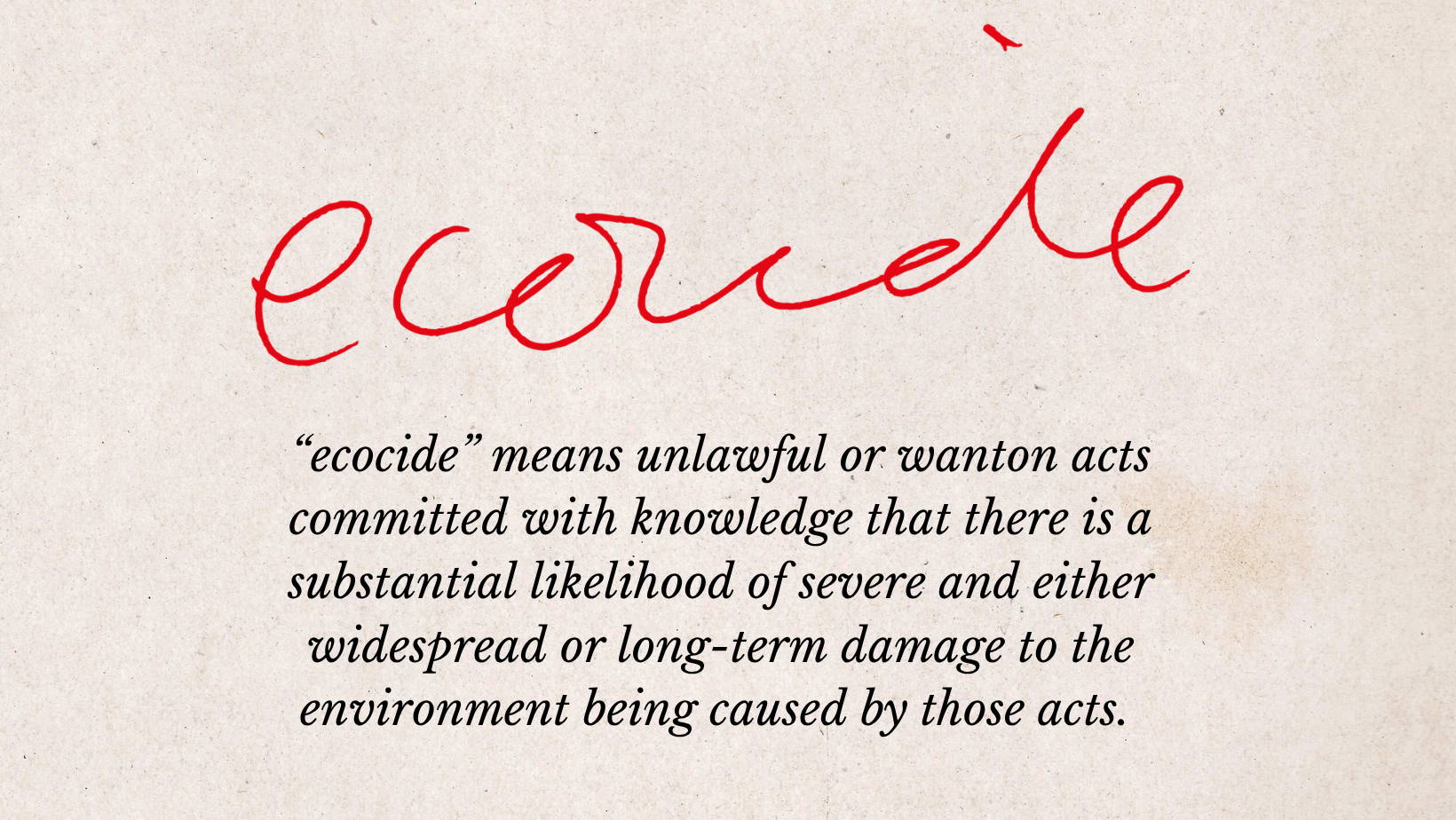
Independent Expert Panel for the Definition of Ecocide, 2021.
However, there are grounds for optimism. In September 2024, the Pacific Island nations of Vanuatu, Fiji and Samoa formally submitted a proposal to amend the Rome Statute of the International Criminal Court (ICC) to recognise ecocide as a fifth international atrocity crime, alongside genocide, war crimes, crimes against humanity and the crime of agression.
Momentum is also building at the regional level with the EU’s Environmental Crime Directive requiring member states to criminalise the most serious environmental offences, including conduct described as “comparable to ecocide”. The African Ministerial Conference on the Environment has included ecocide among its environmental priorities for 2025–2027, while a new Model Ecocide Law for Latin America, launched this month (October 2026), provides a framework to support countries across the region in developing and harmonising national legislation.
At the national level, progress is equally encouraging. Since the Independent Expert Panel published its legal definition of ecocide in 2021, countries around the world have taken steps to incorporate ecocide, or equivalent serious environmental offences, into domestic law. Belgium criminalised ecocide in February 2024, followed by Azerbaijan later that year and Mauritius in April 2026. Legislative proposals are right now progressing in Scotland, India, Mexico, Italy, Peru and the Democratic Republic of the Congo, among many others.
These developments exemplify both how a shift in collective values can transform existing law, and the law’s potential to be a catalyst for change in itself. Still, it is clear that the progress made so far, while undoubtedly great, must be a signifier of even greater evolution to come.
I began with a quote from Benjamin Franklin, in a letter he wrote in 1816. But if that seems too newfangled and modern, let’s end by going back a bit further to the ancient Greek philosopher Epicurus:
Where without any change in circumstances the things held to be just by law are seen not to correspond with the concept of justice in actual practice, such laws are not really just…
Both Franklin and Epicurus, over 2,000 years apart, speak of changing circumstances. The very nature of law is to uphold order and social stability, but that doesn’t mean we can’t use those same structures to promulgate progressive reform, indeed even to foment a revolution, a revolution of values, a revolution of consciousness that lets us see our species as an organic part of a grand tapestry. Not the weavers of the tapestry, but a thread within it. Such a revolution is not a good idea. Not a positive development. It is fundamental to our survival. Otherwise, as Ms. Thunberg said, that’s that.
Environmental tipping points, the cascade of cause and effect, are morally and politically neutral. Neither need they be strictly relegated to the realms of physics and climate science. There are tipping points in the world of human social and political structures, in the world of human endeavour. New ideas and new values can rip through populations and change who we are and how we see ourselves. Criminalising ecocide can be the small act that transforms a world teetering on a razor’s edge. At this late hour, when the stakes can be summed up with a word as simple as…tomorrow, it is not hyperbolic to say that the law can be the tool that sows the seeds of our salvation.