
A Legal Milestone for Nature: Latin America Now Has a Model Ecocide Law
Latin America is home to an extraordinary share of the planet's biodiversity — and, at the same time, to some of the most severe socio-environmental conflicts. In response to this reality, an unprecedented legal instrument has been developed: a Model Ecocide Law designed specifically for Latin American legal systems.
The initiative is led by Stop Ecocide International, together with the Association of Environmental and Climate Criminal Law Researchers (AIDPAC), the Mexican Centre for Environmental Law (CEMDA), the Iberoamerican University in Mexico City, the University Transdisciplinary Centre for Sustainability (CENTRUS) and the Alliance of Environmental Law Clinics of Latin America and the Caribbean.
Why a regional model law?
In 2021, an Independent Expert Panel convened by the Stop Ecocide Foundation developed a legal definition of ecocide as an international crime. This definition underpins the proposed amendment to the Rome Statute put forward in 2024 by Vanuatu, Fiji, and Samoa. However, for ecocide to be effectively incorporated into the domestic legislation of countries in Latin America, which share a civil law tradition, an adaptation process is needed, one that takes into account each country's constitutional framework, existing environmental legislation, and local socio-environmental realities.
The Model Law does not seek to replace national legislative processes, but rather to provide a technical and legal reference point that can strengthen future legislative initiatives across the region, tackle impunity for the most serious destruction of ecosystems, and ensure that ecocide can be effectively deterred by establishing personal criminal accountability.
A participatory process in three phases
The drafting of the Model Law was a participatory and collaborative process divided into three key stages, moving from civil society input to final technical consolidation:
- Regional Public Consultation (Phase One): Held between June and July 2026, it brought together citizens, academia, Indigenous peoples, civil society organisations, and experts from multiple Latin American countries to establish the conceptual foundations.
- Virtual Expert Roundtables (Phase Two): A technical consultation phase held between July and September, where legal scholars and specialists addressed the key elements of the region's legal framework.
- In-Person Drafting Congress (Phase Three): On 29–30 September 2026, over thirty experts and specialists from across Latin America gathered in Mexico City to debate, synthesise input from previous phases, and draft the final text of the Model Ecocide Law for Latin America.
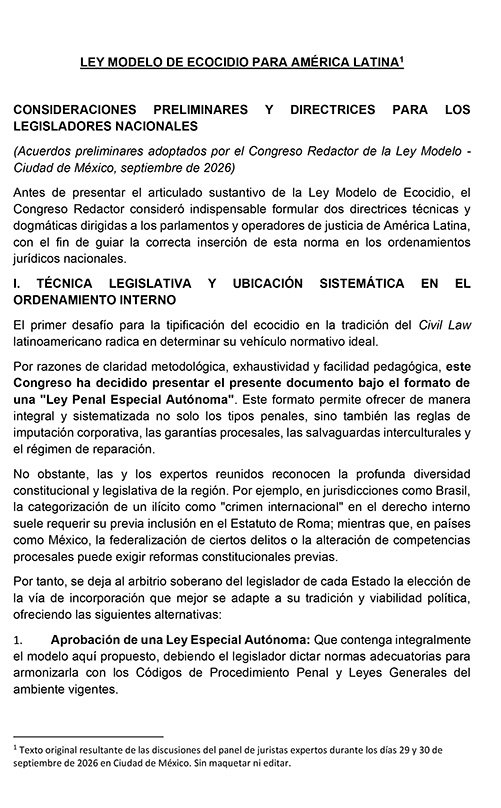
Download and access the text of the Model Ecocide Law
Thanks to a collective regional effort, the Model Ecocide Law for Latin America is now complete and is available as a technical reference tool for lawmakers, legal experts, NGOs, and environmental defenders across the region.
*The document is currently undergoing final formatting and layout design, but is being made available to the public in its complete, unedited text version for immediate reference and use.
For more information
Rodrigo Lledó: rodrigo@stopecocidio.org
Maite Mompó: maite@stopecocidio.org