
EU Council passes new ecocide rules, but what does that mean?
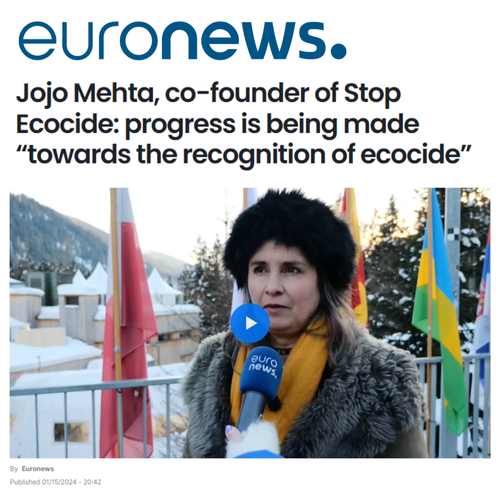
“The historic vote from the EU to include ecocide-level crimes in its revised crime directive shows leadership and compassion, and will strongly reinforce existing environmental laws across the region,’ said Jojo Mehta, Co-Founder and CEO of Stop Ecocide International. ‘It will establish a clear moral as well as legal “red line”, creating an essential steer for European industry leaders and policy-makers going forward.”
By Martin Guttridge-Hewitt for Environment Journal, 28/02/2024

‘Revolutionary’: EU Parliament votes to criminalise most serious cases of ecosystem destruction
“The European Union has become the first international body to criminalise the most serious cases of environmental damage that are “comparable to ecocide”.
Ecosystem destruction, including habitat loss and illegal logging, will be punished with tougher penalties and prison sentences under the EU’s updated environmental crime directive.”
By Mette Mølgaard Henriksen for Euronews, 27/02/2024

Belgium becomes first in EU to recognise ecocide as international crime
“With prominent voices like that of Belgium leading the way, tangible progress is being made internationally, particularly so in Europe following last November’s agreement to include ecocide-level crimes in the EU’s revised environmental crimes directive. I have no doubt we will see international recognition of the crime of ecocide in the near future.” - Jojo Mehta
By Maïthé Chini for The Brussels Times, 23/02/2024

Our Common Heritage: the Role of Ecocide Law
“A new crime of ecocide, a preventative and all-encompassing framework, can rectify an existing taboo in international environmental regulation: the most serious destructions of nature are morally reprehensible and thus criminally liable acts. Ecocide law therefore holds significant potential to usher in a new era of environmental governance that can ensure exacting protection for nature, on Earth and in outer space.”
By Anna Madrick for Eco-nnect, 11/02/2024

World ‘not prepared’ for climate disasters after warmest ever January
From deadly floods in California to devastating fires in Chile, scientists say the world is not prepared for the climate disasters that are hitting with increasing frequency as human-driven global heating continues to break records.
By Jonathan Watts for The Guardian, 06/02/2024

Ecocide Bill can keep Scotland bonnie and protect our lochs, mountains and beaches
“A country renowned across the globe for its breathtaking natural beauty, has become one of the most nature-depleted in the world.
No one should deliberately harm our environment and expect the public to foot the bill. That’s why I’m consulting on a proposed new law to make ecocide a crime.”
By Monica Lennon MSP for the Scottish Daily Express, 03/02/2024

EU Tackles ‘Ecocide’ in Landmark Moment for Environmentalism
Advocates are hailing the legislation as a landmark moment for global environmentalism, and especially the Stop Ecocide movement, which seeks to move legal enforcement of the most serious environmental crimes from the civil into the criminal arena – and thus reframe egregious destruction of nature as more akin to crimes against people.
By Trevor Bach for US News, 02/02/2024

‘Ecocidio y lucha por la biodiversidad’, en el Hay Festival de Cartagena de Indias: Philipe Sands, Rebecca Solnit, Brigitte Baptiste y Eliane Brum, conversan sobre la biodiversidad y los retos frente al medio ambiente. 28/01/2024

Scotland leading the conversation in move for 'ecocide' laws, says top campaigner
Jojo Mehta, CEO of the group Stop Ecocide International, said Scotland is now at “the forefront of the global conversation” on criminalising ecocide - a term to describe severe types of environmental destruction.
It comes as Scottish Labour MSP Monica Lennon is consulting on groundbreaking proposals for an Ecocide Bill in Scotland.
By Dan Vevers for the Daily Record, 20/01/2024

Ambientalistas y juristas sostienen que el concepto de ecocidio debería ser punible en la Corte Penal Internacional para hacer frente a los crímenes contra el medioambiente. 18/01/2024

The term “ecocide” first emerged during the Vietnam War, used to describe the destructive environmental consequences of the defoliant Agent Orange. After featuring in United Nations talks during the following decades, by 1998, ecocide had been proposed as an international crime against peace in a draft of the Rome Statute, the treaty that created the ICC.
By Fermín Koop for Diálogo Chino, 16/01/2024

While several climate activists have been sent to prison for their involvement in disruptive protests, legislation is now also being strengthened to impose criminal sanctions on individuals found responsible for large-scale environmental damage.
By Claudia De Meulemeester for SustainableViews, 11/01/2024


Humans have this deep separation from nature, that gives us a kind of cultural inability to recognize the severity of what it means when we harm the natural world. We have a large number of environmental laws around the world, and what we’re seeing is that they’re not effective or adequate to address global, ecological, and climate crisis.
By Matthew Green for DeSmog, 8/12/2023

The Scottish Government has been urged to show “much-need global leadership” at COP28 and harness its work on loss and damage into efforts to tackle ecocide.
The appeal comes after delegates unexpectedly agreed to set up a global loss and damage fund on the first day of COP28 in Dubai, with at least $400m pledged so far.
By David Bol for The Herald, 1/12/2023

New EU "Ecocide" crime agreed. Perpetrators could face at least 10 years in prison while companies could be hit with fines as high as €40 million per offence.
By Katie Surma for Inside Climate News, 23/11/2023

The European Union has become the first international body to criminalise widescale environmental damage “comparable to ecocide.
By Isabella Kaminski for The Guardian, 17/11/2023

Although civil penalties exist for pollution, the proposed strong criminal law for the most serious damage to the environment, with proposed jail terms of between ten and 20 years for individuals and large fines for companies, would make anyone think twice before committing to a course of action which would cause serious harm to nature or the climate.
By Richard Dixon for The Scotsman, 15/11/2023
