
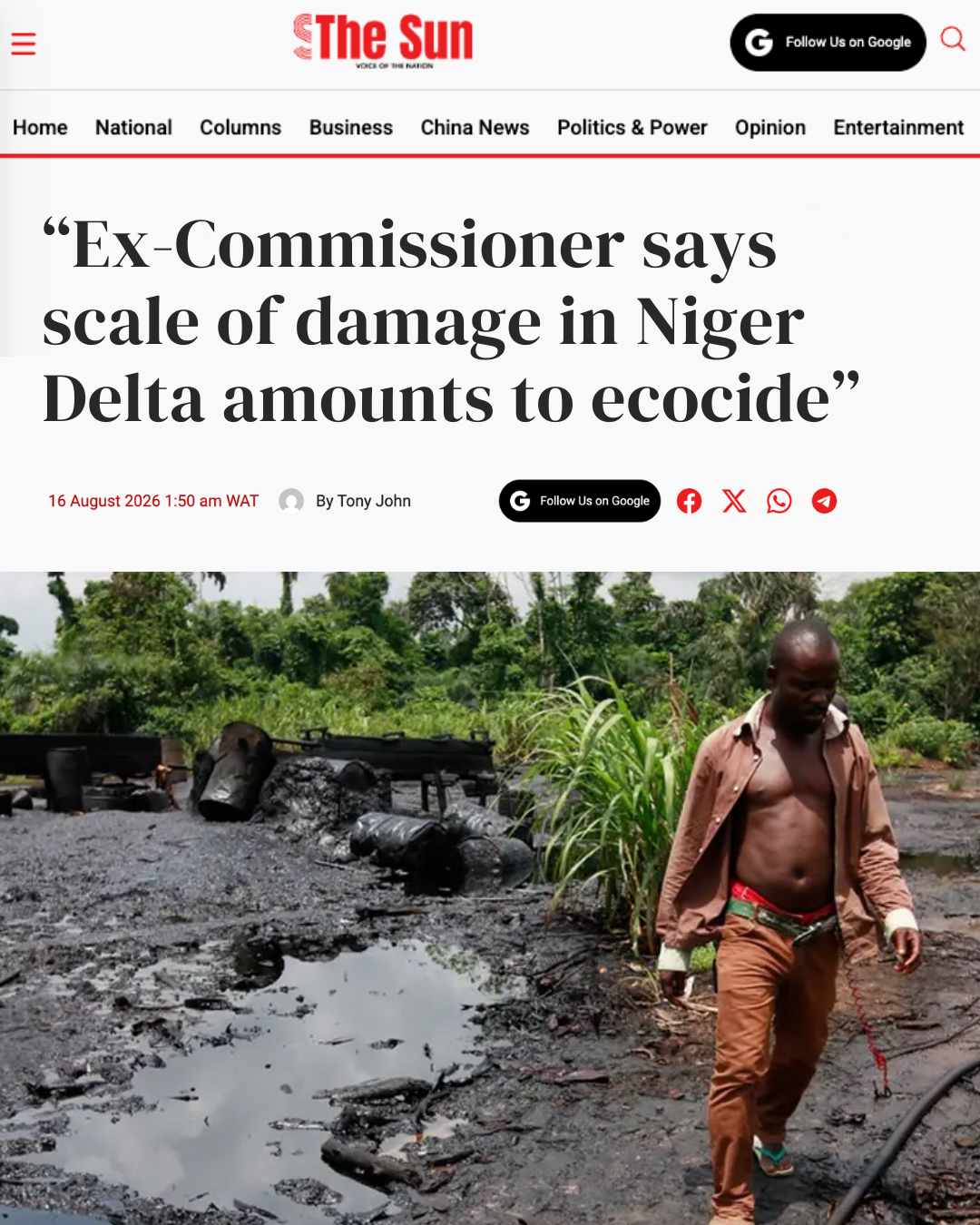
Ex-commissioner tasks Niger Deltans on oil pollution
Iniruo Wills, former state Environment Commissioner in Nigeria, has called for criminal accountability for large-scale oil pollution in the Niger Delta. Wills’ call showcases growing support in Nigeria and Africa for treating mass environmental destruction as a serious crime.
Tony John for The Sun (Nigeria), 16/08/26
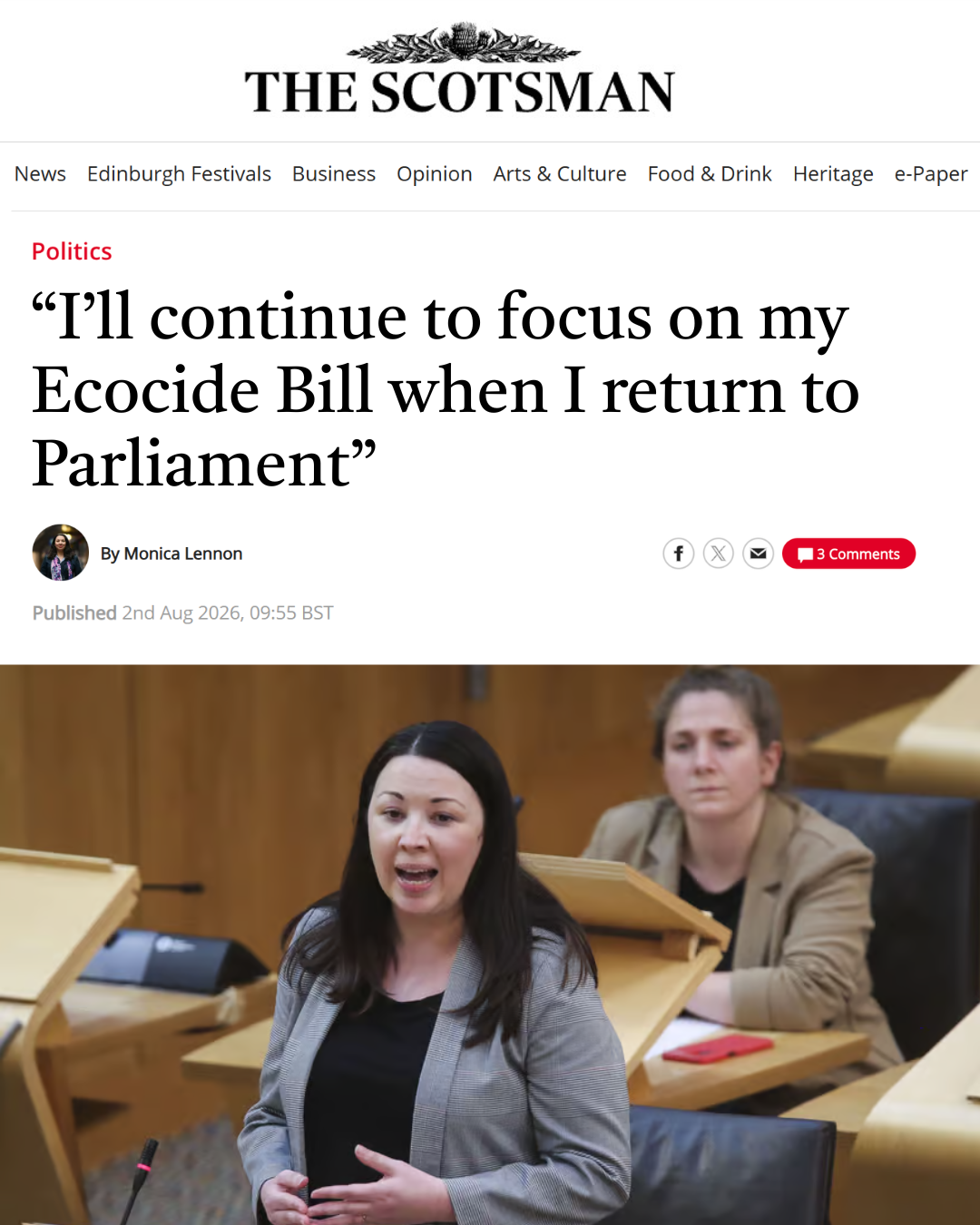
“I’ll continue to focus on my Ecocide Bill when I return to Parliament”
Monica Lennon reflects on her record as a Member of the Scottish Parliament, including her work championing the bill to criminalise ecocide in Scots law, which she cites as being among her biggest successes.
Monica Lennon for The Scotsman, 02/08/26

A Model Ecocide Law for Latin America
Rodrigo Lledó explains the participatory process in the development of a Model Ecocide Law for Latin America which brings together legal experts, academics, civil society and affected communities to develop a harmonised legal framework that can support future national legislation in the region.
Rodrigo Lledó for ICONnect, 29/07/26
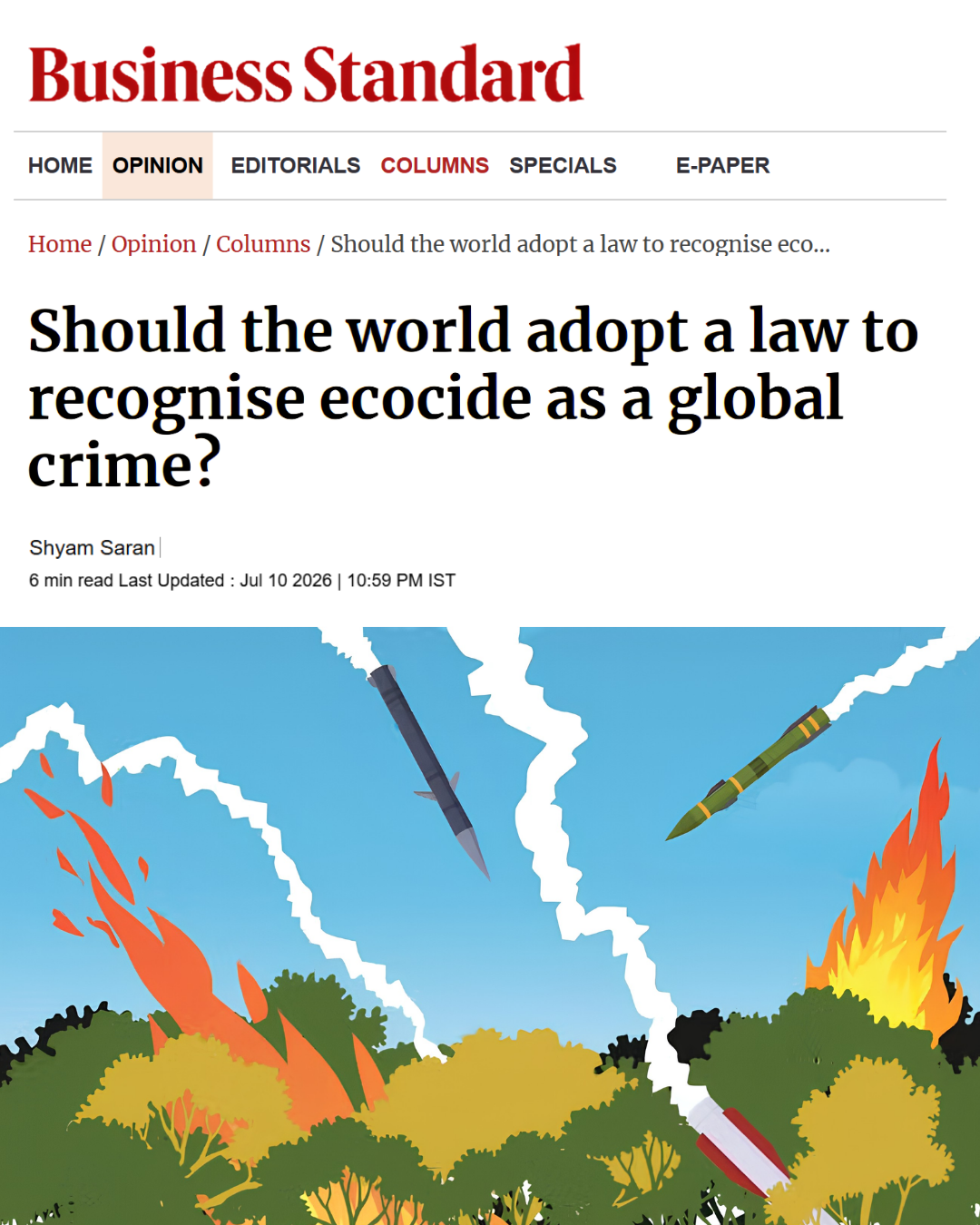
Should the world adopt a law to recognise ecocide as a global crime?
Former Indian Foreign Secretary, Shyam Saran, makes the case for recognising ecocide as a global crime. Acknowledging that ecocide can occur in both peacetime and wartime, Saran focuses on the major environmental impacts that have become a regular feature of modern warfare.
Shyam Saran for Business Standard (India), 10/07/26
How the EU’s New Ecocide Law Binds National Courts
Paul Pogba covers the EU's revised Environmental Crime Directive, which requires all 27 states to introduce offences lawmakers have described as “comparable to ecocide”.
Paul Pogba for The European Post, 06/07/26

Human rights expert Philippe Sands wins German Peace Prize
Prof. Philippe Sands KC has won the Peace Prize of the German Book Trade, recognised in part for his advocacy for ecocide law. Sands co-chaired the 2021 Independent Expert Panel that formulated the legal definition of ecocide now used in proposals worldwide, including the 2024 push to amend the Rome Statute.
Elizabeth Grenier for DW, 25/06/26
Who Controls the Weather? Engineering the Sky and the Vacuum of Global Governance
Anna Maddrick, Legal Adviser on Climate for the Permanent Mission of Vanuatu to the UN, writes that geoengineering technologies are advancing without an agreed upon accountability framework. She argues that ecocide law offers a credible way to govern their development.
Anna F. Maddrick for Earth.org, 12/06/26
‘Ecocide’: when harm to nature becomes a crime
Najah Ahmed, Deputy Chairperson of the Mauritius National Human Rights Commission, writes that Mauritius joins a growing group of states in treating ecocide as a crime. She frames the new law as a human rights measure, arguing that a healthy environment is foundational to human wellbeing.
Najah Ahmed for L’express Mu (Mauritius), 27/05/26
![[Insight] Window on Europe: Belgium becomes first EU nation to legislate against ecocide](https://images.squarespace-cdn.com/content/v1/5ca2608ab914493c64ef1f6d/1781109928191-KXUSKXU1PZFYMJH3GIDF/IEEP+UK+Belgium+Article++May+2026.png)
[Insight] Window on Europe: Belgium becomes first EU nation to legislate against ecocide
Michael Nicholson writes that the new ecocide law in Belgium is a positive step forward for the country while also offering a model for other countries to introduce similar legislation.
Michael Nicholson for Institute for European Environmental Policy (UK), 21/05/2026
Mauritius Criminalises Ecocide
Mauritius introduces an amendment to its Environment Act 2024, making ecocide a criminal offence. As a Small Island Developing State, it is particularly vulnerable to environmental threats, which highlights the law’s significance for the country’s environmental protection efforts.
Celine Bellouard & Shrivan Dabee for Mondaq, 13/05/2026
Why ecocide laws could be coming far sooner than many predict
Stuart Spray discusses the latest developments in the movement to make mass environmental destruction, ecocide, a crime. Speaking to SEI’s Jojo Mehta, and drawing on other legal experts such as Gerard Forlin KC, Paulo Busse and Alexa Culver, he traces the momentum and potential of ecocide law.
Stuart Spray for ENDS Report, 12/05/2026
Ecocide: Understanding the Global and Indian Fight Against Environmental Destruction
Legal scholar Imran Wahab writes that making mass harm to nature a serious crime would inspire a shift in environmental accountability, ensuring that clear red lines prevent the most serious ecological harms before they occur. Not only would it protect vital ecosystems, it would also promote climate resilience, safeguard livelihoods, and ensure that development can occur within healthy limits.
Md. Imran Wahab for Legal Service India, 23/04/2026
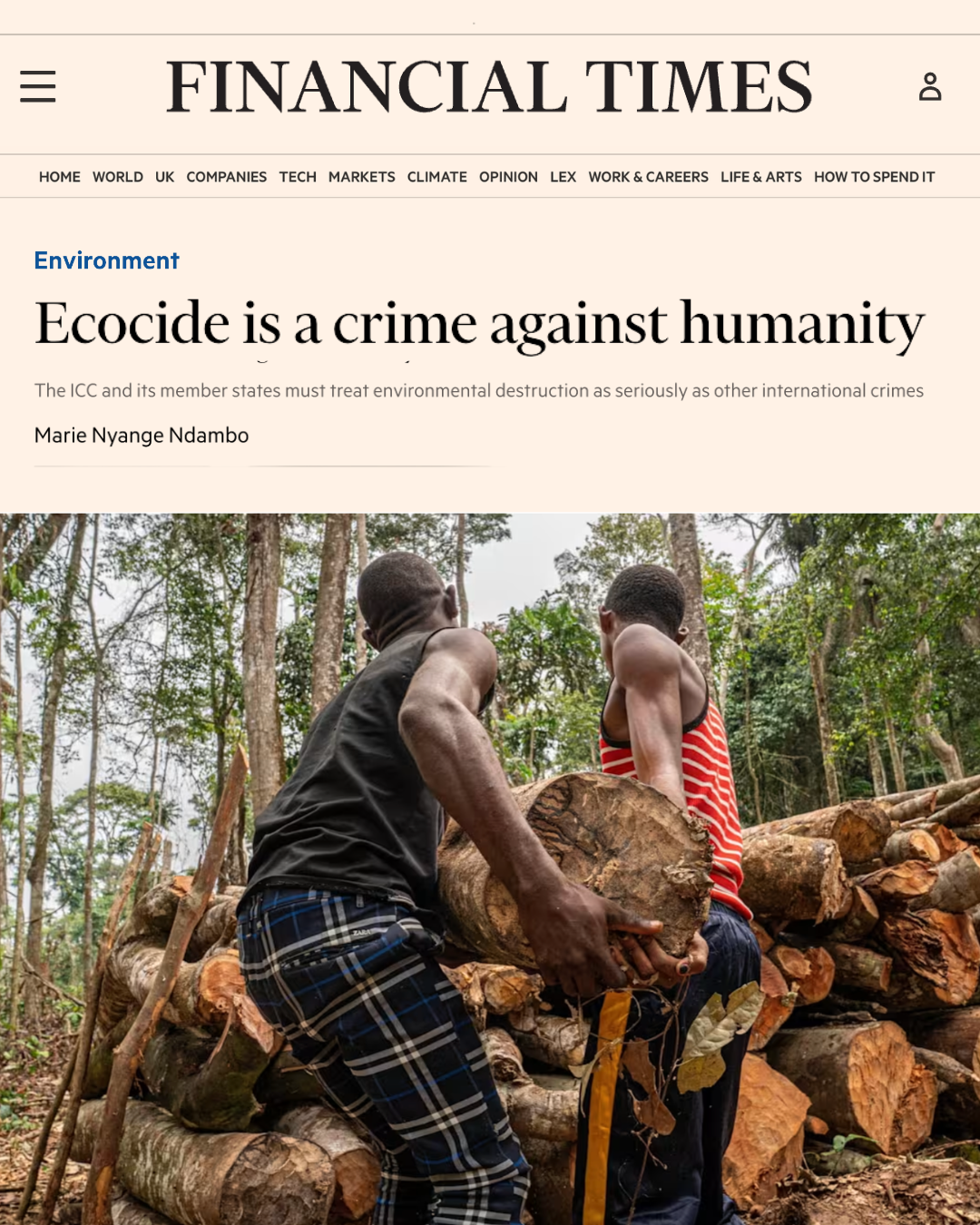
Ecocide is a crime against humanity
The DRC’s Environment Minister Marie Nyange Ndambo writes that ecocide law would shift incentives away from short-term exploitation and toward sustainable, accountable development.
Marie Nyange Ndambo for Financial Times, 22/04/2026

Ecocide, the first step towards a fully integrated eco-centric legal framework?
Analyses the significance of Mauritius establishing ecocide as a domestic crime. Namely, its potential as a deterrent, shifting decision-making towards sustainable practices. She also notes that its introduction signals a shift toward an eco-centric legal framework where all of nature is considered to be inherently valuable and deserving of legal standing.
Valentine Mayer for L’express Maurice, 19/04/2026
“The Recognition of “Ecocide” as an International Crime: A New Frontier in Global Jurisprudence”
Traces how the 2021 ecocide definition developed by the Independent Expert Panel (convened by the Stop Ecocide Foundation) has become the basis for legislative efforts worldwide.
Imran Wahab for Legal Service India, 01/04/2026
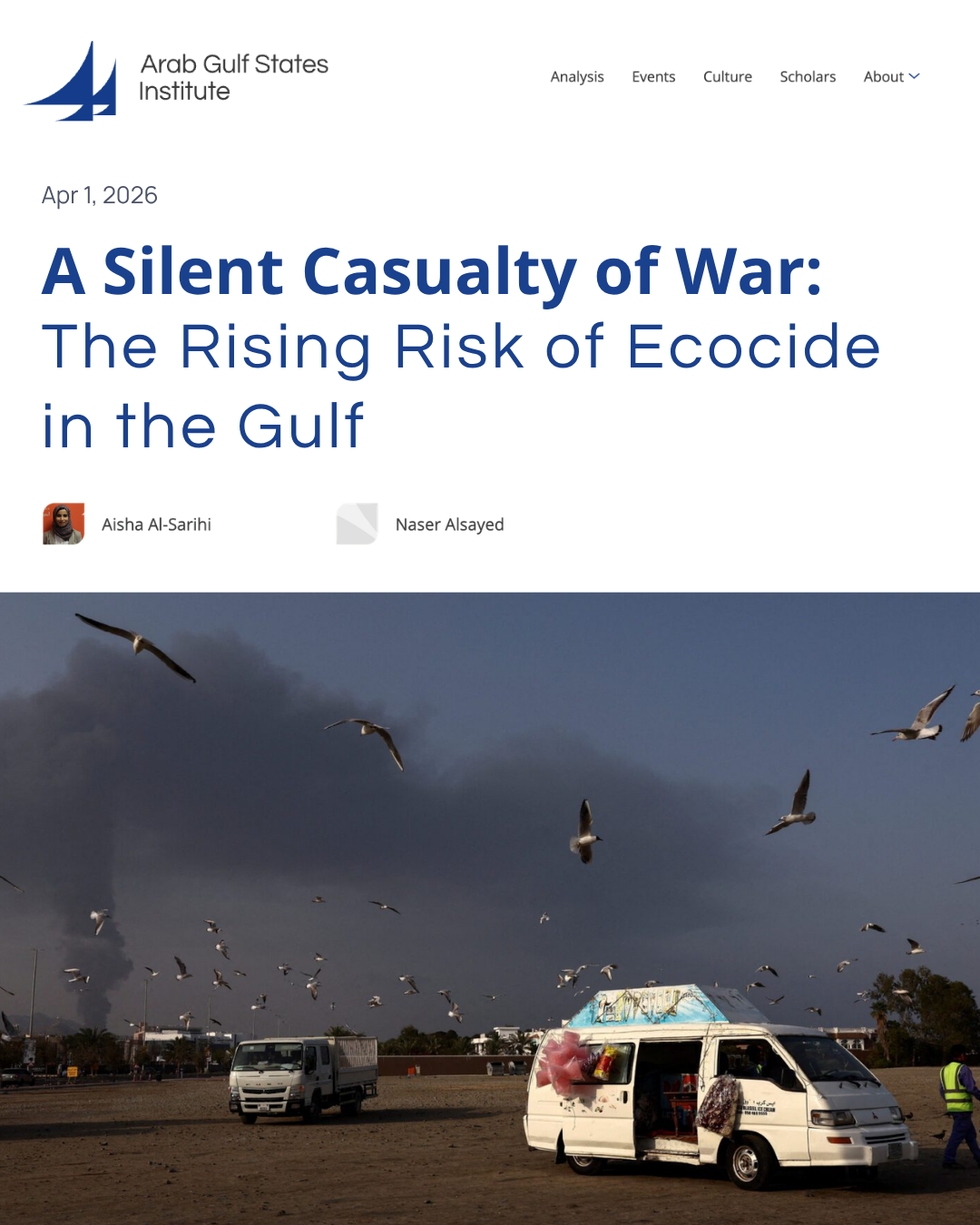
“A Silent Casualty of War: The Rising Risk of Ecocide in the Gulf”
Examines how the ongoing conflict in the Gulf is causing environmental harm, from toxic "black acidic rain" following refinery strikes, to oil spill risks in the Persian Gulf, and attacks on desalination plants that supply drinking water to over 100 million people.
Aisha Al-Sarihi and Naser Alsayed for Arab Gulf Institute, 01/04/2026
Ecocide bill seeking 20-year jail terms for major polluters passes to next stage in race against May elections
Reports on the Scottish parliament’s vote to advance Monica Lennon’s ecocide bill.
Tess Colley for Ends Report, 06/02/26
Plan to jail bosses of major polluters passes Holyrood vote
In the first stage of voting on the Ecocide (Scotland) Bill, parliamentarians overwhelmingly voted to back the general principles of the legislation, BBC News reports.In the first stage of voting on the Ecocide (Scotland) Bill, parliamentarians overwhelmingly voted to back the general principles of the legislation, BBC News reports.
BBC News, 05/02/26
David Attenborough’s Scots cameraman urges MSPs to back Ecocide Bill at crunch vote
David Attenborough’s cameraman, Doug Allan, calls on parliamentarians to back Scotland’s Ecocide Bill ahead of a crucial vote.
Dan Vevers for Scottish Daily Record, 01/02/26
Protecting the Environment through Criminal Law: Ecocide, Harm and Human Consequences
Argues that civil and administrative penalties are inadequate to prevent the worst environmental harms globally.
Kariuki Muigua & Company for The Lawyer Africa, 31/01/26