Historic ICC Policy Puts Ecological Harm at the Centre of International Criminal Law
Summary:
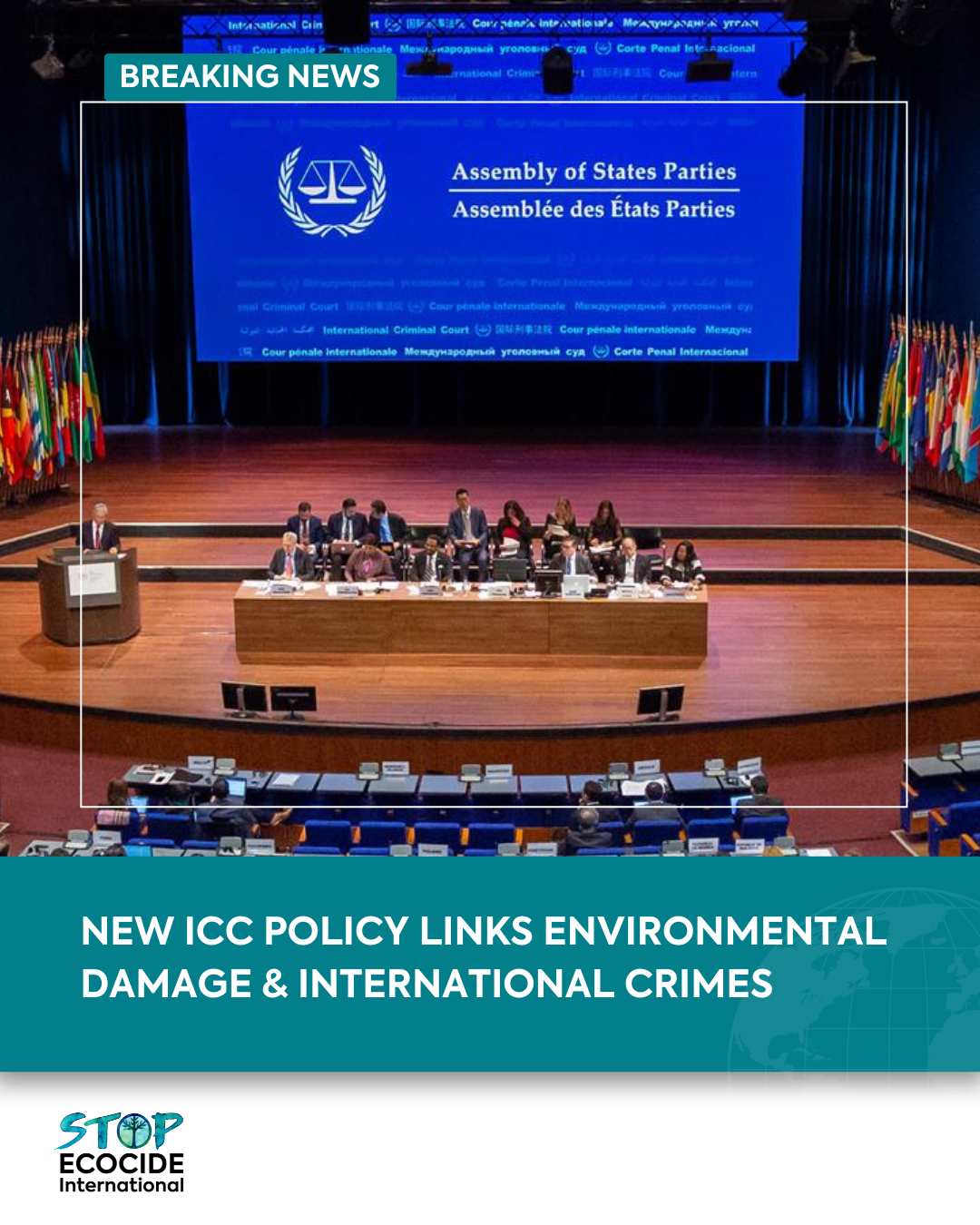
In a landmark step for the International Criminal Court, the Office of the Prosecutor (OTP) has issued a comprehensive policy devoted entirely to environmental damage, signalling a marked shift in how international justice will engage with ecological harm.
Crucially, the policy sets out in detail how severe environmental damage can underpin some crimes already within the ICC’s jurisdiction, including genocide, crimes against humanity, war crimes and aggression (pp.14–24). This systematic analysis is new and creates a clear legal pathway for addressing various types of large-scale ecological destruction under existing international criminal law.
It also strengthens the broader foundations on which a dedicated core crime of ecocide can continue to be built, and gives states a more explicit understanding of how environmental devastation can already constitute or result from existing international crimes.
The ‘Policy on Addressing Environmental Damage Through the Rome Statute’, is the culmination of an extensive consultation held in two formal rounds (16 February–16 March 2024 and 18 December 2024–21 February 2025) and introduces, for the first time, a systematic operational framework for recognising, investigating and prosecuting environmental damage within existing ICC crimes.
Importantly, the policy paper also sets out how the ICC’s Office of The Prosecutor will take a complementary and collaborative approach in supporting all governments to address environmental harms through their own criminal laws.
Key Policy Themes
The natural environment as foundational: Recognition that severe environmental degradation threatens human survival and disproportionately harms marginalised groups (pp.3–4).
Environmental harm embedded across Rome Statute crimes: Clarification of how genocide, persecution, starvation, forcible transfer, war crimes and aggression may be committed by means of or result in environmental damage (pp.14–24).
A modern, principles-based approach: Adoption of intersectional, interdisciplinary and intergenerational frameworks to assess environmental harms with scientific and human-rights expertise (pp.25–27).
Corporate decision-makers in scope: Underscores that senior individuals, not corporations, may face liability where their decisions result in serious environmental damage (p.13).
Complementarity as catalyst: Commitment to supporting and encouraging national prosecutions of environmental crimes, strengthening international-domestic alignment (pp.26–27).
Jojo Mehta, CEO & Co-founder of Stop Ecocide International, said:
“This policy from the ICC’s Office of the Prosecutor is a significant and welcome development. It makes clear that environmental destruction is not peripheral to atrocity crimes but increasingly central to how they occur and are experienced.
By defining how severe ecological harm can already be pursued in specific contexts under the Court’s existing mandate, the Office begins to close longstanding gaps in accountability and reinforces the wider legal trajectory toward recognising ecocide as a standalone crime.
This policy paper reflects an international justice system starting to engage seriously with ecological reality. The importance of making this connection cannot be overstated. It is an absolutely essential step in the shift towards meaningful prevention and credible deterrence - in other words, towards a safer world.”
You can read the Office of the Prosecutor’s full Policy on Addressing Environmental Damage Through the Rome Statute here.