
Ghana: National crime of ecocide proposed in state-mandated constitutional review
Summary
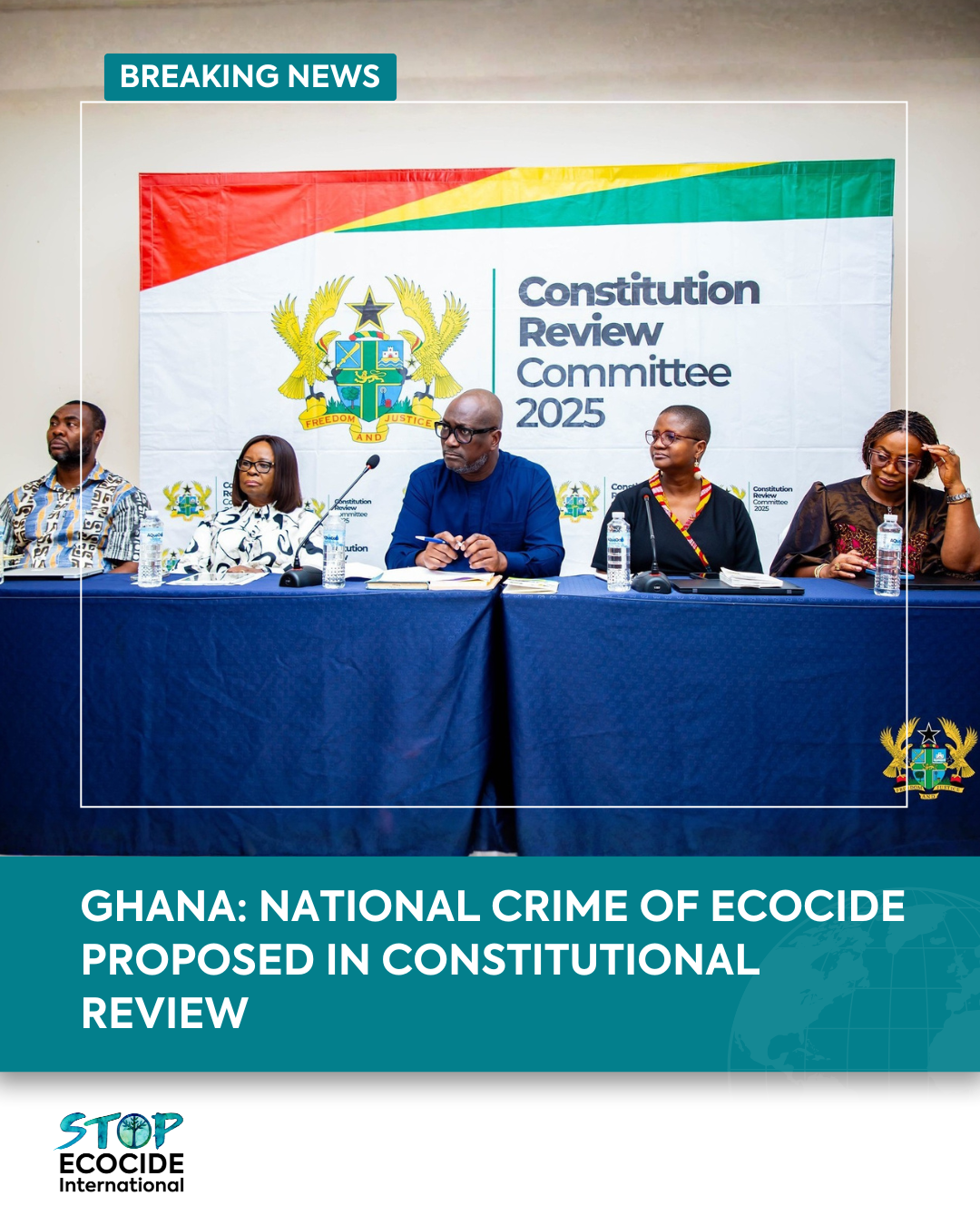
In a far-reaching package of reforms presented to President John Dramani Mahama, Ghana’s Constitution Review Committee has proposed establishing a domestic crime of ecocide, stating:
“In order to express society’s revulsion and opprobrium to illegal mining in Ghana, the Committee will be remiss in its duty of constitutional review if it does not recommend the creation of an offence of ecocide with very stiff and punitive sanctions. This further gives true expression to the right to a clean environment.” (Chapter III, para. 3.18).
The state-mandated review, Transforming Ghana: From Electoral Democracy to Developmental Democracy, recommends strengthening constitutional protection for the environment, democratic accountability, public institutions and fundamental rights, and was commissioned to examine Ghana’s 1992 Constitution following extensive nationwide consultations involving more than 21,500 participants from civil society, traditional authorities, youth groups, experts and public institutions.
If the review recommendations are implemented, Ghana would become the first African nation to establish ecocide as a domestic crime. Beyond ecocide, the report sets out the most comprehensive blueprint for constitutional reform in Ghana since 1992. Key proposals include strengthening checks on executive power, reforming Parliament to improve accountability, enhancing the independence and resourcing of oversight institutions, and expanding rights and inclusion across areas such as gender equality, disability rights, digital privacy, anti-corruption measures and decentralisation.
The inclusion of ecocide within Ghana’s constitutional reform agenda reflects growing momentum across Africa to address mass environmental destruction through criminal law, shaped in part by leadership from the Democratic Republic of the Congo, which in October 2024 backed the formal proposal by Vanuatu, Fiji and Samoa to amend the Rome Statute of the International Criminal Court to include ecocide. The African Ministerial Conference on the Environment (AMCEN) has since named ecocide a priority for the 2025–2027 period, while the Congo Basin Climate Commission has called for African Union processes to be used to secure recognition of ecocide as an international crime.
You can read the full review, Transforming Ghana: From Electoral Democracy to Developmental Democracy, here.