Argentina: Ecocide Bill Advances Following Senate Committee Approval
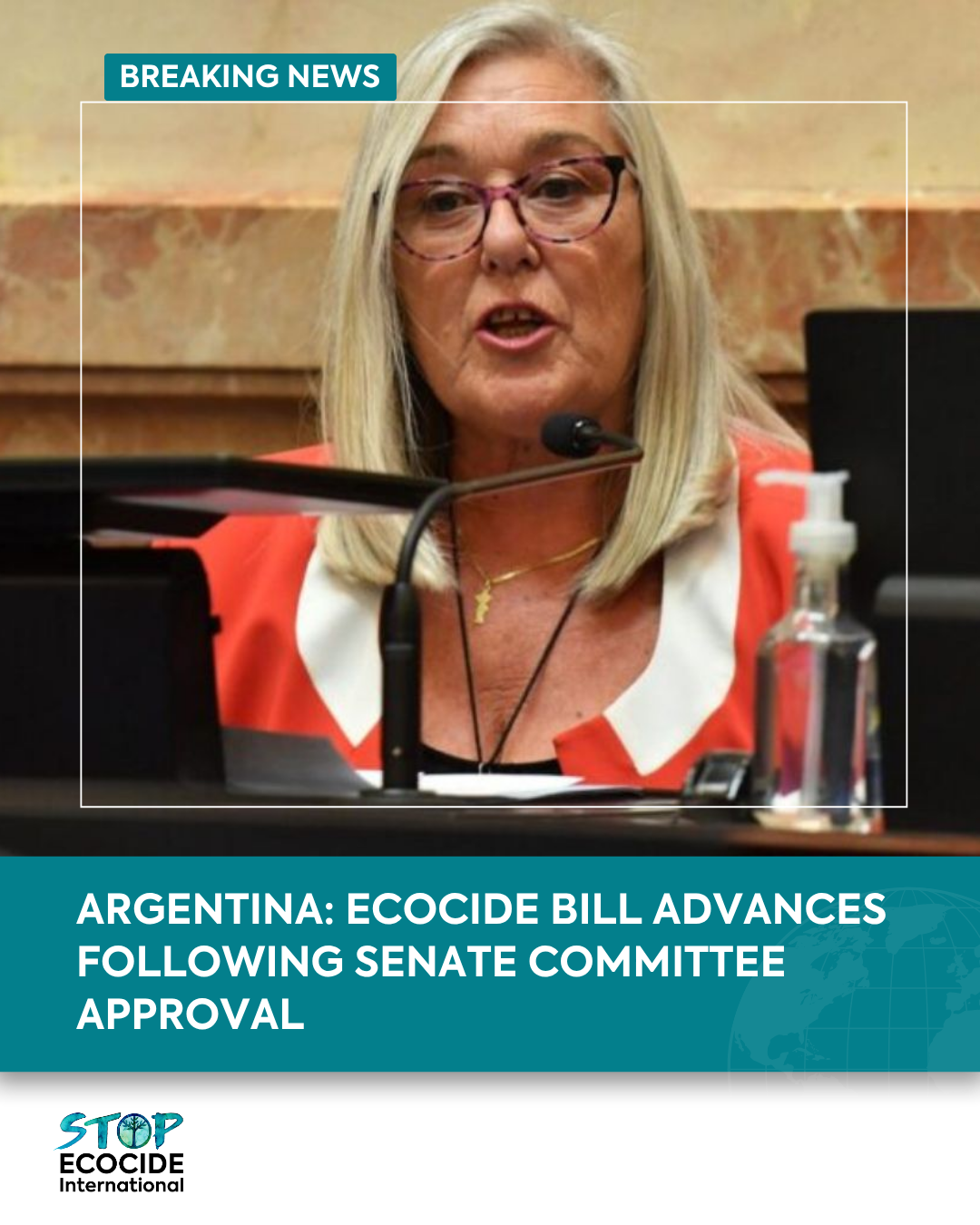
On Tuesday, 9 June, Argentina took a significant step towards criminalising ecocide and other serious environmental crimes when the Senate's Justice and Criminal Affairs Committee and Environment and Sustainable Development Committee approved a Bill that would, if passed by the full Senate and the Chamber of Deputies, establish a dedicated chapter on environmental crimes, including ecocide, within the Argentine Penal Code for the first time.
Introduced by Senator Edith Terenzi (UCR – Despierta Chubut Bloc) in June 2025, the Bill has since undergone extensive review by advisers to the Justice and Environment Committees. The committees' approval on 9 June has cleared the way for debate by the full Senate.
A project with history
Terenzi's Bill is not the only ecocide-related proposal to have circulated in the Argentine Congress. Since 2024, the issue has gained increasing legislative traction in both chambers. In October 2024, Deputy Ana Clara Romero (PRO – Chubut) introduced her own initiative in the Chamber of Deputies. Several months later, in April 2025, and partly in response to the devastating fires in Patagonia, former Deputy Margarita Stolbizer (GEN – Buenos Aires) presented a Bill incorporating the definition developed by the Independent Expert Panel convened by the Stop Ecocide Foundation in 2021. Terenzi's proposal, introduced in June 2025, became the third such initiative and is currently the most advanced.
What changes if it is approved?
Today in Argentina, the destruction of an ecosystem is not specifically defined as a criminal offence. This Bill aims to fill that gap with two specific changes to the Penal Code. The first is technical but crucial: the incorporation into Article 77, the Code's glossary, of definitions intended to provide greater clarity and consistency in the interpretation of environmental offences including, "irreversible environmental damage", "especially serious environmental damage", "environment" and "spatial extent of environmental damage".
The second change is the heart of the project: the creation of a new Title XIV after Article 313, dedicated entirely to environmental crimes. Ecocide is established as a distinct legal category, with penalties that increase depending on who is responsible. Public officials involved in serious environmental damage would face harsher sentences. Companies could be subject to fines calculated as multiples of the minimum wage, described by Terenzi as "very high, very burdensome", as well as suspension of activities, exclusion from public procurement processes, loss of subsidies, and even publication of the sentence.
The voice behind the project
Terenzi is no stranger to this issue. She has been advocating for this legislation for years and is clear about why it matters:
"It is vital that we make progress in this type of crime due to the severity of the environmental damage that certain human activities cause to ecosystems and the consequences this has for future generations. We are talking about concrete and tangible consequences. We are taking a significant step towards ensuring that Argentina has effective tools to deal with those who cause serious environmental damage, compromise strategic resources, and affect the right of future generations to live in a healthy environment.”
“We believe in a development model that generates production, employment, and investment, but that also establishes clear limits against environmental destruction and impunity. Protecting the environment is not a slogan; it is a responsibility of the State."
What's next?
With the committee report in hand, the Bill awaits its turn in the Senate. If approved, it will move to the Chamber of Deputies.
Rodrigo Lledó, Americas Director, Stop Ecocide International, said:
“This important step is part of a Latin American and global effort to criminalise the most serious acts of environmental destruction, such as ecocide. We are currently in the process of adopting a Model Law for Latin America, which we expect to finalise by the end of September, and which will facilitate legislative initiatives like the one we are seeing advance in Argentina today.
Constanza Soler, Americas Co-ordinator, Stop Ecocide International, said:
"Ecocide is already a legally recognised concept in various parts of the world, and Argentina is on its way to joining that movement. This ruling represents years of collective work, numerous discussions, and the conviction that protecting the environment cannot depend solely on goodwill: it must be an obligation with real consequences. That is what this law can do."
The full draft Bill on Special Forms of Environmental Criminality can be found here.
A video recording of the joint session of the Senate's Justice and Environment Committees is available here.